KI-Beratung Beta

  • Produktbild: Nonlinear Programming Codes
  • Produktbild: Nonlinear Programming Codes
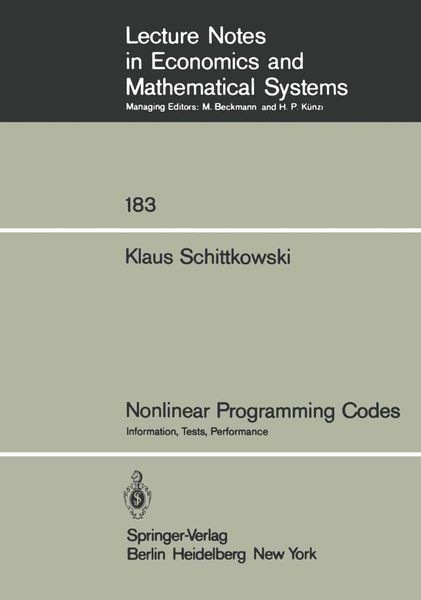
Band 183

Nonlinear Programming Codes Information, Tests, Performance

49,99 €

inkl. gesetzl. MwSt., Versandkostenfrei


Beschreibung

Produktdetails

Einband

Taschenbuch

Erscheinungsdatum

01.09.1980

Abbildungen

VIII, 248 p.

Verlag

Springer Berlin

Seitenzahl

248

Maße (L/B/H)

25,4/17,8/1,5 cm

Gewicht

496 g

Auflage

Softcover reprint of the original 1st ed. 1980

Sprache

Englisch

ISBN

978-3-540-10247-2

Beschreibung

Produktdetails

Einband

Taschenbuch

Erscheinungsdatum

01.09.1980

Abbildungen

VIII, 248 p.

Verlag

Springer Berlin

Seitenzahl

248

Maße (L/B/H)

25,4/17,8/1,5 cm

Gewicht

496 g

Auflage

Softcover reprint of the original 1st ed. 1980

Sprache

Englisch

ISBN

978-3-540-10247-2

Herstelleradresse

Springer-Verlag KG
Sachsenplatz 4-6
1201 Wien
AT

Email: ProductSafety@springernature.com

Noch keine Bewertungen vorhanden

Verfassen Sie die erste Bewertung zu diesem Artikel

Helfen Sie anderen Kundinnen und Kunden durch Ihre Meinung.

Kundinnen und Kunden meinen

Bewertungen (0)

  • Produktbild: Nonlinear Programming Codes
  • Produktbild: Nonlinear Programming Codes
  • I: Introduction.- II: Optimization methods.- 1. Line-search algorithms.- 2. Quadratic programming.- 3. Unconstrained optimization.- 4. Penalty methods.- 5. Multiplier methods.- 6. Quadratic approximation methods.- 7. Generalized reduced gradient methods.- 8. The method of Robinson.- III: Optimization programs.- 1. Program organization.- 2. Description of the programs.- IV: The construction of test problems.- 1. Fundamentals of the test problem generator.- 2. General test problems.- 3. Linearly constrained test problems.- 4. Degenerate test problems.- 5. Ill-conditioned test problems.- 6. Indefinite test problems.- 7. Convex test problems.- V: Performance evaluation.- 1. Notations.- 2. Efficiency, reliability, and global convergence.- 3. Performance for solving degenerate, ill-conditioned, and indefinite problems.- 4. Sensitivity to slight variations of the problem.- 5. Sensitivity to the position of the starting point.- 6. Ease of use.- 7. How to get a final score.- VI: Conclusions, recommendations, remarks.- 1. Pinal conclusions.- 2. Recommendations for the design of optimization programs.- 3. Some technical details.- Appendix A : Numerical data for constructing test problems.- Appendix B : Sensitivity analysis for the test problems.- Appendix C : Further results.- Appendix D : Evaluation of significance factors.- References.