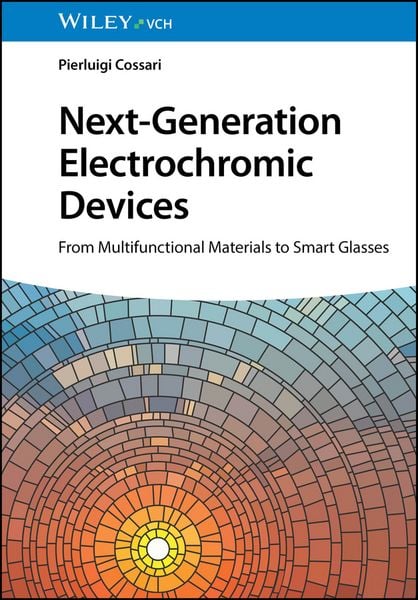
Next-Generation Electrochromic Devices From Multifunctional Materials to Smart Glasses
132,99 €
UVP
149,00 €
inkl. gesetzl. MwSt.,
Lieferung nach Hause
Beschreibung
Produktdetails
Einband
Gebundene Ausgabe
Erscheinungsdatum
23.07.2025
Abbildungen
150 schwarz-weiße und 50 farbige Abbildungen
Verlag
Wiley-VCHSeitenzahl
368
Maße (L/B/H)
25,2/17,9/2,7 cm
Gewicht
666 g
Auflage
1. Auflage
Sprache
Englisch
ISBN
978-3-527-34925-8
Next-Generation Electrochromic Devices: From Multifunctional Materials to Smart Glasses covers the basic concepts and the potential use of electrolytes, conducting polymers and multifunctional materials for the development of electrochromic (EC) and integrated systems, focusing on the influence of solid-state electrolytes and interface features on the design of new device structures and simplified manufacturing.
The book is divided into three parts. Part I explores the chemistry of the main components of devices with a special focus on the main critical material issues, covering mixed-ion and electron conductors, electrodes, and more. Part II describes EC and multifunctional devices, such as photoelectrochromic smart windows and see-through ECOLED displays, and the main characterization techniques for the study of material properties, interfaces and device performance. Part III comprehends device manufacturing, scale-up procedures, and discusses the main benefits of smart windows in terms of energy savings, visual comfort, and environmental impact, proposing contextually a multitude of pioneering ideas and concepts with a specific insight into emerging devices in the era of Artificial Intelligence (AI), immersive reality and invisible technologies.
Next-Generation Electrochromic Devices includes information on:
* Inorganic and organic electrochromic materials, including graphene, 3D transitional metal oxides, Prussian blue, viologens, conducting polymers, organic mixed ionic and electronic materials, and highly transparent electrodes
* Electrolytes including inorganic, liquid, gel, and solid-state polymers, their ionic conductivity and transport properties
* Thin film deposition methods: chemical deposition through solution processing techniques, sol-gel, Langmuir-Blodgett, electrochemical and physical deposition by means thermal and electron-beam evaporation, sputtering, pulsed laser, and molecular beam epitaxy deposition
* Electrochemical analysis of materials, interface, and device durability
* Organic mixed ionic and electronic conductor materials for innovative and multifunctional optoelectronic systems
* Optical, structural, chemical, and physical methods for the study of electrochromism and material properties including NMR, X-Ray diffraction analysis, XPS, UV-Vis, FTIR, and Raman spectroscopy
* Energy efficiency of EC glazings and their impact on thermal and visual comfort
* Emerging materials for chromogenic systems, smart windows, and new energy devices
* Fully integrated ECOLED see-through displays and multifunctional smart devices for immersive reality and invisible technologies
* Impact of AI and next-generation technologies on social, human, and environmental changes
Next-Generation Electrochromic Devices is an essential reference on the subject for materials scientists, chemists, physicists, as well as architects, electrical and civil engineers. It can be also a source of inspiration for artists, graphic designers, and art workers.
Kundinnen und Kunden meinen
Verfassen Sie die erste Bewertung zu diesem Artikel
Helfen Sie anderen Kund*innen durch Ihre Meinung
Kurze Frage zu unserer Seite
Vielen Dank für dein Feedback
Wir nutzen dein Feedback, um unsere Produktseiten zu verbessern. Bitte habe Verständnis, dass wir dir keine Rückmeldung geben können. Falls du Kontakt mit uns aufnehmen möchtest, kannst du dich aber gerne an unseren Kund*innenservice wenden.
zum Kundenservice