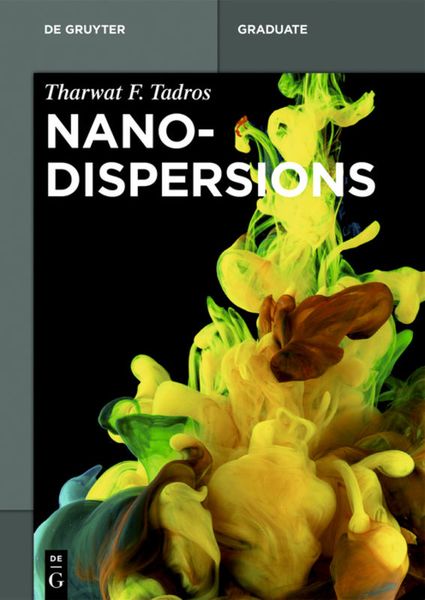
Nanodispersions
-
- Taschenbuch ausgewählt
- eBook
-
Sprache:Englisch
62,99 €
inkl. gesetzl. MwSt.,
Lieferung nach Hause
Beschreibung
Produktdetails
Einband
Taschenbuch
Erscheinungsdatum
27.11.2015
Abbildungen
100 b/w and 50 col. Illustrationen, 50 b/w tblättern, 50 b/w img., 50 b/w and 50 col. ld
Verlag
De GruyterSeitenzahl
298
Maße (L/B/H)
24/17/1,7 cm
Gewicht
510 g
Auflage
1. Auflage
Sprache
Englisch
ISBN
978-3-11-029033-2
General introduction - Definition of nanodispersions (nanosuspensions, nanoemulsions, swollen micelles or microemulsions, liposomes and vesicles) and their size range. General description of their colloid stability. Main advantages of nanodispersions and their industrial applications.
Preparation of nanosuspensions by top-up process - Nucleation and growth and control of particle size distribution. Factors determining the formation of narrow particle size distribution. Role of surfactants and polymers. Preparation of nano-polymer colloids (lattices) by emulsion and dispersion polymerization. Factors affects the stability of nanosuspensions.
Preparation of nanosuspensions by bottom down process - Dispersion of preformed particles in liquids and the need of a wetting agent. Break-up of aggregates and agglomerates by application of high speed stirrers. Reduction of particle size by application of intense energy (microfluidization or bead milling). Maintenance of the colloid stability of the resulting particles. Reduction of Ostwald ripening.
Industrial applications of nanosuspensions - Application in pharmacy to enhance bioavailability, Application in sunscreens for UV protection. Application in paints and coatings.
Preparation of nanoemulsions by the use of high pressure homogenisers - Principles of emulsion formation and the role of the emulsifier. Selection of emulsifiers. Methods of emulsification and prevention of coalescence during emulsification. Origin of colloid stability of nanoemulsions. Prevention of Ostwald ripening
Low energy methods for nanoemulsion preparation - The phase inversion composition method and the role of mixing the surfactant with oil and water. The phase inversion temperature method for preparation of nanoemulsions. Preparation of nanoemulsions by dilution of microemulsions.
Practical examples of nanoemulsions and their industrial application - Nanoemulsions based on non-ionic surfactants and the role of the hydrophilic-lipophilic balance. Effect of oil solubility on the stabilityof nanoemulsions. Nanoemulsions based on polymeric surfactants. Applications in pharmacy and cosmetics.
Swollen micelles or microemulsions Definition of microemulsions and their size range. Thermodynamic definition of microemulstions. Theories of microemulsion formation and stability. Characterisation of microemulsions using scattering, conductivity and NMR rechniques.
Formulation of microemulsions and their industrial applications - Distinction between microemulsions and macroemulsions. Formulation of oil/water and water/oil microemulsions. Selection of emulsifiers for microemulsions. Application of microemulsions in tertiary oil recovery.
Liposomes and vesicles - Formation of multilamellar lipid layers (liposomes) by dispersion of lipids in water. Formation of unilamellar vesicles by sonication of the liposomes. Factors responsible for stabilisation of liposomes and vesicles. Use of block copolymers to enhance the stability of vesicles. Applications of liposomes and vesicles in pharmacy and cosmetics.
Kundinnen und Kunden meinen
Verfassen Sie die erste Bewertung zu diesem Artikel
Helfen Sie anderen Kund*innen durch Ihre Meinung
Kurze Frage zu unserer Seite
Vielen Dank für dein Feedback
Wir nutzen dein Feedback, um unsere Produktseiten zu verbessern. Bitte habe Verständnis, dass wir dir keine Rückmeldung geben können. Falls du Kontakt mit uns aufnehmen möchtest, kannst du dich aber gerne an unseren Kund*innenservice wenden.
zum Kundenservice