Beschreibung
Details
Einband
Set mit diversen Artikeln
Erscheinungsdatum
27.09.2025
Abbildungen
XVI, 39 illus., 33 illus. in color., schwarz-weiss Illustrationen, farbige Illustrationen
Herausgeber
Nigel Field + weitereVerlag
SpringerSeitenzahl
223
Maße (L/B/H)
24,1/16/1,8 cm
Gewicht
571 g
Sprache
Englisch
ISBN
978-3-031-76447-9
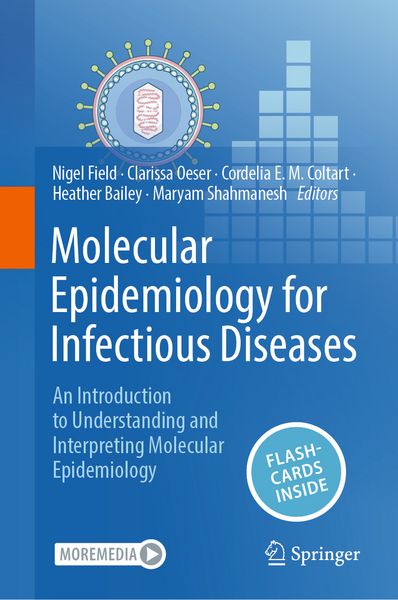
This textbook introduces the reader to molecular epidemiology as a field that improves our understanding of infectious diseases, their natural history, and their control. The sudden onset of the COVID-19 pandemic prompted an increased awareness about epidemiology and molecular biology. Policy makers have required specialist knowledge to assess the evolving situation and make informed judgements about the clinical and public health implications.
This book bridges the gap between primary research and advanced graduate textbooks.
The field of molecular epidemiology has developed at the interface between epidemiology and molecular biology as high throughput molecular techniques have become cheaper and increasingly sophisticated for typing pathogen strains and characterising the host immune response. At the same time, bioinformatics and statistical methods have evolved so these complex and high-dimensional data can be analysed in combination with classical epidemiological data on time, person, and place. However, the analysis of datasets combining classical epidemiological and molecular data is highly specialised. Few postgraduate courses cover this topic in sufficient detail to allow meaningful interpretation.
This textbook introduces the major methods used to generate molecular datasets and the epidemiological and statistical concepts that are used to link these data with clinical and behavioural data. An introductory chapter explains key terms, definitions and the challenges of accurate and reproducible measurements in microbiology (metrology) and reviews the development of molecular epidemiology as a field and its history. Subsequent chapters introduce the readers to pathogen phylogenetics, host transcriptomics, proteomics, serology, and the microbiome. An additional chapter covers the ethical issues that arise when using molecular data combined with epidemiological and clinical information. The concluding chapter takes a look at the bigger picture and considers the contributions of molecular epidemiology to infectious disease control and health policy.
Additional questions and answers via app: Download the Springer Nature Flashcards app free of charge and use exclusive additional material to test your knowledge.
Unsere Kundinnen und Kunden meinen
Verfassen Sie die erste Bewertung zu diesem Artikel
Helfen Sie anderen Kund*innen durch Ihre Meinung
Kurze Frage zu unserer Seite
Vielen Dank für dein Feedback
Wir nutzen dein Feedback, um unsere Produktseiten zu verbessern. Bitte habe Verständnis, dass wir dir keine Rückmeldung geben können. Falls du Kontakt mit uns aufnehmen möchtest, kannst du dich aber gerne an unseren Kund*innenservice wenden.
zum Kundenservice