Gutscheinbedingungen

**Gültig bis 10.06.2026 / Gültig für gebrauchte Bücher / Mindestbestellwert 20,00 € / Einzelne Artikel können ausgeschlossen sein / Online auf www.bücher.de.de / Nicht kombinierbar mit anderen Gutscheinen oder Preisaktionen / Nur einmal pro Einkauf einlösbar / Gutschein wird auf max. 500€ Bestellwert angerechnet / Keine Barauszahlung / Nicht gültig für Versandkosten und Services

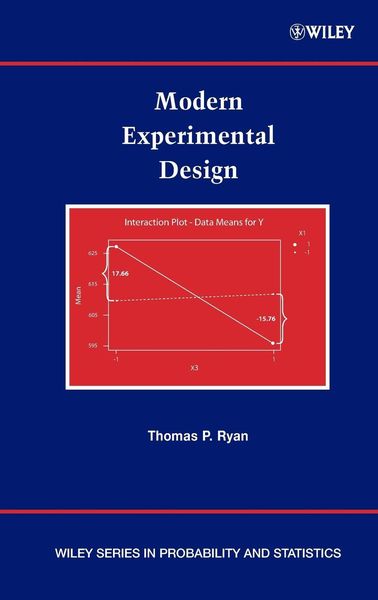
Produktbild: Modern Experimental Design

Modern Experimental Design

219,99 €

inkl. gesetzl. MwSt., Versandkostenfrei

Lieferung nach Hause

Beschreibung

Produktdetails

Einband

Gebundene Ausgabe

Erscheinungsdatum

02.02.2007

Verlag

John Wiley & Sons Inc

Seitenzahl

624

Maße (L/B/H)

24/16,1/3,8 cm

Gewicht

1097 g

Auflage

1. Auflage

Sprache

Englisch

ISBN

978-0-471-21077-1

Beschreibung

Rezension

"A good introduction to statistical design of experiments, covering a wide variety of topics in a well readable and structured way." (Statistical Papers 2008)
 
"It is definitely nice to have such a book in the library." (International Statistical Review, 2007)
 
"... this book will prove to be a boon for advances in experimental design." (Zentralblatt MATH, 2007)

Produktdetails

Einband

Gebundene Ausgabe

Erscheinungsdatum

02.02.2007

Verlag

John Wiley & Sons Inc

Seitenzahl

624

Maße (L/B/H)

24/16,1/3,8 cm

Gewicht

1097 g

Auflage

1. Auflage

Sprache

Englisch

ISBN

978-0-471-21077-1

Herstelleradresse

Libri GmbH
Europaallee 1
36244 Bad Hersfeld
DE

Email: gpsr@libri.de

Kundinnen und Kunden meinen

0 Bewertungen

Informationen zu Bewertungen

Zur Abgabe einer Bewertung ist eine Anmeldung im Konto notwendig. Die Authentizität der Bewertungen wird von uns nicht überprüft. Wir behalten uns vor, Bewertungstexte, die unseren Richtlinien widersprechen, entsprechend zu kürzen oder zu löschen.

Die Bewertungen sind nach Format, Anzahl Sterne und Datum sortiert.

Verfassen Sie die erste Bewertung zu diesem Artikel

Helfen Sie anderen Kund*innen durch Ihre Meinung

Kundinnen und Kunden meinen

0 Bewertungen filtern

Die Leseprobe wird geladen.
  • Produktbild: Modern Experimental Design
  • Preface.

    1. Introduction.

    1.1 Experiments All Around Us.

    1.2 Objectives for Experimental Designs.

    1.3 Planned Experimentation versus use of Observational Data.

    1.4 Basic Design Concepts.

    1.5 Terminology.

    1.6 Steps for the Design of Experiments.

    1.7 Processes Should Ideally be in a State of Statistical Control.

    1.8 Types of Experimental Designs.

    1.9 Analysis of Means.

    1.10 Missing Data.

    1.11 Experimental Designs and Six Sigma.

    1.12 Quasi-Experimental Design.

    1.13 Summary.

      2. Completely Randomized Design.

    2.1 completely Randomized Design.

    2.2 Analysis of Means.

    2.3 Software for Experimental Design.

    2.4 Missing Values.

    2.5 Summary.

    3. Designs that Incorporate Extraneous (Blocking) Factors.

    3.1 Randomized Block Design.

    3.2 Incomplete Block Designs.

    Graeco-Latin Square Design.

    3.5 Youden Squares.

    3.6 Missing Values.

    3.7 Software.

    3.8 Summary.

    4. Full Factorial Designs with Two Levels.

    4.1 The nature of Factorial Designs.

    4.2 The Deleterious Effects of Interactions.

    4.3 Effect Estimates.

    4.4 Why Not One-Factor-at-a-Time Designs?

    4.5 ANOVA Table for Unreplicated Two-factor Design?

    4.6 The 2 3 Design.

    4.7 Built-in Replication.

    4.8 Multiple Readings versus Replicates.

    4.9 Reality versus Textbook Examples.

    4.10 Bad data in Factorial Designs.

    4.11 Normal Probability Plot Methods.

    4.12 Missing Data in Factorial Designs.

    4.13 Inaccurate Levels in Factorial Designs.

    4.14 Checking for Statistical Control.

    4.15 Blocking 2 k Designs.

    4.16 The Role of Expected Mean Squares in Experimental Design.

    4.17 Hypothesis Tests with Only Random Factors in 2 k Designs? Avoid Them!

    4.18 Hierarchical versus Nonhierarchical Models.

    4.19 Hard-to-Change factors.

    4.20 Factors Not reset.

    4.21 Detecting Dispersion Effects.

    4.22 Software.

    4.23 Summary.

    5. Fractional factorial Designs with Two-Levels.

    5.1 2 k-1 Designs.

    5.2 2 k-2 Designs.

    5.3 Designs with k & p = 16.

    5.4 Utility of Small Fractional factorials vis-à-vis Normal Probability Plots.

    5.5 Design Efficiency.

    5.6 Retrieving a Lost Defining Relation.

    5.7 Minimum Aberration Designs and Minimum Confounded Effects Designs.

    5.8 Blocking Factorial Design.

    5.9 Foldover Designs.

    5.10 John's ¿ Designs.

    5.11 Projective Properties of 2 k-p Designs.

    5.12 Small Fractions and Irregular Designs.

    5.13 An Example of Sequential Experimentation.

    5.14 Inadvertent Nonorthogonality-Case Study.

    5.15 Fractional factorial Designs for Natural Subsets of factors.

    5.16 Relationship Between Fractional Factorials and Latin Squares.

    5.17 Alternatives to Fractional Factorials.

    5.18 Missing and Bad data.

    5.19 Plackett-Burman Designs.

    5.20 Software.

    5.21 Summary.

    6. Designs With More Than Two Levels.

    6.1 3 k Designs.

    6.2 Conditional Effects.

    6.3 3 k-p Designs.

    6.4 Mixed factorials.

    6.5 Mixed Fractional Factorials.

    6.6 Orthogonal Arrays with Mixed levels.

    6.7 Minimum Aberration Designs and Minimum Confounded Effects Designs.

    6.8 Four or More Levels.

    6.9 Software.

    6.10 Catalog of Designs.

    6.11 Summary.

    7. Nested Designs.

    7.1 Various Examples.

    7.2 Software Shortcomings.

    7.3 Staggered Nested Designs.

    7.4 Nested and Staggered Nested Designs with factorial Structure.

    7.5 Estimating Variance Components.

    7.6 ANOM for Nested Designs?

    7.7 Summary.

    8. Robust Designs.

    8.1 "Taguchi Designs?"

    8.2 Identification of Dispersion Effects.

    8.3 Designs with Noise factors.

    8.4 Product Array, Combined Array, or Compound Array?

    8.5 Software.

    8.6 Further Reading.

    8.7 Summary.

    9. Split-Unit, Split-Lot, and Related Designs.

    9.1 Split-Unit Design.

    9.2 Split-Lot Design.

    9.3 Commonalities and Differences Between these Designs.

    9.4 Software.

    9.5 Summary.

    10. Response Surface Designs.

    10.1 Response Surface Experimentation: One Design or More Than One?

    10.2 Which Designs?

    10.3 Classical Response Surface Designs versus Alternatives.

    10.4 Methods of Steepest Ascent (Descent).

    10.5 Central Composite Designs.

    10.6 Properties of Space-Filling Designs.

    10.7 Applications of Uniform Designs.

    10.8 Box-Behnken Designs.

    10.9 Conditional Effects?

    10.10 Other Response Surface Designs.

    10.11 Blocking Response Surface Designs.

    10.12 Comparison of Designs.

    10.13 Analyzing the Fitted Surface.

    10.14 Response Surface Designs for Computer Simulations.

    10.15 ANOM with Response Surface Designs?

    10.16 Further reading.

    10.17 The Present and Future Direction of response Surface Designs.

    10.18 Software.

    10.19 Catalogs of Designs.

    10.20 Summary.

    11. Repeated Measure Designs.

      11.1 One factor.

    11.2 More Than One Factor.

    11.3 Crossover Designs.

    11.4 Designs for Carryover Effects.

    11.5 How Many Repeated Measures?

    11.6 Further Reading.

    11.7 Software.

    11.8 Summary.

    12. Multiple Responses.

    12.1 Overlaying Contour Plots.

    12.2 Seeking Multiple Response Optimization with Desirability Functions.

    12.3 Dual response Optimization.

      12.4 Designs Used with Multiple Responses.

    12.5 Applications.

    12.6 Multiple Response Optimization variations.

    12.7 The Importance of Analysis.

    12.8 Software.

    12.9 Summary.

    13. Miscellaneous Design Topics.

    13.1 One-Factor-at-a-Time Designs.

    13.2 Cotter Designs.

    13.3 Rotation Designs.

    13.4 Screening Designs.

    13.5 Design of Experiments for Analytic Studies.

    13.6 Equileverage Designs.

    13.7 Optimal Designs.

    13.8 Designs for Restricted Regions of Operability.

    13.9 Space-Filling, Designs.

    13.10 Trend-Free Designs.

    13.11 Cost-Minimizing Designs.

    13.12 Mixture Designs.

    13.13 Design of Measurement Capability Studies.

    13.14 Design of Computer Experiments.

    13.15 Design of Experiments for Categorical Response variables.

    13.16 Weighing Designs and Calibration Designs.

    13.17 Designs for Assessing the Capability of a System.

    13.18 Designs for Nonlinear Models.

    13.19 Model-Robust Designs.

    13.20 Designs and Analyses for Non-normal Responses.

    13.21 Design of Microarray Experiments.

    13.22 Multi-Vari Plot.

    13.23 Evolutionary Operation.

    13.24 Software.

    13.25 Summary.

    14. Tying It All Together.

    14.1 Training for Experimental Design Use.

    Answers to Selected Exercises.

    Appendix: Statistical Tables.

    Author Inde.

    Subject Index.