
• Produktbild: Mathematical Population Genetics 1
  • Produktbild: Mathematical Population Genetics 1
  • Produktbild: Mathematical Population Genetics 1
Band 27 - 12%

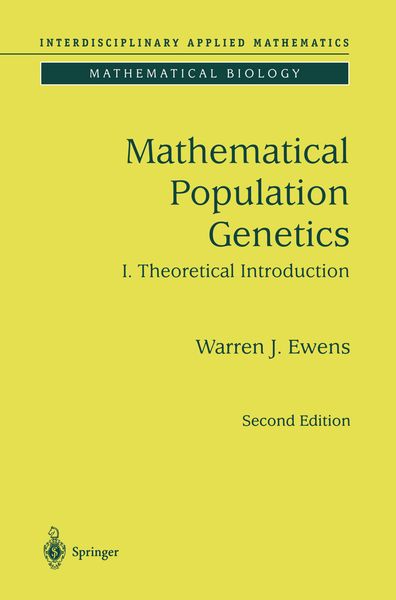
Mathematical Population Genetics 1 Theoretical Introduction

12% sparen

148,99 € UVP 169,99 €

inkl. gesetzl. MwSt., Versandkostenfrei

Lieferung nach Hause

Beschreibung

Produktdetails

Einband

Gebundene Ausgabe

Erscheinungsdatum

09.01.2004

Verlag

Springer Us

Seitenzahl

418

Maße (L/B/H)

24,1/16/3 cm

Gewicht

734 g

Auflage

Second Edition 2004

Sprache

Englisch

ISBN

978-0-387-20191-7

Beschreibung

Rezension

From reviews of the 1979 edition:


"Here we have perhaps the most articulate of the many fine Australian population geneticists bringing us up to date on the mathematical aspects of his field." -B. S. Weir, William Neal Reynolds Professor of Statistics and Genetics, Director, Bioinformatics Research Center, North Carolina State University


"This book is an excellent source to learn the field for a mathematician or mathematically sophisticated reader." -SIAM Review


"An important reference to anyone interested in the mathematical aspects of population genetics, not only to those actually doing it, but to anyone trying to bridge the now substantial gap between theoretical and experimental population genetics." -The Quarterly Review of Biology


From the reviews of the second edition:


"It is the first of a planned two-volume sequence treating mathematical aspects of population genetics theory and its applications to evolution. … The presentation is very clear and the author confers many of his deep insights to the reader. Therefore, this new edition has very good prospects to serve as the most important introductory text to this active field of research … ." (R. Bürger, Monatshefte für Mathematik, Vol. 145 (1), 2005)


From the reviews of the second edition:


"This book is an extensively revised and expanded second edition … . It presents the principles of mathematical population genetics with an emphasis on evolutionary theory. … Ewens presentation bridges marvellously mathematics and biology. The author effectively copes with the problem that mathematicians want to see technical details, while biologists do not like formalism." (Martin Möhle, Zeitschrift für Angewandte Mathematik und Mechanik, Vol. 85 (1), 2005)


From the reviews of the second edition:


"The book concentrates on the mathematical aspects of population genetics at the graduate or researchlevel. … an excellent summary of the most important results, and very welcome in view of a vast scattered literature. I particularly like the many interesting connections that are made … . Another highlight is an extra chapter on Moran model … . Ewens’ account of mathematical population genetics is unique … . I am very happy to see this second edition in print … ." (Ellen Baake, Mathematical Biosciences, Vol. 197, 2005)


"This is an excellent book on population genetics and evolution placing the emphasis on mathematical and statistical aspects of the theory. … the author successfully connects classical prospective theory with the current retrospective viewpoint of population genetics. … this is an exciting and significant book which reflects the author’s enthusiasm and experience in the field through many decades. It should be read by graduate students and researchers interested in mathematical aspects of population genetics … ." (Günther Karigl, Zentralblatt MATH, Vol. 1060, 2005)


"This book is in a series of texts specializing in interdisciplinary applied mathematics and is scheduled as the first volume of two devoted to population genetics by the same author; it is the second edition of the book first published in 1979. … This book will be of most use to postgraduate researchers … . the book under review admirably sets the scene by including a discussion of the broad theories of population dynamics." (Tony Crilly, The Mathematical Gazette, Vol. 89 (516), 2005)

Produktdetails

Einband

Gebundene Ausgabe

Erscheinungsdatum

09.01.2004

Verlag

Springer Us

Seitenzahl

418

Maße (L/B/H)

24,1/16/3 cm

Gewicht

734 g

Auflage

Second Edition 2004

Sprache

Englisch

ISBN

978-0-387-20191-7

Herstelleradresse

Springer-Verlag KG
Sachsenplatz 4-6
1201 Wien
AT

Email: [email protected]

Kundinnen und Kunden meinen

0 Bewertungen

Informationen zu Bewertungen

Zur Abgabe einer Bewertung ist eine Anmeldung im Konto notwendig. Die Authentizität der Bewertungen wird von uns nicht überprüft. Wir behalten uns vor, Bewertungstexte, die unseren Richtlinien widersprechen, entsprechend zu kürzen oder zu löschen.

Die Bewertungen sind nach Format, Anzahl Sterne und Datum sortiert.

Verfassen Sie die erste Bewertung zu diesem Artikel

Helfen Sie anderen Kund*innen durch Ihre Meinung

Kundinnen und Kunden meinen

0 Bewertungen filtern

  • Produktbild: Mathematical Population Genetics 1
  • Produktbild: Mathematical Population Genetics 1
  • Produktbild: Mathematical Population Genetics 1
  • Contents
    Preface
    Introduction
    1 Historical Background
    1.1 Biometricians, Saltationists and Mendelians
    1.2 The Hardy–Weinberg Law
    1.3 The Correlation Between Relatives
    1.4 Evolution
    1.4.1 The Deterministic Theory
    1.4.2 Non-Random-Mating Populations
    1.4.3 The Stochastic Theory
    1.5 Evolved Genetic Phenomena
    1.6 Modelling
    1.7 Overall Evolutionary Theories 2 Technicalities and Generalizations
    2.1 Introduction
    2.2 Random Union of Gametes
    2.3 Dioecious Populations
    2.4 Multiple Alleles
    2.5 Frequency-Dependent Selection
    2.6 Fertility Selection
    2.7 Continuous-Time Models
    2.8 Non-Random-Mating Populations
    2.9 The Fundamental Theorem of Natural Selection
    2.10 Two Loci
    2.11 Genetic Loads
    2.12 Finite Markov Chains 3 Discrete Stochastic Models
    3.1 Introduction
    3.2 Wright–Fisher Model: Two Alleles
    3.3 The Cannings (Exchangeable) Model: Two Alleles
    3.4 Moran Models: Two Alleles
    3.5 K-Allele Wright–Fisher Models
    3.6 Infinitely Many Alleles Models
    3.6.1 Introduction
    3.6.2 The Wright–Fisher In.nitely Many Alleles Model
    3.6.3 The Cannings In.nitely Many Alleles Model
    3.6.4 The Moran In.nitely Many Alleles Model
    3.7 The Effective Population Size
    3.8 Frequency-Dependent Selection
    3.9 Two Loci 4 Diffusion Theory
    4.1 Introduction
    4.2 The Forward and Backward Kolmogorov Equations
    4.3 Fixation Probabilities
    4.4 Absorption Time Properties
    4.5 The Stationary Distribution
    4.6 Conditional Processes
    4.7 Diffusion Theory
    4.8 Multi-dimensional Processes
    4.9 Time Reversibility
    4.10 Expectations of Functions of Di.usion Variables 5 Applications of Diffusion Theory
    5.1 Introduction
    5.2 No Selection or Mutation
    5.3 Selection
    5.4 Selection: Absorption Time Properties
    5.5 One-Way Mutation
    5.6 Two-Way Mutation
    5.7 Diffusion Approximations andBoundary Conditions
    5.8 Random Environments
    5.9 Time-Reversal and Age Properties
    5.10 Multi-Allele Diffusion Processes 6 Two Loci
    6.1 Introduction
    6.2 Evolutionary Properties of Mean Fitness
    6.3 Equilibrium Points
    6.4 Special Models
    6.5 Modifier Theory
    6.6 Two-Locus Diffusion Processes
    6.7 Associative Overdominance and Hitchhiking
    6.8 The Evolutionary Advantage of Recombination
    6.9 Summary 7 Many Loci
    7.1 Introduction
    7.2 Notation
    7.3 The Random Mating Case
    7.3.1 Linkage Disequilibrium, Means and Variances
    7.3.2 Recurrence Relations for Gametic Frequencies
    7.3.3 Components of Variance
    7.3.4 Particular Models
    7.4 Non-Random Mating
    7.4.1 Introduction
    7.4.2 Notation and Theory
    7.4.3 Marginal Fitnesses and Average Effects
    7.4.4 Implications
    7.4.5 The Fundamental Theorem of Natural Selection
    7.4.6 Optimality Principles
    7.5 The Correlation Between Relatives
    7.6 Summary 8 Further Considerations
    8.1 Introduction
    8.2 What is Fitness?
    8.3 Sex Ratio
    8.4 Geographical Structure
    8.5 Age Structure
    8.6 Ecological Considerations
    8.7 Sociobiology 9 Molecular Population Genetics: Introduction
    9.1 Introduction
    9.2 Technical Comments
    9.3 In.nitely Many Alleles Models: Population Properties
    9.3.1 The Wright–Fisher Model
    9.3.2 The Moran Model
    9.4 In.nitely Many Sites Models: Population Properties
    9.4.1 Introduction
    9.4.2 The Wright–Fisher Model
    9.4.3 The Moran Model
    9.5 Sample Properties of In.nitely Many Alleles Models
    9.5.1 Introduction
    9.5.2 The Wright–Fisher Model
    9.5.3 The Moran Model
    9.6 Sample Properties of In.nitely Many Sites Models
    9.6.1 Introduction
    9.6.2 The Wright–Fisher Model
    9.6.3 The Moran Model
    9.7 Relation Between In.nitely Many Alleles and Infinitely Many Sites Models
    9.8 Genetic Variation Within and Between