Gutscheinbedingungen

**Gültig bis 10.06.2026 / Gültig für gebrauchte Bücher / Mindestbestellwert 20,00 € / Einzelne Artikel können ausgeschlossen sein / Online auf www.bücher.de.de / Nicht kombinierbar mit anderen Gutscheinen oder Preisaktionen / Nur einmal pro Einkauf einlösbar / Gutschein wird auf max. 500€ Bestellwert angerechnet / Keine Barauszahlung / Nicht gültig für Versandkosten und Services

  • Produktbild: Mathematical Enculturation
  • Produktbild: Mathematical Enculturation
Band 6 - 13%

Mathematical Enculturation A Cultural Perspective on Mathematics Education

13% sparen

157,99 € UVP 181,89 €

inkl. gesetzl. MwSt., Versandkostenfrei

Lieferung nach Hause

Beschreibung

Produktdetails

Einband

Taschenbuch

Erscheinungsdatum

30.06.1991

Verlag

Springer Netherland

Seitenzahl

196

Maße (L/B/H)

23,5/15,5/1,2 cm

Gewicht

313 g

Auflage

1991

Sprache

Englisch

ISBN

978-0-7923-1270-3

Beschreibung

Rezension

`
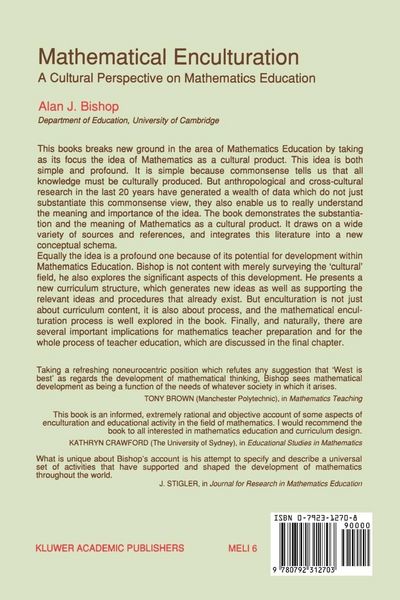
Taking a refreshing noneurocentric position which refutes any suggestion that `West is best' as regards the development of mathematical thinking, Bishop sees mathematical development as being a function of the needs of whatever society in which it arises.
'

Tony Brown (Manchester Polytechnic)
, in
Mathematics Teaching

`
This book is an informed, extremely rational and objective account of some aspects of enculturation and educational activity in the field of mathematics. I would recommend the book to all interested in mathematics education and curriculum design.
'

Kathryn Crawford (The University of Sydney)
, in
Educational

Studies in Mathematics

`
What is unique about Bishop's account is his attempt to specify and describe a universal set of activities that have supported and shaped the development of mathematics throughout the world.
'

J. Stigler,
in
Journal for Research in Mathematics Education

Produktdetails

Einband

Taschenbuch

Erscheinungsdatum

30.06.1991

Verlag

Springer Netherland

Seitenzahl

196

Maße (L/B/H)

23,5/15,5/1,2 cm

Gewicht

313 g

Auflage

1991

Sprache

Englisch

ISBN

978-0-7923-1270-3

Herstelleradresse

Springer-Verlag GmbH
Tiergartenstr. 17
69121 Heidelberg
DE

Email: ProductSafety@springernature.com

Kundinnen und Kunden meinen

0 Bewertungen

Informationen zu Bewertungen

Zur Abgabe einer Bewertung ist eine Anmeldung im Konto notwendig. Die Authentizität der Bewertungen wird von uns nicht überprüft. Wir behalten uns vor, Bewertungstexte, die unseren Richtlinien widersprechen, entsprechend zu kürzen oder zu löschen.

Die Bewertungen sind nach Format, Anzahl Sterne und Datum sortiert.

Verfassen Sie die erste Bewertung zu diesem Artikel

Helfen Sie anderen Kund*innen durch Ihre Meinung

Kundinnen und Kunden meinen

0 Bewertungen filtern

Weitere Artikel findest du in

  • Produktbild: Mathematical Enculturation
  • Produktbild: Mathematical Enculturation
  • 1/Towards a Way of Knowing.- 1.1. The conflict.- 1.2. My task.- 1.3. Preliminary thoughts on Mathematics education and culture.- 1.4. Technique-oriented curriculum.- 1.5. Impersonal learning.- 1.6. Text teaching.- 1.7. False assumptions.- 1.8. Mathematical education, a social process.- 1.9. What is mathematical about a mathematical education?.- 1.10. Overview.- 2/Environmental Activities and Mathematical Culture.- 2.1. Perspectives from cross-cultural studies.- 2.2. The search for mathematical similarities.- 2.3. Counting.- 2.4. Locating.- 2.5. Measuring.- 2.6. Designing.- 2.7. Playing.- 2.8. Explaining.- 2.9. From ‘universals’ to ‘particulars’.- 2.10. Summary.- 3/The Values of Mathematical Culture.- 3.1. Values, ideals and theories of knowledge.- 3.2. Ideology — rationalism.- 3.3. Ideology — objectism.- 3.4. Sentiment — control.- 3.5. Sentiment — progress.- 3.6. Sociology — openness.- 3.7. Sociology — mystery.- 4/Mathematical Culture and the Child.- 4.1. Mathematical culture — symbolic technology and values.- 4.2. The culture of a people.- 4.3. The child in relation to the cultural group.- 4.4. Mathematical enculturation.- 5/Mathematical Enculturation — The Curriculum.- 5.1. The curriculum project.- 5.2. The cultural approach to the Mathematics curriculum — five principles.- 5.2.1. Representativeness.- 5.2.2. Formality.- 5.2.3. Accessibility.- 5.2.4. Explanatory power.- 5.2.5. Broad and elementary.- 5.3. The three components of the enculturation curriculum.- 5.4. The symbolic component: concept-based.- 5.4.1. Counting.- 5.4.2. Locating.- 5.4.3. Measuring.- 5.4.4. Designing.- 5.4.5. Playing.- 5.4.6. Explaining.- 5.4.7. Concepts through activities.- 5.4.8. Connections between concepts.- 5.5. The societal component: project-based.- 5.5.1. Society in the past.- 5.5.2. Society at present.- 5.5.3. Society in the future.- 5.6. The cultural component: investigation-based.- 5.6.1. Investigations in mathematical culture.- 5.6.2. Investigations in Mathematical culture.- 5.6.3. Investigations and values.- 5.7. Balance in this curriculum.- 5.8. Progress through this curriculum.- 6/Mathematical Enculturation — The Process.- 6.1. Conceptualising the enculturation process in action.- 6.1.1. What should it involve?.- 6.1.2. Towards a humanistic conception of the process.- 6.2. An asymmetrical process.- 6.2.1. The role of power and influence.- 6.2.2. Legitimate use of power.- 6.2.3. Constructive and collaborative engagement.- 6.2.4. Facilitative influence.- 6.2.5. Metaknowledge and the teacher.- 6.3. An intentional process.- 6.3.1. The choice of activities.- 6.3.2. The concept-environment.- 6.3.3. The project-environment.- 6.3.4. The investigation-environment.- 6.4. An ideational process.- 6.4.1. Social construction of meanings.- 6.4.2. Sharing and contrasting Mathematical ideas.- 6.4.3. The shaping of explanations.- 6.4.4. Explaining and values.- 7/The Mathematical Enculturators.- 7.1. People are responsible for the process.- 7.2. The preparation of Mathematical enculturators — preliminary thoughts.- 7.3. The criteria for the selection of Mathematical enculturators.- 7.3.1. Ability to personify Mathematical culture.- 7.3.2. Commitment to the Mathematical enculturation process.- 7.3.3. Ability to communicate Mathematical ideas and values.- 7.3.4. Acceptance of accountability to the Mathematical culture.- 7.3.5. Summary of criteria.- 7.4. The principles of the education of Mathematical enculturators.- 7.4.1. Mathematics as a cultural phenomenon.- 7.4.2. The values of Mathematical culture.- 7.4.3. The symbolic technology of Mathematics.- 7.4.4. The technical level of Mathematical culture.- 7.4.5. The meta-concept of Mathematical enculturation.- 7.4.6. Summary of principles.- 7.5. Socialising the future enculturator into the Mathematics Education community.- 7.5.1. The developing Mathematics Education community.- 7.5.2. The critical Mathematics Education community.- Notes.- Index of Names.