Gutscheinbedingungen

**Gültig vom 15.06.2026 bis 17.06.2026 | Gültig für nicht preisgebundene fremdsprachige Bücher | Einzelne Artikel können ausgeschlossen sein | Maximaler rabattfähiger Warenkorbwert 500 € | Nicht kombinierbar mit weiteren Aktionen | Nur einmal pro Person einlösbar | Nur solange der Vorrat reicht

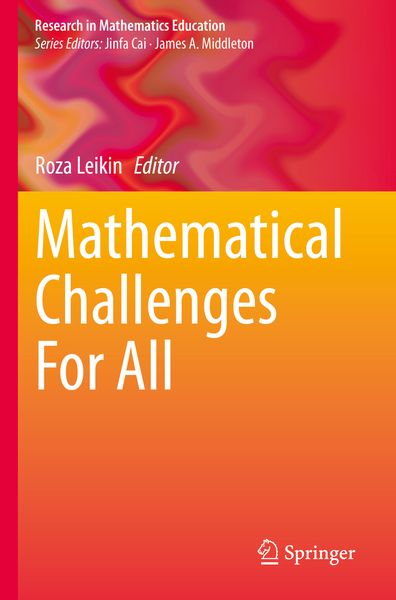
Produktbild: Mathematical Challenges For All
- 10%

Mathematical Challenges For All

10% sparen

171,99 € UVP 192,59 €

inkl. gesetzl. MwSt., Versandkostenfrei

Lieferung nach Hause

Beschreibung

Produktdetails

Einband

Taschenbuch

Erscheinungsdatum

19.03.2024

Herausgeber

Roza Leikin

Verlag

Springer

Seitenzahl

589

Maße (L/B/H)

23,5/15,5/3,3 cm

Gewicht

896 g

Sprache

Englisch

ISBN

978-3-031-18870-1

Beschreibung

Portrait

Roza Leikin is a Professor of Mathematics Education and Education of Gifted at the Faculty of Education, University of Haifa. Her research and practice is focuses on mathematically challenging instructional design, associated mathematical tasks and teachers’ professional potential. She is interested in integration of neuro-cognitive research to the field of mathematics education. Dr. Leikin is the Dean of faculty of Education, a member of the Department of Mathematics Education and the Establishing Director of the RANGE Center - the Interdisciplinary Center for the Research and Advancement of Giftedness and Excellence in the University of Haifa. During 2012-2017 she served as the President of MCG – the International Group for Mathematical Creativity and Giftedness (affiliated with ICMI). Dr. Leikin is a Senior Mathematical Editor of the International Journal for Science and Mathematics Education. She has edited 12 volumes related to research in mathematics education and the education of gifted, published more than 150 papers in peer reviewed research journals, books, and refereed conference proceedings. 

Produktdetails

Einband

Taschenbuch

Erscheinungsdatum

19.03.2024

Herausgeber

Roza Leikin

Verlag

Springer

Seitenzahl

589

Maße (L/B/H)

23,5/15,5/3,3 cm

Gewicht

896 g

Sprache

Englisch

ISBN

978-3-031-18870-1

Herstelleradresse

Springer-Verlag GmbH
Tiergartenstr. 17
69121 Heidelberg
DE

Email: ProductSafety@springernature.com

Kundinnen und Kunden meinen

0 Bewertungen

Informationen zu Bewertungen

Zur Abgabe einer Bewertung ist eine Anmeldung im Konto notwendig. Die Authentizität der Bewertungen wird von uns nicht überprüft. Wir behalten uns vor, Bewertungstexte, die unseren Richtlinien widersprechen, entsprechend zu kürzen oder zu löschen.

Die Bewertungen sind nach Format, Anzahl Sterne und Datum sortiert.

Verfassen Sie die erste Bewertung zu diesem Artikel

Helfen Sie anderen Kund*innen durch Ihre Meinung

Kundinnen und Kunden meinen

0 Bewertungen filtern

Weitere Artikel findest du in

  • Produktbild: Mathematical Challenges For All
  • Chapter 1. Unravelling the construct of mathematical challenge based on conceptual characteristics of mathematical tasks, instructional setting and socio-mathematical norms.- Part I. Mathematical challenges in curriculum and instructional design.- Chapter 2. Introduction to Section I Mathematical challenges in curriculum and instructional design.- Chapter 3. Development and stimulation of early core mathematical competencies in young children: results from the Leuven Wis and Co project.- Chapter 4. Mathematical modelling as a stimulus for curriculum and instructional reform in secondary school mathematics.- Chapter 5. Personalized mathematics and mathematics inquiry: A design framework for mathematics textbooks.- Chapter 6. MATH-KEY program: Opening mathematical minds by means of open tasks supported by dynamic applets .- Chapter 7. Making mathematics challenging through problem posing in the classroom .- Chapter 8. Challenging students to develop mathematical reasoning.- Chapter 9. Mathematical argumentation in small-group discussions of complex mathematical tasks in elementary teacher education settings.- Chapter 10. Commentary to Section I. Commentary on ‘Challenge' in terms of curriculum materials and task, the teacher’s role and the curriculum.- Part II. Kinds and variation of mathematically challenging tasks.- Chapter 11. Introduction to Section II Many faces of mathematical challenge.- Chapter 12. Probing Beneath the Surface of Resisting and Accepting Challenges in the Mathematics Classroom.- Chapter 13. Mathematical challenge in connecting advanced and secondary mathematics: Recognizing binary operations as functions.- Chapter 14. Challenging variations on a simple task.- Chapter 15. Visualization a pathway to mathematical challenging tasks.- Chapter 16. Challenges in designing and solving technology-based tasks.- Chapter 17. Creativity and Challenge: connections between task complexity and insight required for tasks solution.- Chapter 18. Challenging and assessing undergraduate students’ mathematical and pedagogical discourses through MathTASK activities.- Chapter 19. Commentary on Section II Making Mathematics Difficult? What Could Make a Mathematical Challenge Challenging?.- Part III. Collections of mathematical problems.- Chapter 20. Introduction to Section III In Search of Effectiveness and Meaningfulness.- Chapter 21. Problem Collections, and “The Unity of  Mathematics”.- Chapter 22. Meeting the challenge of heterogeneity through the self-differentiation potential of mathematical modeling problems.- Chapter 23. Complexity of Geometry Problems as a Function of Field-dependency and Asymmetry of a Diagram.- Chapter 24. Problem Sets in School Textbooks: Examples from the United States .- Chapter 25. Exams in Russia as an Example of Problem Set Organization .- Chapter 26. Taiwanese Teachers’ Collection of Geometry Tasks for Classroom Teaching: A Cognitive Complexity Perspective.- Chapter 27. Flow and Variation Theory: Powerful Allies in Creating and Maintaining Thinking in the Classroom.- Chapter 28. Designing stepped tasks through investigations in Dynamic Geometry Environments.- Chapter 29. Commentary on Section III On Problems, Problem Solving, and Thinking Mathematically.