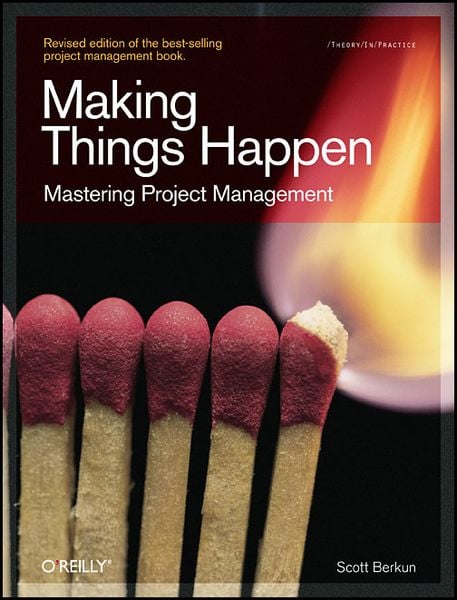
Making Things Happen Mastering Project Management
-
- Taschenbuch ausgewählt
- eBook
-
Sprache:Englisch
45,99 €
inkl. gesetzl. MwSt.,
Lieferung nach Hause
Beschreibung
Produktdetails
Einband
Taschenbuch
Erscheinungsdatum
29.04.2008
Verlag
O'Reilly MediaSeitenzahl
392
Maße (L/B/H)
23,1/17,9/2,5 cm
Gewicht
688 g
Sprache
Englisch
ISBN
978-0-596-51771-7
In the updated edition of this critically acclaimed and bestselling book, Microsoft project veteran Scott Berkun offers a collection of essays on field-tested philosophies and strategies for defining, leading, and managing projects. Each essay distills complex concepts and challenges into practical nuggets of useful advice, and the new edition now adds more value for leaders and managers of projects everywhere.
Based on his nine years of experience as a program manager for Internet Explorer, and lead program manager for Windows and MSN, Berkun explains to technical and non-technical readers alike what it takes to get through a large software or web development project. Making Things Happen doesn't cite specific methods, but focuses on philosophy and strategy. Unlike other project management books, Berkun offers personal essays in a comfortable style and easy tone that emulate the relationship of a wise project manager who gives good, entertaining and passionate advice to those who ask.
Topics in this new edition include:
* How to make things happen
* Making good decisions
* Specifications and requirements
* Ideas and what to do with them
* How not to annoy people
* Leadership and trust
* The truth about making dates
* What to do when things go wrong
Complete with a new forward from the author and a discussion guide for forming reading groups/teams, Making Things Happen offers in-depth exercises to help you apply lessons from the book to your job. It is inspiring, funny, honest, and compelling, and definitely the one book that you and your team need to have within arm's reach throughout the life of your project.
Coming from the rare perspective of someone who fought difficult battles on Microsoft's biggest projects and taught project design and management for MSTE, Microsoft's internal best practices group, this is valuable advice indeed. It will serve you well with your current work, and on future projects to come.
Based on his nine years of experience as a program manager for Internet Explorer, and lead program manager for Windows and MSN, Berkun explains to technical and non-technical readers alike what it takes to get through a large software or web development project. Making Things Happen doesn't cite specific methods, but focuses on philosophy and strategy. Unlike other project management books, Berkun offers personal essays in a comfortable style and easy tone that emulate the relationship of a wise project manager who gives good, entertaining and passionate advice to those who ask.
Topics in this new edition include:
* How to make things happen
* Making good decisions
* Specifications and requirements
* Ideas and what to do with them
* How not to annoy people
* Leadership and trust
* The truth about making dates
* What to do when things go wrong
Complete with a new forward from the author and a discussion guide for forming reading groups/teams, Making Things Happen offers in-depth exercises to help you apply lessons from the book to your job. It is inspiring, funny, honest, and compelling, and definitely the one book that you and your team need to have within arm's reach throughout the life of your project.
Coming from the rare perspective of someone who fought difficult battles on Microsoft's biggest projects and taught project design and management for MSTE, Microsoft's internal best practices group, this is valuable advice indeed. It will serve you well with your current work, and on future projects to come.
Kundinnen und Kunden meinen
Verfassen Sie die erste Bewertung zu diesem Artikel
Helfen Sie anderen Kund*innen durch Ihre Meinung
Kurze Frage zu unserer Seite
Vielen Dank für dein Feedback
Wir nutzen dein Feedback, um unsere Produktseiten zu verbessern. Bitte habe Verständnis, dass wir dir keine Rückmeldung geben können. Falls du Kontakt mit uns aufnehmen möchtest, kannst du dich aber gerne an unseren Kund*innenservice wenden.
zum Kundenservice