• Produktbild: Making Constitutions
  • Produktbild: Making Constitutions

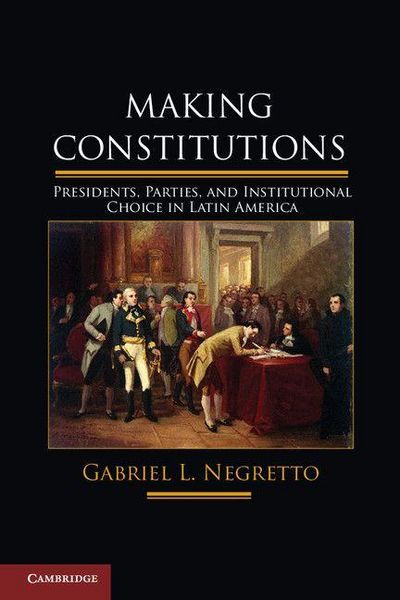
Making Constitutions Presidents, Parties, and Institutional Choice in Latin America

141,99 €

inkl. gesetzl. MwSt., Versandkostenfrei

Lieferung nach Hause

Beschreibung

Produktdetails

Einband

Gebundene Ausgabe

Erscheinungsdatum

01.06.2013

Verlag

Cambridge University Press

Seitenzahl

296

Maße (L/B/H)

23,5/15,7/2,2 cm

Gewicht

610 g

Sprache

Englisch

ISBN

978-1-107-02652-0

Beschreibung

Zitat

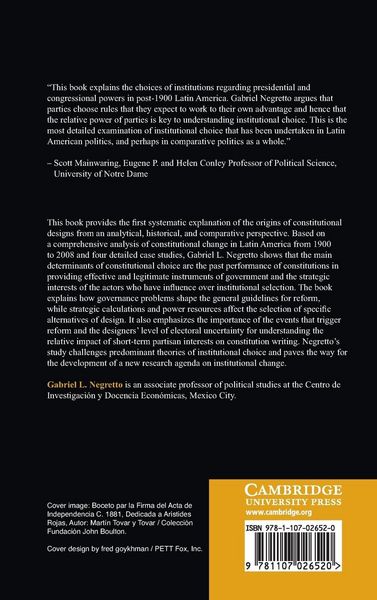
'Gabriel Negretto challenges the traditional wisdom, largely inspired by the experiences of the United Kingdom and the United States, which conceives constitutions as stable frameworks for political action. With a focus on Latin America, he shows that constitutions can be as unstable as political parties and electoral behavior are in the region, thus making the choices of institutions endogenous to the political process. This work will be of interest to students of political institutions everywhere.' Josep Colomer, Georgetown University 'This is a terrific book. There are very few studies of institutional choice in Latin America, and fewer still grounded in both theory and careful on-the-ground research. The book shows that in unusual circumstances, when the whole political elite is threatened by widespread and sometimes violent opposition, constitution writers may cooperate across party lines to choose provisions expected to increase government efficiency and responsiveness. Most of the time, however, the partisan interests of constitution makers motivate revisions expected to help them win future elections and enact policies to benefit their supporters.' Barbara Geddes, University of California, Los Angeles 'Despite the fact that constitutional design in Latin America has occurred all too frequently, it is poorly understood. Negretto's volume elucidates the interaction of politics and environment in producing particular constitutional designs. Combining theoretical clarity, rigorous data analysis, and close readings of important cases, this book will be the state of the art for years to come.' Tom Ginsburg, Leo Spitz Professor of International Law, University of Chicago Law School 'This book explains the choices of institutions regarding presidential and congressional powers in post-1900 Latin America. Gabriel Negretto argues that parties choose rules that they expect to work to their own advantage and hence that the relative power of parties is key to understanding institutional choice. This is the most detailed examination of institutional choice that has been undertaken in Latin American politics, and perhaps in comparative politics as a whole.' Scott Mainwaring, Eugene P. and Helen Conley Professor of Political Science, University of Notre Dame

Produktdetails

Einband

Gebundene Ausgabe

Erscheinungsdatum

01.06.2013

Verlag

Cambridge University Press

Seitenzahl

296

Maße (L/B/H)

23,5/15,7/2,2 cm

Gewicht

610 g

Sprache

Englisch

ISBN

978-1-107-02652-0

Kundinnen und Kunden meinen

0 Bewertungen

Informationen zu Bewertungen

Zur Abgabe einer Bewertung ist eine Anmeldung im Konto notwendig. Die Authentizität der Bewertungen wird von uns nicht überprüft. Wir behalten uns vor, Bewertungstexte, die unseren Richtlinien widersprechen, entsprechend zu kürzen oder zu löschen.

Die Bewertungen sind nach Format, Anzahl Sterne und Datum sortiert.

Verfassen Sie die erste Bewertung zu diesem Artikel

Helfen Sie anderen Kund*innen durch Ihre Meinung

Kundinnen und Kunden meinen

0 Bewertungen filtern

Die Leseprobe wird geladen.
  • Produktbild: Making Constitutions
  • Produktbild: Making Constitutions
  • Part I. The Logic of Constitutional Choice: Theory and Data: 1. Constitutional change and patterns of design; 2. A two-level theory of constitutional choice; 3. Determinants of variation in constitutional choice; Part II. Case Studies: The Origins of Reforms: 4. Constitutional change as a means to consolidate power: Argentina 1949; 5. Constitutional change as a strategy to redistribute power: Argentina 1994; 6. Constitutional change as a response to state failure: Colombia 1991; 7. Constitutional change as a remedy for ungovernability: Ecuador 1998.