
Interface Between Competition and the Internal Market Market Separation Under Article 102 Tfeu
-
- Hardcover ausgewählt
- Taschenbuch
- eBook
-
Sprache:Englisch
199,99 €
inkl. gesetzl. MwSt.,
Beschreibung
Produktdetails
Einband
Gebundene Ausgabe
Erscheinungsdatum
01.07.2014
Verlag
Bloomsbury AcademicSeitenzahl
276
Maße (L/B/H)
24/16,1/1,9 cm
Gewicht
581 g
Sprache
Englisch
ISBN
978-1-84946-569-4
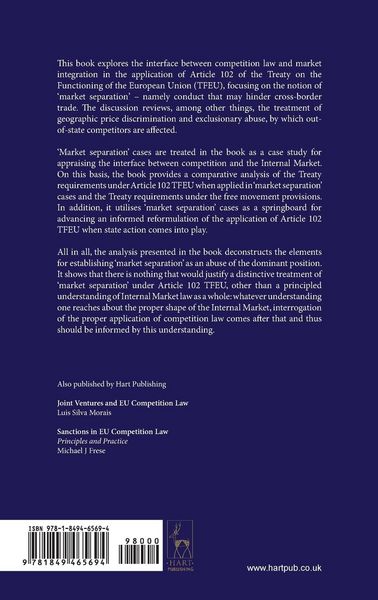
This book explores the interface between competition law and market integration in the application of Article 102 of the Treaty on the Functioning of the European Union (TFEU), focusing on the notion of 'market separation' - namely, conduct that may hinder cross-border trade. The discussion reviews, among other things, the treatment of geographic price discrimination and exclusionary abuse, by which out-of-state competitors are affected. 'Market separation' cases are treated in the book as a case study for appraising the interface between competition and the Internal Market. On this basis, the book provides a comparative analysis of the Treaty requirements under Article 102 TFEU when applied in 'market separation' cases and the Treaty requirements under the free movement provisions. In addition, it utilizes 'market separation' cases as a springboard for advancing an informed reformulation of the application of Article 102 TFEU when state action comes into play. All in all, the analysis deconstructs the elements for establishing 'market separation' as an abuse of the dominant position. It shows that there is nothing that would justify a distinctive treatment of 'market separation' under Article 102 TFEU, other than a principled understanding of Internal Market law as a whole: whatever understanding one reaches about the proper shape of the Internal Market, interrogation of the proper application of competition law comes after that and thus should be informed by this understanding. (Series: Hart Studies in Competition Law - Vol. 9)
Noch keine Bewertungen vorhanden
Verfassen Sie die erste Bewertung zu diesem Artikel
Helfen Sie anderen Kundinnen und Kunden durch Ihre Meinung.
Kurze Frage zu unserer Seite
Vielen Dank für dein Feedback
Wir nutzen dein Feedback, um unsere Produktseiten zu verbessern. Bitte habe Verständnis, dass wir dir keine Rückmeldung geben können. Falls du Kontakt mit uns aufnehmen möchtest, kannst du dich aber gerne an unseren Kund*innenservice wenden.
zum Kundenservice