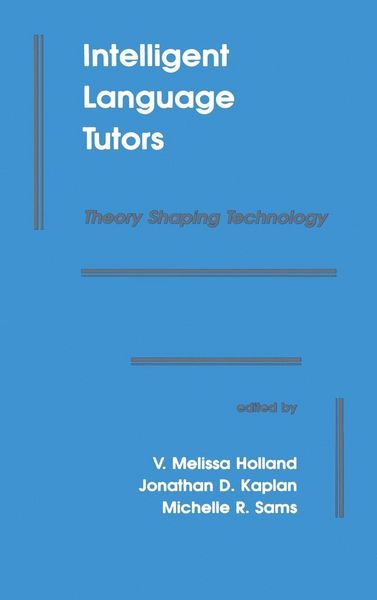

Intelligent Language Tutors Theory Shaping Technology
-
- Hardcover ausgewählt
- Taschenbuch
- eBook
-
Sprache:Englisch
249,99 €
inkl. gesetzl. MwSt.,
Beschreibung
Produktdetails
Einband
Gebundene Ausgabe
Erscheinungsdatum
01.09.1995
Herausgeber
Holland V. Melissa + weitereVerlag
Taylor and FrancisSeitenzahl
404
Maße (L/B/H)
23,5/15,7/2,6 cm
Gewicht
734 g
Sprache
Englisch
ISBN
978-0-8058-1502-3
The techniques of natural language processing (NLP) have been widely applied in machine translation and automated message understanding, but have only recently been utilized in second language teaching. This book offers both an argument for and a critical examination of this new application, with an examination of how systems may be designed to exploit the power of NLP, accomodate its limitations, and minimize its risks. This volume marks the first collection of work in the U.S. and Canada that incorporates advanced human language technologies into language tutoring systems, covering languages as diverse as Arabic, Spanish, Japanese, and English. The book is organized into sections that express the levels of analysis dealt with in learning and teaching a language and with the tasks of the student as writer, reader, conversant, and actor in the world. These sections bring together research by specialists in linguistics, artificial intelligence, psychology, instructional design, and language teaching. In addition to providing detailed descriptions of working systems, amply illustrated with screens from lesson and authoring interfaces, the contributors address a spectrum of common issues: * What can current NLP technology contribute to computer-assisted language instruction and to research on language learning? * How can this technology meet the demands of pedagogical theory for communicative language teaching in authentic contexts? * How can designers constrain tutoring environments to ensure accurate analysis of learners' language? * What can NLP-based systems teach us about language acquisition, about linguistic theory, and about theories of language pedagogy? * What lessons have been learned in using these systems to date? Discipline-specific issues are illuminated as well: the relative merits of the major syntactic frameworks for NLP-based language tutoring; the adaptation of theories like lexical conceptual structure to support semantic interpretation; the integration of input language with visual microworlds and dialogue games; the pragmatics of the tutoring discourse; the selection of instructional principles to guide system design; and the accomodation of design to individual differences and learner styles. A concluding section assesses this work from larger theoretical and practical perspectives -- experimental psychology and psycholinguistics, linguistics, language teaching, and second language acquisition research.
Noch keine Bewertungen vorhanden
Verfassen Sie die erste Bewertung zu diesem Artikel
Helfen Sie anderen Kundinnen und Kunden durch Ihre Meinung.
Kurze Frage zu unserer Seite
Vielen Dank für dein Feedback
Wir nutzen dein Feedback, um unsere Produktseiten zu verbessern. Bitte habe Verständnis, dass wir dir keine Rückmeldung geben können. Falls du Kontakt mit uns aufnehmen möchtest, kannst du dich aber gerne an unseren Kund*innenservice wenden.
zum Kundenservice