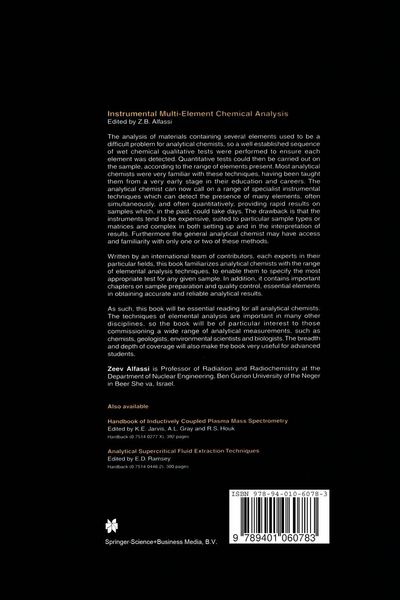
• Produktbild: Instrumental Multi-Element Chemical Analysis
  • Produktbild: Instrumental Multi-Element Chemical Analysis
- 12%

Instrumental Multi-Element Chemical Analysis

12% sparen

79,99 € UVP 90,94 €

inkl. gesetzl. MwSt., Versandkostenfrei

Lieferung nach Hause

Beschreibung

Produktdetails

Einband

Taschenbuch

Erscheinungsdatum

28.10.2012

Herausgeber

Z.B. Alfassi

Verlag

Springer Netherland

Seitenzahl

506

Maße (L/B/H)

23,5/15,5/2,9 cm

Gewicht

808 g

Auflage

Softcover reprint of the original 1st ed. 1998

Sprache

Englisch

ISBN

978-94-010-6078-3

Beschreibung

Produktdetails

Einband

Taschenbuch

Erscheinungsdatum

28.10.2012

Herausgeber

Z.B. Alfassi

Verlag

Springer Netherland

Seitenzahl

506

Maße (L/B/H)

23,5/15,5/2,9 cm

Gewicht

808 g

Auflage

Softcover reprint of the original 1st ed. 1998

Sprache

Englisch

ISBN

978-94-010-6078-3

Herstelleradresse

Springer-Verlag GmbH
Tiergartenstr. 17
69121 Heidelberg
DE

Email: [email protected]

Kundinnen und Kunden meinen

0 Bewertungen

Informationen zu Bewertungen

Zur Abgabe einer Bewertung ist eine Anmeldung im Konto notwendig. Die Authentizität der Bewertungen wird von uns nicht überprüft. Wir behalten uns vor, Bewertungstexte, die unseren Richtlinien widersprechen, entsprechend zu kürzen oder zu löschen.

Die Bewertungen sind nach Format, Anzahl Sterne und Datum sortiert.

Verfassen Sie die erste Bewertung zu diesem Artikel

Helfen Sie anderen Kund*innen durch Ihre Meinung

Kundinnen und Kunden meinen

0 Bewertungen filtern

  • Produktbild: Instrumental Multi-Element Chemical Analysis
  • Produktbild: Instrumental Multi-Element Chemical Analysis
  • 1 Preparation of samples.- 1.1 Introduction.- 1.2 Dissolution of geological and environmental inorganic samples.- 1.3 Dissolution of biological (organic) material.- 1.4 Contamination from reagents and equipment.- References.- 2 Separation and preconcentration of trace inorganic elements.- 2.1 Introduction.- 2.2 Precipitation.- 2.3 Separation and preconcentration of trace elements by columns (ion exchange and sorption).- 2.4 Preconcentration of trace elements by solvent extraction.- 2.5 Preconcentration by formation of volatile compounds.- 2.6 Electrochemical preconcentration.- References.- 3 Quality assurance, control and assessment.- 3.1 Introduction.- 3.2 Quality assessment.- 3.3 Statistical methods.- 3.4 Significance tests.- 3.5 Errors in instrumental analysis—calibration lines.- References.- 4 Activation analysis.- 4.1 Introduction.- 4.2 Nuclear structure.- 4.3 Nuclear reactions.- 4.4 Decay rates.- 4.5 Irradiation sources.- 4.6 Detection and measurement of radiation.- 4.7 Activation analysis techniques.- 4.8 Special activation analysis methods.- 4.9 Exercises and solutions.- References.- 5 Inductively coupled plasma optical emission and mass speetrometry.- 5.1 Inductively coupled plasma as an analytical source.- 5.2 Inductively coupled plasma optical emission spectrometry.- 5.3 Inductively coupled plasma mass spectrometry.- 5.4 Sample introduction.- References.- 6 Electroanalytical methods.- 6.1 Introduction.- 6.2 Fundamentals.- 6.3 Potentiometry.- 6.4 Conductometry.- 6.5 Electrogravimetry and coulometry.- 6.6 Voltammetry and amperometry.- References.- 7 Atomic absorption spectrometry.- 7.1 Introduction.- 7.2 Theory.- 7.3 Major components and instrument types.- 7.4 Atomization.- 7.5 Hydride generation.- 7.6 Interferences.- 7.7 Instrumental background corrections.-7.8 Modifiers, standards and chemicals.- 7.9 Sample preparation and automation.- References.- 8 X-ray fluorescence analysis.- 8.1 Introduction.- 8.2 Wavelength- and energy-dispersive XRF.- 8.3 X-ray tubes and radioisotope sources.- 8.4 Methods of quantitative analysis.- 8.5 Scattered radiation.- 8.6 Electron probe micro-analysis.- 8.7 Other XRF techniques.- 8.8 Examples.- 8.9 Appendix.- References.- 9 Analysis of ions using high-performance liquid chromatography.- 9.1 What is ion chromatography?.- 9.2 Fundamentals of the Chromatographic process.- 9.3 Principles of the separation.- 9.4 Types of stationary phases.- 9.5 Properties of mobile phases.- 9.6 Ion suppression in ion chromatography.- 9.7 Detection in ion chromatography.- 9.8 Applications—summary.- References.- 10 Scattering methods.- 10.1 Introduction.- 10.2 Theoretical considerations.- 10.3 The experimental arrangement.- 10.4 Spectrum analysis.- 10.5 Numerical methods.- 10.6 Applications to elemental analysis.- References.- 11 Elemental analysis of surfaces.- 11.1 Introduction: overview of surface phenomena and major techniques.- 11.2 Auger electron spectroscopy and X-ray photoelectron spectroscopy.- 11.3 Secondary-ion mass spectrometry.- 11.4 Comparative evaluation of the performance of the three techniques.- 11.5 Summary.- References.