
• Produktbild: Innovative Earthquake Soil Dynamics
  • Produktbild: Innovative Earthquake Soil Dynamics
- 17%

Innovative Earthquake Soil Dynamics

17% sparen

62,99 € UVP 76,30 €

inkl. gesetzl. MwSt., Versandkostenfrei

Lieferung nach Hause

Beschreibung

Produktdetails

Einband

Taschenbuch

Erscheinungsdatum

30.06.2020

Verlag

Taylor & Francis

Seitenzahl

506

Maße (L/B/H)

24,6/17,4/2,7 cm

Gewicht

940 g

Sprache

Englisch

ISBN

978-0-367-57332-4

Beschreibung

Rezension


"The book Innovative Earthquake Soil Dynamics is very appropriately titled and reflects the unique background and extensive expertise of the author, Dr. Takaji Kokusho, Emeritus Professor, Chuo University, Tokyo, Japan. The book is composed of six chapters that can be grouped into four categories: background material (Chapters 1-3), site amplification and dynamic soil-structure-interaction (Chapter 4), liquefaction and related phenomena (Chapter 5), and earthquake-induced slope failure (Chapter 6). The background material presented in Chapters 1-3 gives an in depth coverage of elastic wave propagation in soil, dynamic soil properties, and soil modeling and sets the stage for the topics covered in the latter chapters.

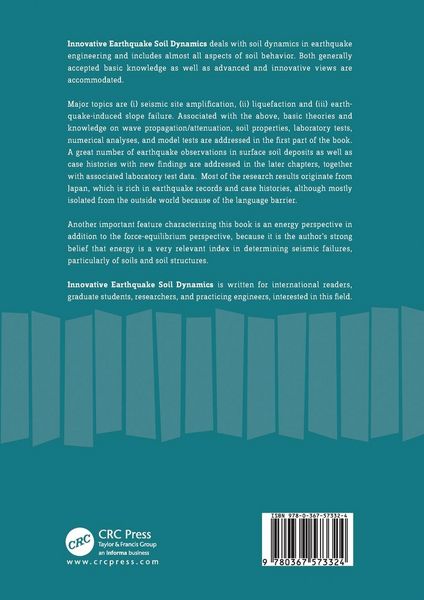
Innovative Earthquake Soil Dynamics is unique from other books on geotechnical aspects of earthquake engineering in that it includes a detailed coverage of soil dynamics, as related to earthquake engineering, in addition to the oft-presented empirical relationships. The book is innovative in that it presents the material from both "traditional" (e.g., stress-, strain-, and force-based perspectives) and "energy" perspectives, with the latter largely derived from the author's own extensive research. The author shows that energy is central to site amplification and dynamic soil-structure-interaction and can be used as a simple index for evaluating liquefaction and related phenomena and earthquake-induced slope failures.

Another unique aspect of Innovative Earthquake Soil Dynamics stems from the author having received his higher education in both the United States (Duke University) and Japan (University of Tokyo), and having spent the first half of his career working for the electric power industry in Japan and the second half of his career as a professor at Chuo University. As a result, the material presented in the book reflects research and engineering procedures from both Japan and the United States, as well as other countries, and all the material presented builds to applications in engineering practice. The book is equally suited to serve as a text for graduate courses in geotechnical aspects of earthquake engineering and soil dynamics or as a reference book for practicing engineers."

Russell A. Green, Professor of Civil and Environmental Engineering at Virginia Tech, Blacksburg, Virginia, USA.

Produktdetails

Einband

Taschenbuch

Erscheinungsdatum

30.06.2020

Verlag

Taylor & Francis

Seitenzahl

506

Maße (L/B/H)

24,6/17,4/2,7 cm

Gewicht

940 g

Sprache

Englisch

ISBN

978-0-367-57332-4

Kundinnen und Kunden meinen

0 Bewertungen

Informationen zu Bewertungen

Zur Abgabe einer Bewertung ist eine Anmeldung im Konto notwendig. Die Authentizität der Bewertungen wird von uns nicht überprüft. Wir behalten uns vor, Bewertungstexte, die unseren Richtlinien widersprechen, entsprechend zu kürzen oder zu löschen.

Die Bewertungen sind nach Format, Anzahl Sterne und Datum sortiert.

Verfassen Sie die erste Bewertung zu diesem Artikel

Helfen Sie anderen Kund*innen durch Ihre Meinung

Kundinnen und Kunden meinen

0 Bewertungen filtern

Die Leseprobe wird geladen.
  • Produktbild: Innovative Earthquake Soil Dynamics
  • Produktbild: Innovative Earthquake Soil Dynamics
  • Preface

    Chapter 1. Elastic wave propagation in soil

    1.1. Introduction

    1.2. One-dimensional wave propagation and wave energy

    1.3. Three-dimensional body waves

    1.4. Surface waves

    1.5. Viscoelastic model and soil damping for wave propagation

    1.6. Wave attenuation by internal damping

    1.7. Wave attenuation including geometric damping

    1.8. Summary

    Chapter 2. Soil properties during earthquakes

    2.1. Characterization of dynamic soil properties

    2.2. How to measure soil properties

    2.3. Typical small strain properties

    2.4. Strain-dependent equivalent linear properties

    2.5. Summary

    Chapter 3. Soil modeling for dynamic analysis and scaled model test

    3.1. Modeling of soil properties

    3.2. Dynamic soil analyses

    3.3. Scaled model tests and soil model

    3.4. Summary

    Chapter 4. Seismic site amplification and wave energy

    4.1. Soil condition and site amplification

    4.2. Amplification in two-layer system

    4.3. Site amplification by earthquake observation

    4.4. Site amplification derived from vertical array records

    4.5. SSI and radiation damping in one-dimensional wave propagation

    4.6. Energy flow in wave propagation

    4.7. Summary

    Chapter 5. Liquefaction

    5.1. Typical Liquefaction Behavior

    5.2. General conditions for liquefaction triggering

    5.3. Geotechnical conditions for liquefaction triggering

    5.4. Effect of gravels and fines

    5.5. Liquefaction potential evaluation by in situ tests

    5.6. Energy-based liquefaction potential evaluation

    5.7. Effect of incomplete saturation

    5.8. Effect of initial shear stress

    5.9. Cyclic softening of clayey soils

    5.10. Liquefaction-induced failure and associated mechanism

    5.11. Base-isolation during liquefaction

    5.12. Summary

    Chapter 6. Earthquake-induced slope failures

    6.1. Slip-surface analysis by seismic coefficient

    6.2. Newmark method

    6.3. Self-weight deformation analysis using degraded moduli

    6.4. Energy-based slope failure evaluation

    6.5. Case histories and back-calculations by energy-based method

    6.6. Summary