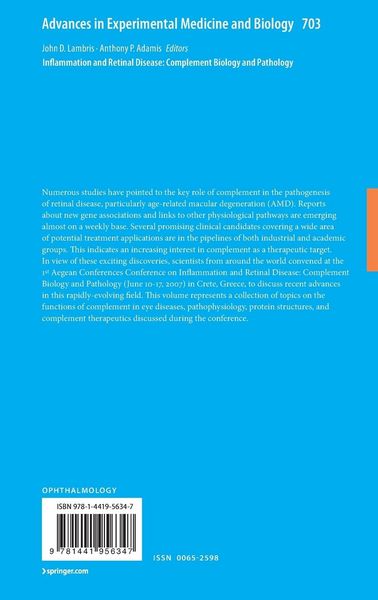
• Produktbild: Inflammation and Retinal Disease: Complement Biology and Pathology
  • Produktbild: Inflammation and Retinal Disease: Complement Biology and Pathology
Band 703 - 13%

Inflammation and Retinal Disease: Complement Biology and Pathology

13% sparen

185,99 € UVP 213,99 €

inkl. MwSt, Versandkostenfrei

Lieferung nach Hause

Beschreibung

Details

Einband

Gebundene Ausgabe

Erscheinungsdatum

25.08.2010

Herausgeber

John D. Lambris + weitere

Verlag

Springer Us

Seitenzahl

170

Maße (L/B/H)

24,1/16/1,7 cm

Gewicht

481 g

Auflage

2010

Sprache

Englisch

ISBN

978-1-4419-5634-7

Beschreibung

Details

Einband

Gebundene Ausgabe

Erscheinungsdatum

25.08.2010

Herausgeber

Verlag

Springer Us

Seitenzahl

170

Maße (L/B/H)

24,1/16/1,7 cm

Gewicht

481 g

Auflage

2010

Sprache

Englisch

ISBN

978-1-4419-5634-7

Herstelleradresse

Springer-Verlag KG
Sachsenplatz 4-6
1201 Wien
AT

Email: ProductSafety@springernature.com

Weitere Bände von Advances in Experimental Medicine and Biology

Weitere Bände von Advances in Experimental Medicine and Biology

Unsere Kundinnen und Kunden meinen

0 Bewertungen

Informationen zu Bewertungen

Zur Abgabe einer Bewertung ist eine Anmeldung im Konto notwendig. Die Authentizität der Bewertungen wird von uns nicht überprüft. Wir behalten uns vor, Bewertungstexte, die unseren Richtlinien widersprechen, entsprechend zu kürzen oder zu löschen.

Verfassen Sie die erste Bewertung zu diesem Artikel

Helfen Sie anderen Kund*innen durch Ihre Meinung

Unsere Kundinnen und Kunden meinen

0 Bewertungen filtern

  • Produktbild: Inflammation and Retinal Disease: Complement Biology and Pathology
  • Produktbild: Inflammation and Retinal Disease: Complement Biology and Pathology
  • Preface

    Contributors

    1. The Case for Complement and Inflammation in AMD: Open Questions
    Natalia Karagianni and Anthony P. Adamis

    Abstract
    1. Introduction
    2 Drusen
    3. Geographic Atrophy
    4. Choroidal Neovascularization
    References

    2. The Role of Complement in AMD
    Peter F. Zipfel, Nadine Lauer and Christine Skerka

    Abstract
    1 Age-related macular degeneration
    1.1 The disease
    1.2 AMD - a chronic inflammatory disease
    2 Age-related macular degeneration – a genetic disorder
    3 Effect of the reported SNPs for protein function
    3.1 Factor H and other Complement Proteins
    3.1.1 Factor H and FHL1
    3.1.2 Complement Factor H related proteins (CFHRs)
    3.1.3 Other Complement proteins associated with AMD: C2, Factor B and C3
    3.2. Gene products of the chromosome 10q26: ARMS-2 and HRTA1
    4 Lessons learned from rare disorders (HUS, MPGN)
    5 Outlook
    References

    3. Multiple interactions of complement factor H with its ligands in solution: a progress report
    Stephen J Perkins, Ruodan Nan, Azubuike I. Okemefuna, Keying Li, Sanaullah Khan and Ami Miller

    Abstract
    1. Complement Factor H
    2. Structure of Factor H
    3. Self-association of Factor H
    5. Interaction of Factor H with C-reactive protein
    6. Interaction of Factor H with heparin
    7. Interaction of Factor H with C3d
    8. Conclusions and Future Considerations
    References

    4. Genetic Control of Complement Activation in Humans and Age Related Macular Degeneration
    Laura A. Hecker, and Albert O. Edwards

    Abstract
    1.Genes associated with AMD
    2. Non-genetic factors increasing the risk of AMD
    3. Complement proteins and AMD
    4. Conclusions
    References

    5. Bisretinoids of RPE Lipofuscin: Trigger for Complement Activation in Age-Related Macular Degeneration
    Janet R. Sparrow

    Abstract
    1 RPE Lipofuscin and Macular Degeneration
    2 Age-related Macular Degeneration and the Complement System
    3 Complement Activation by Photoproducts of the RPE Bisretinoid A2E
    4 Complement Activation by Oxidized all-trans-retinal-dimer
    5 Complement Activation by BisretinoidPhotoproducts is Dependent on Factor B
    6 C-Reactive Protein Modulates Complement Activation by RPE Bisretinoids
    7 Suppression by POT-3, a C3 Cleavage Inhibitor
    8 Summary
    9 Acknowledgements
    References

    6. The Role of the Classical Complement Cascade in Synapse Loss during Development and Glaucoma
    Allison M Rosen and Beth Stevens

    Abstract
    1 Introduction
    2 Current Opinion on Glaucoma
    3 Animal models of glaucoma
    4 Pathological progression of glaucoma
    5 Role of Glial Activation in Glaucoma
    6 Inflammation and enhanced cytokine production in glaucoma
    7 Complement Cascade Upregulation and Activation in Glaucoma
    8 Parallels between Complement-mediated Synapse Elimination and Synapses
    9 Conclusions and Perspecitves
    Acknowledgment
    References:

    7. A Role for Complement in Glaucoma?
    Lizhen Ren, John Danias

    Abstract
    1 Introduction
    2 Complement and glaucoma

    8. The ATP-binding Cassette Transporter ABCA4: Structural and Functional Properties and Role in Retinal Disease
    Yaroslav Tsybovsky, Robert S. Molday and Krzysztof Palczewski

    Abstract
    1 Introduction to ABC Transporters
    2 Human ABC Transporters
    3 ABCA4 and Vision Diseases
    4 Molecular View of ABCA4
    4.1 Primary Structure
    4.2 Localization
    4.3 Insights into Topology, Structure and Posttranslational Modifications
    4.4 Structural Features of Individual Domains
    5 Biological Role of ABCA4
    5.1 Identification of Substrate: Biochemical Evidence
    5.2 Proposed General Model of Transport
    5.3 Abca4 Knockout Mice
    5.4 Proposed Role of ABCA4 in the Visual Cycle
    5.5 Unresolved Issues
    6 ABCA4 Mutations and Autosomal Recessive Macular Degeneration
    7 Conclusions
    References

    9. Suppression of Drusen Formation by Compstatin, a Peptide Inhibitor of Complement C3 activation, on Cynomolgus Monkey with Early-Onset Macular Degeneration
    Zai-Long Chi, Tsunehiko Yoshida, John Lambris, and Takeshi Iwata

    Abstract
    1 AMD and association of complement related genes
    2 Activated complement component in drusen
    3 Cynomolgus monkey with early-onset macular degene