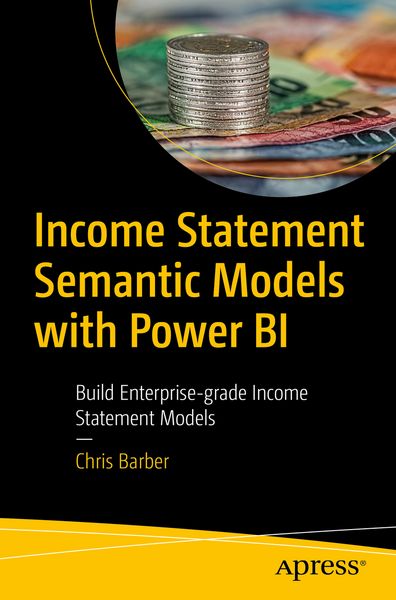
Income Statement Semantic Models Building Enterprise-Grade Income Statement Models with Power BI
-
- Taschenbuch ausgewählt
- eBook
-
Sprache:Englisch
49,99 €
inkl. gesetzl. MwSt.,
Lieferung nach Hause
Beschreibung
Produktdetails
Einband
Taschenbuch
Erscheinungsdatum
29.08.2024
Verlag
ApressSeitenzahl
433
Maße (L/B/H)
23,5/15,5/2,6 cm
Gewicht
703 g
Auflage
1. Auflage
Sprache
Englisch
EAN
9798868803291
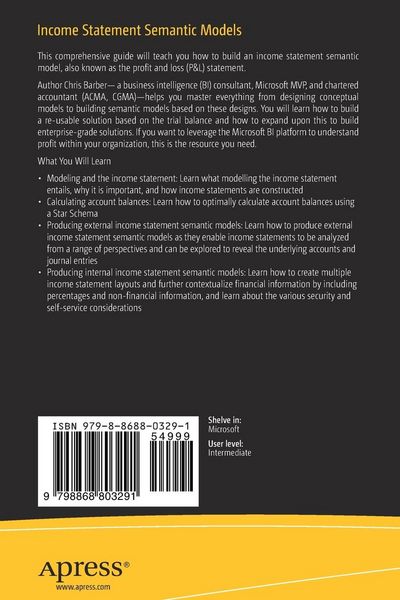
This comprehensive guide will teach you how to build an income statement semantic model, also known as the profit and loss (P&L) statement.
Author Chris Barber— a business intelligence (BI) consultant, Microsoft MVP, and chartered accountant (ACMA, CGMA)—helps you master everything from designing conceptual models to building semantic models based on these designs. You will learn how to build a re-usable solution based on the trial balance and how to expand upon this to build enterprise-grade solutions. If you want to leverage the Microsoft BI platform to understand profit within your organization, this is the resource you need.
What You Will Learn
- Modeling and the income statement: Learn what modelling the income statement entails, why it is important, and how income statements are constructed
- Calculating account balances: Learn how to optimally calculate account balances using a Star Schema
- Producing external income statement semantic models: Learn how to produce external income statement semantic models as they enable income statements to be analyzed from a range of perspectives and can be explored to reveal the underlying accounts and journal entries
- Producing internal income statement semantic models: Learn how to create multiple income statement layouts and further contextualize financial information by including percentages and non-financial information, and learn about the various security and self-service considerations
Who This Book Is For
Technical users (solution architects, Microsoft Fabric developers, Power BI developers) who require a comprehensive methodology for income statement semantic models because of the modeling complexities and knowledge needed of the accounting process; and finance (management accountants) who have hit the limits of Excel and have started using Power BI, but are unsure how income statement semantic models are built
Kundinnen und Kunden meinen
Verfassen Sie die erste Bewertung zu diesem Artikel
Helfen Sie anderen Kund*innen durch Ihre Meinung
Kurze Frage zu unserer Seite
Vielen Dank für dein Feedback
Wir nutzen dein Feedback, um unsere Produktseiten zu verbessern. Bitte habe Verständnis, dass wir dir keine Rückmeldung geben können. Falls du Kontakt mit uns aufnehmen möchtest, kannst du dich aber gerne an unseren Kund*innenservice wenden.
zum Kundenservice