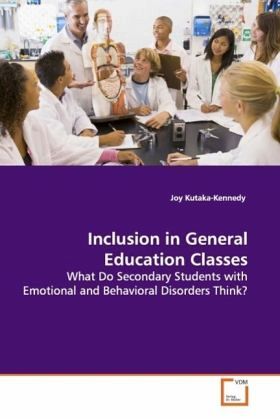
Inclusion in General Education Classes
What Do Secondary Students with Emotional and Behavioral Disorders Think?
Versandkostenfrei!
Versandfertig in 6-10 Tagen
39,99 €
inkl. MwSt.

PAYBACK Punkte
20 °P sammeln!

The growing trend of inclusion affects students with emotional and behavioral disorders (EBD) who often have great difficulty and fail in general education. This study examines the perceptions and opinions of secondary EBD students on their inclusive experiences. Students completed a survey on ideal practices they would like from general and special educators followed by a survey on actual experiences. They described the advantages and challenges of inclusion, ending with recommendations for teachers. Major findings indicate that EBD students fell into two groups: high-achieving or low-functio...
The growing trend of inclusion affects students with
emotional and behavioral disorders (EBD) who often
have great difficulty and fail in general
education. This study examines the perceptions and
opinions of secondary EBD students on their
inclusive experiences. Students completed a survey
on ideal practices they would like from general and
special educators followed by a survey on
actual experiences. They described the advantages
and challenges of inclusion, ending with
recommendations for teachers. Major findings
indicate that EBD students fell into two groups:
high-achieving or low-functioning. High-achieving
students wanted accommodations to help them succeed
academically, while low-functioning students wanted
no accommodations to maximize their similarity to
general education peers. Both groups wanted support
from teachers, albeit in different ways. High
achieving students wanted help to really function
like their general education peers; low functioning
students wanted to just look like their general
education peers. Both groups wanted to avoid
embarrassment while learning and socializing with
peers without disabilities.
emotional and behavioral disorders (EBD) who often
have great difficulty and fail in general
education. This study examines the perceptions and
opinions of secondary EBD students on their
inclusive experiences. Students completed a survey
on ideal practices they would like from general and
special educators followed by a survey on
actual experiences. They described the advantages
and challenges of inclusion, ending with
recommendations for teachers. Major findings
indicate that EBD students fell into two groups:
high-achieving or low-functioning. High-achieving
students wanted accommodations to help them succeed
academically, while low-functioning students wanted
no accommodations to maximize their similarity to
general education peers. Both groups wanted support
from teachers, albeit in different ways. High
achieving students wanted help to really function
like their general education peers; low functioning
students wanted to just look like their general
education peers. Both groups wanted to avoid
embarrassment while learning and socializing with
peers without disabilities.
Andere Kunden interessierten sich für