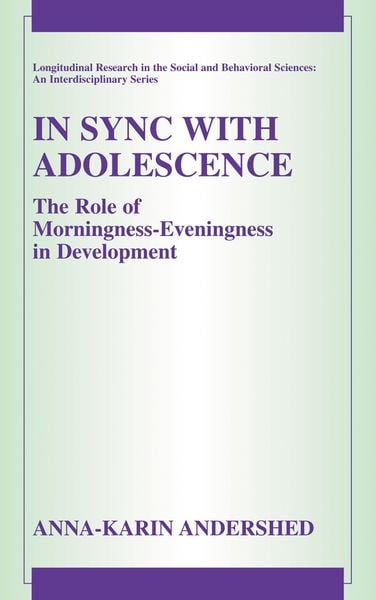
In Sync with Adolescence The Role of Morningness-Eveningness in Development
-
- Hardcover ausgewählt
- Taschenbuch
- eBook
-
Sprache:Englisch
128,99 €
inkl. gesetzl. MwSt.,
Lieferung nach Hause
Beschreibung
Produktdetails
Einband
Gebundene Ausgabe
Erscheinungsdatum
07.01.2005
Verlag
Springer UsSeitenzahl
184
Maße (L/B/H)
24/15,9/1,7 cm
Gewicht
452 g
Auflage
2005
Sprache
Englisch
ISBN
978-0-387-22417-6
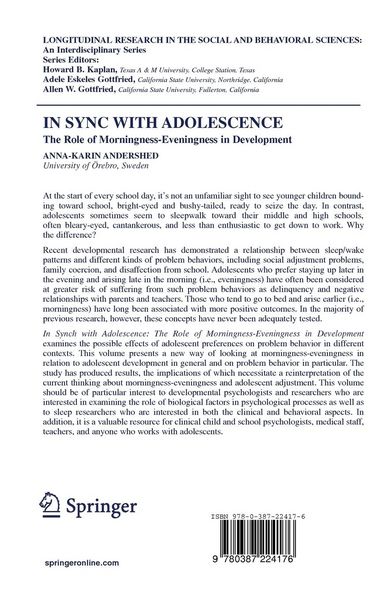
At the start of every school day, it’s not an unfamiliar sight to see younger children bounding toward school, bright-eyed and bushy-tailed, ready to seize the day. In contrast, adolescents sometimes seem to sleepwalk toward their middle and high schools, often bleary-eyed, cantankerous, and less than enthusiastic to get down to work. Why the difference?
Recent developmental research has demonstrated a relationship between sleep/wake patterns and different kinds of problem behaviors, including social adjustment problems, family coercion, and disaffection from school. Adolescents who prefer staying up later in the evening and arising late in the morning (i.e., eveningness) have often been considered at greater risk of suffering from such problem behaviors as delinquency and negative relationships with parents and teachers. Those who tend to go to bed and arise earlier (i.e., morningness) have long been associated with more positive outcomes. In the majority of previous research, however, these concepts have never been adequately tested.
In Sync with Adolescence: The Role of Morningness-Eveningness in Development examines the possible effects of adolescent preferences on problem behavior in different contexts. This volume presents a new way of looking at morningness-eveningness in relation to adolescent development in general and on problem behavior in particular. The study has produced results, the implications of which necessitate a reinterpretation of the current thinking about morningness-eveningness and adolescent adjustment.
This volume should be of particular interest to developmental psychologists and researchers who are interested in examining the role of biological factors in psychological processes as well as to sleep researchers who are interested in both the clinical and behavioral aspects. In addition, it is a valuable resource for clinical child and school psychologists, medical staff,teachers, and anyone who works with adolescents.
Kundinnen und Kunden meinen
Verfassen Sie die erste Bewertung zu diesem Artikel
Helfen Sie anderen Kund*innen durch Ihre Meinung
Kurze Frage zu unserer Seite
Vielen Dank für dein Feedback
Wir nutzen dein Feedback, um unsere Produktseiten zu verbessern. Bitte habe Verständnis, dass wir dir keine Rückmeldung geben können. Falls du Kontakt mit uns aufnehmen möchtest, kannst du dich aber gerne an unseren Kund*innenservice wenden.
zum Kundenservice