Gutscheinbedingungen

**Gültig vom 15.06.2026 bis 17.06.2026 | Gültig für nicht preisgebundene fremdsprachige Bücher | Einzelne Artikel können ausgeschlossen sein | Maximaler rabattfähiger Warenkorbwert 500 € | Nicht kombinierbar mit weiteren Aktionen | Nur einmal pro Person einlösbar | Nur solange der Vorrat reicht

Produktbild: Human-Computer Creativity
- 19%

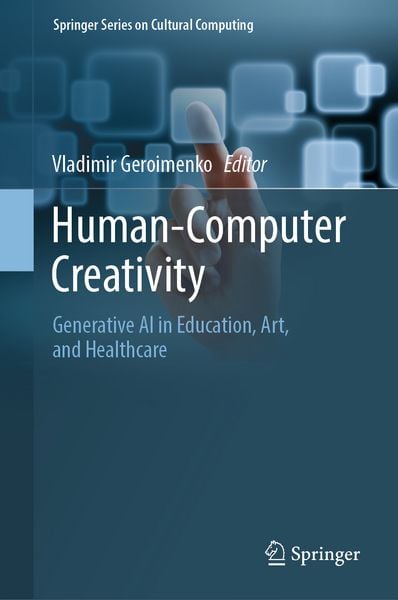
Human-Computer Creativity Generative AI in Education, Art, and Healthcare

19% sparen

189,99 € UVP 235,39 €

inkl. gesetzl. MwSt., Versandkostenfrei

Lieferung nach Hause

Beschreibung

Produktdetails

Einband

Gebundene Ausgabe

Erscheinungsdatum

17.06.2025

Abbildungen

XXIV, 56 illus., 50 illus. in color., farbige Illustrationen, schwarz-weiss Illustrationen

Herausgeber

Vladimir Geroimenko

Verlag

Springer

Seitenzahl

382

Maße (L/B/H)

24,1/16/2,8 cm

Gewicht

774 g

Sprache

Englisch

ISBN

978-3-031-86550-3

Beschreibung

Portrait

Dr Vladimir Geroimenko is a Professor at the Faculty of Informatics and Computer Science at the British University in Egypt, Cairo.  He has edited and authored 23 books, 16 of which have been published by Springer. His most recent research monographs include: “Augmented and Virtual Reality in the Metaverse”, Springer, 2024; “Augmented Reality and Artificial Intelligence: The Fusion of Advanced Technologies”, Springer, 2023; “Augmented Reality Art: From an Emerging Technology to a Novel Creative Medium”, 3rd Edition, Springer, 2022; “Augmented Reality in Tourism, Museums and Heritage: A New Technology to Inform and Entertain”, Springer, 2021; “Augmented Reality in Education: A New Technology for Teaching and Learning”, Springer, 2020; “Augmented Reality Games I: Understanding the Pokémon GO Phenomenon”, Springer, 2019; “Augmented Reality Games II: The Gamification of Education, Medicine and Art”, Springer, 2019.

Dr Geroimenko received his MSc degree in Physics and Mathematics from Vitebsk State University, Belarus (1976), PhD degree in the Methodology of Science from Belarusian Academy of Sciences, Minsk (1982) and a higher DSc (Doctor of Science) degree in Cognitive Sciences from Belarusian State University, Minsk (1990).  From 1982 to 1998, he worked at the Belarusian Academy of Sciences. From 1991 to 1993, he was a Research Fellow of the Alexander von Humboldt Foundation at the Ruhr-University Bochum, Germany and from 1995 to 1998 – he was Visiting Professor at the SSKKII Centre for Cognitive Science, Goteborg University & Chalmers University of Technology, Sweden. In September 1998, he joined the University of Plymouth, UK, as a Reader in Multimedia and Web Technology. In September 2016, he joined the British University in Egypt as a Professor of Informatics and Computer Science.

Dr Geroimenko is also a digital artist and short story writer. A British citizen since 2002, he was born in the Vitebsk Region of Belarus, the legendary birthplace of Mark Chagall. Since 1995, he has been experimenting with different types of digital art. His limited-edition prints are in private collections in Australia, Brazil, Canada, Finland, France, Germany, Holland, Japan, Malta, Mexico, Russia, Spain, Switzerland, the UK, and the USA. In 2013, he published the book “A Bottle of Plymouth Gin: 12 Detective Stories Set in Devon and Cornwall”, which features 12 mysterious cases rooted in the lore of two of the most beautiful British counties. More than 60 of his art books of digital, abstract, and surrealist paintings are available in Amazon Kindle stores worldwide.

Produktdetails

Einband

Gebundene Ausgabe

Erscheinungsdatum

17.06.2025

Abbildungen

XXIV, 56 illus., 50 illus. in color., farbige Illustrationen, schwarz-weiss Illustrationen

Herausgeber

Vladimir Geroimenko

Verlag

Springer

Seitenzahl

382

Maße (L/B/H)

24,1/16/2,8 cm

Gewicht

774 g

Sprache

Englisch

ISBN

978-3-031-86550-3

Herstelleradresse

Springer-Verlag GmbH
Tiergartenstr. 17
69121 Heidelberg
DE

Email: ProductSafety@springernature.com

Kundinnen und Kunden meinen

0 Bewertungen

Informationen zu Bewertungen

Zur Abgabe einer Bewertung ist eine Anmeldung im Konto notwendig. Die Authentizität der Bewertungen wird von uns nicht überprüft. Wir behalten uns vor, Bewertungstexte, die unseren Richtlinien widersprechen, entsprechend zu kürzen oder zu löschen.

Die Bewertungen sind nach Format, Anzahl Sterne und Datum sortiert.

Verfassen Sie die erste Bewertung zu diesem Artikel

Helfen Sie anderen Kund*innen durch Ihre Meinung

Kundinnen und Kunden meinen

0 Bewertungen filtern

  • Produktbild: Human-Computer Creativity
  • Part 1: Conceptual facets of generative AI and human-computer creativity.- Generative AI: From human-computer interaction to human-computer creativity.- Emerging paradigms in human-AI creativity: From visualisation to biofeedback in adaptive interfaces.- Creativity in the age of AI: Comparing human and machine performance using standardized tests.- The role of AI in transforming educational models: A critical analysis of opportunities and challenges.- Part 2: Generative AI and creativity in education.- Transforming education: The potential of generative AI tools for improving learning experience.- Enhancing digital pedagogy and creativity: Generative AI, video avatars, and personalized learning in online education.- Creative learning using generative AI: Empowering problem-solving and programming skills.- Generative AI applications in education: A low-code/no-code approach.- Generative AI and digital twins: Fostering creativity in learning environments.- Part 3: Generative AI and creativity in art.- Generative AI and the evolution of artistic creativity.- The Next-GenAI-rtists: A new generation of artists with generative tools.- Augmented creativity: Augmenting the archaeological imagination with generative AI tools.- Artist-computer collaboration and the treachery of AI images: This pipe does not exist.- Disrupting scholarly writing creatively using large language models.- Part 4: Generative AI and creativity in healthcare.- Human doctors vs AI models: Advice perceptions in Serbia, Kazakhstan, and Kyrgyzstan.- AI technology in psychological education and treatment: An overview of practical and creative applications.- Generative AI hallucinations in healthcare: A challenge for prompt engineering and creativity.- Dentistry in the digital age: Exploring human-computer creativity in dental education and practice.- Generative AI with quantum computing for visualizing proteins in mixed reality.- Concluding remarks.