

History of Wireless
165,99 €
inkl. MwSt,
Lieferung nach Hause
Beschreibung
Details
Einband
Gebundene Ausgabe
Erscheinungsdatum
01.12.2005
Verlag
John Wiley & Sons IncSeitenzahl
688
Maße (L/B/H)
24/16,1/4,1 cm
Gewicht
1039 g
Auflage
1. Auflage
Sprache
Englisch
ISBN
978-0-471-71814-7
Premised on the idea that one cannot know a science without knowing its history, History of Wireless offers a lively new treatment that introduces previously unacknowledged pioneers and developments, setting a new standard for understanding the evolution of this important technology.
Starting with the background-magnetism, electricity, light, and Maxwell's Electromagnetic Theory-this book offers new insights into the initial theory and experimental exploration of wireless. In addition to the well-known contributions of Maxwell, Hertz, and Marconi, it examines work done by Heaviside, Tesla, and passionate amateurs such as the Kentucky melon farmer Nathan Stubblefield and the unsung hero Antonio Meucci. Looking at the story from mathematical, physics, technical, and other perspectives, the clearly written text describes the development of wireless within a vivid scientific milieu.
History of Wireless also goes into other key areas, including:
* The work of J. C. Bose and J. A. Fleming
* German, Japanese, and Soviet contributions to physics and applications of electromagnetic oscillations and waves
* Wireless telegraphic and telephonic development and attempts to achieve transatlantic wireless communications
* Wireless telegraphy in South Africa in the early twentieth century
* Antenna development in Japan: past and present
* Soviet quasi-optics at near-mm and sub-mm wavelengths
* The evolution of electromagnetic waveguides
* The history of phased array antennas
Augmenting the typical, Marconi-centered approach, History of Wireless fills in the conventionally accepted story with attention to more specific, less-known discoveries and individuals, and challenges traditional assumptions about the origins and growth of wireless. This allows for a more comprehensive understanding of how various components and systems evolved. Written in a clear tone with a broad scientific audience in mind, this exciting and thorough treatment is sure to become a classic in the field.
Weitere Bände von Wiley Series in Microwave and Optical Engineering
-
History of Wireless von T. K. Sarkar
 Band 1
T. K. Sarkar
History of WirelessBuch
165,99 €
-
Advanced Chipless RFID von Nemai Chandra Karmakar

Nemai Chandra Karmakar
Advanced Chipless RFIDBuch
155,99 €
-
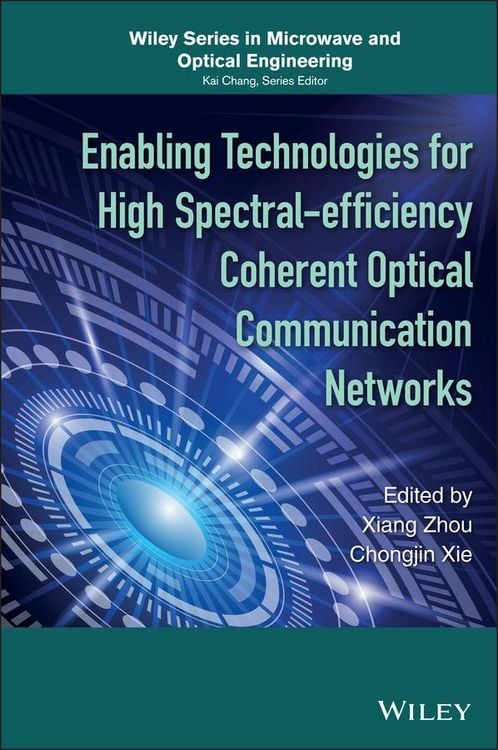
Enabling Technologies for High Spectral-efficiency Coherent Optical Communication Networks von Xiang Zhou
Xiang Zhou
Enabling Technologies for High Spectral-efficiency Coherent Optical Communication NetworksBuch
195,99 €
-
Fundamentals of Optical Fiber Sensors von Zujie Fang

Zujie Fang
Fundamentals of Optical Fiber SensorsBuch
152,99 €
-
Time and Frequency Domain Solutions of EM Problems Using Integral Equations and a Hybrid Methodology von Baek Ho Jung

Baek Ho Jung
Time and Frequency Domain Solutions of EM Problems Using Integral Equations and a Hybrid MethodologyBuch
126,99 €
-
Solar Cells and Their Applications von Larry D. Partain

Larry D. Partain
Solar Cells and Their ApplicationsBuch
209,99 €
-
Parallel Solution of Integral Equation-Based EM Problems in the Frequency Domain von Yu Zhang

Yu Zhang
Parallel Solution of Integral Equation-Based EM Problems in the Frequency DomainBuch
159,99 €
-
Physics of Multiantenna Systems and Broadband Processing von T. K. Sarkar

T. K. Sarkar
Physics of Multiantenna Systems and Broadband ProcessingBuch
201,99 €
-
Adaptive Optics for Vision Science von Jason Porter

Jason Porter
Adaptive Optics for Vision ScienceBuch
271,99 €
-
Arithmetic and Logic in Computer Systems von Mi Lu

Mi Lu
Arithmetic and Logic in Computer SystemsBuch
144,99 €
-
Coplanar Waveguide Circuits, Components and Systems von Rainee N. Simons

Rainee N. Simons
Coplanar Waveguide Circuits, Components and SystemsBuch
213,99 €
-
RF and Microwave Wireless Systems von Kai Chang

Kai Chang
RF and Microwave Wireless SystemsBuch
216,99 €
Unsere Kundinnen und Kunden meinen
Verfassen Sie die erste Bewertung zu diesem Artikel
Helfen Sie anderen Kund*innen durch Ihre Meinung
Kurze Frage zu unserer Seite
Vielen Dank für dein Feedback
Wir nutzen dein Feedback, um unsere Produktseiten zu verbessern. Bitte habe Verständnis, dass wir dir keine Rückmeldung geben können. Falls du Kontakt mit uns aufnehmen möchtest, kannst du dich aber gerne an unseren Kund*innenservice wenden.
zum Kundenservice