
History and Precedent in Environmental Design
-
- Taschenbuch ausgewählt
- eBook
-
Sprache:Englisch
126,99 €
inkl. MwSt,
Lieferung nach Hause
Beschreibung
Details
Einband
Taschenbuch
Erscheinungsdatum
31.07.1990
Verlag
Springer UsSeitenzahl
540
Maße (L/B/H)
25,4/17,8/2,9 cm
Gewicht
907 g
Auflage
Softcover reprint of the original 1st ed. 1990
Sprache
Englisch
ISBN
978-0-306-43445-7
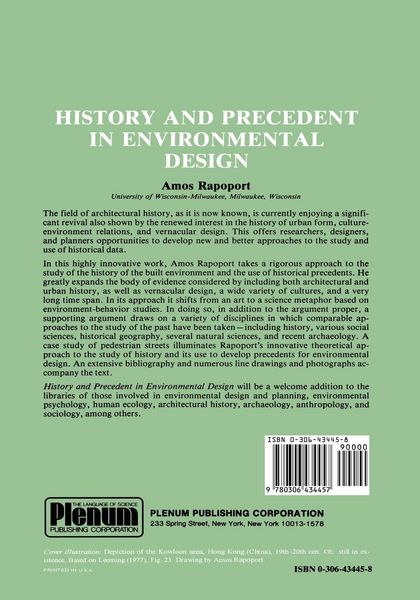
This book is about a new and different way of approaching and studying the history of the built environment and the use of historical precedents in design. However, although what I am proposing is new for what is currently called architectural history, both my approach and even my conclusions are not that new in other fields, as I discovered when I attempted to find supporting evidence. * In fact, of all the disciplines dealing with various aspects of the study of the past, architectural history seems to have changed least in the ways I am advocating. There is currently a revival of interest in the history of architecture and urban form; a similar interest applies to theory, vernacular design, and culture-environment relations. After years of neglect, the study of history and the use of historical precedent are again becoming important. However, that interest has not led to new approaches to the subject, nor have its bases been examined. This I try to do. In so doing, I discuss a more rigorous and, I would argue, a more valid way of looking at historical data and hence of using such data in a theory of the built environment and as precedent in environmental design. Underlying this is my view of Environment-Behavior Studies CEBS) as an emerging theory rather than as data to help design based on current "theory. " Although this will be the subject of another book, a summary statement of this position may be useful.
Unsere Kundinnen und Kunden meinen
Verfassen Sie die erste Bewertung zu diesem Artikel
Helfen Sie anderen Kund*innen durch Ihre Meinung
Kurze Frage zu unserer Seite
Vielen Dank für dein Feedback
Wir nutzen dein Feedback, um unsere Produktseiten zu verbessern. Bitte habe Verständnis, dass wir dir keine Rückmeldung geben können. Falls du Kontakt mit uns aufnehmen möchtest, kannst du dich aber gerne an unseren Kund*innenservice wenden.
zum Kundenservice