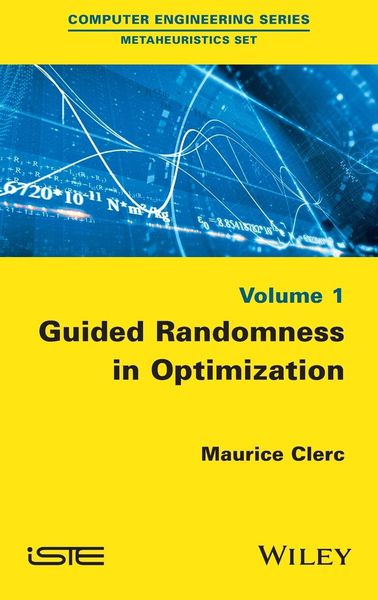
• Produktbild: Guided Randomness in Optimization, Volume 1
  • Produktbild: Guided Randomness in Optimization, Volume 1

Guided Randomness in Optimization, Volume 1

197,99 €

inkl. gesetzl. MwSt., Versandkostenfrei

Lieferung nach Hause

Beschreibung

Produktdetails

Einband

Gebundene Ausgabe

Erscheinungsdatum

15.06.2015

Verlag

Wiley

Seitenzahl

316

Maße (L/B/H)

24/16,1/2,2 cm

Gewicht

645 g

Sprache

Englisch

ISBN

978-1-84821-805-5

Beschreibung

Produktdetails

Einband

Gebundene Ausgabe

Erscheinungsdatum

15.06.2015

Verlag

Wiley

Seitenzahl

316

Maße (L/B/H)

24/16,1/2,2 cm

Gewicht

645 g

Sprache

Englisch

ISBN

978-1-84821-805-5

Herstelleradresse

Libri GmbH
Europaallee 1
36244 Bad Hersfeld
DE

Email: gpsr@libri.de

Kundinnen und Kunden meinen

0 Bewertungen

Informationen zu Bewertungen

Zur Abgabe einer Bewertung ist eine Anmeldung im Konto notwendig. Die Authentizität der Bewertungen wird von uns nicht überprüft. Wir behalten uns vor, Bewertungstexte, die unseren Richtlinien widersprechen, entsprechend zu kürzen oder zu löschen.

Die Bewertungen sind nach Format, Anzahl Sterne und Datum sortiert.

Verfassen Sie die erste Bewertung zu diesem Artikel

Helfen Sie anderen Kund*innen durch Ihre Meinung

Kundinnen und Kunden meinen

0 Bewertungen filtern

Die Leseprobe wird geladen.
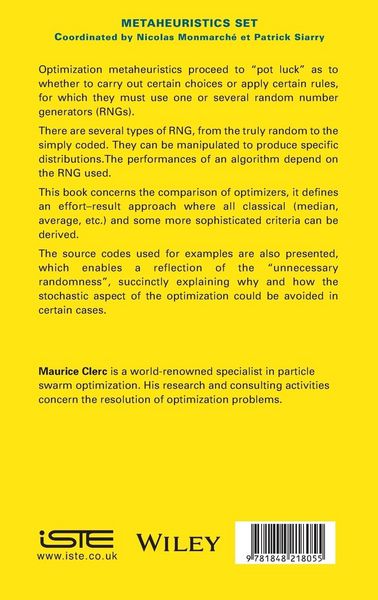
  • Produktbild: Guided Randomness in Optimization, Volume 1
  • Produktbild: Guided Randomness in Optimization, Volume 1
  • PREFACE xi

    INTRODUCTION xv

    PART 1. RANDOMNESS IN OPTIMIZATION  1

    CHAPTER 1. NECESSARY RISK 3

    1.1. No better than random search 3

    1.1.1. Uniform random search 4

    1.1.2. Sequential search 5

    1.1.3. Partial gradient 5

    1.2. Better or worse than random search 7

    1.2.1. Positive correlation problems 8

    1.2.2. Negative correlation problems 10

    CHAPTER 2. RANDOM NUMBER GENERATORS (RNGS) 13

    2.1. Generator types 14

    2.2. True randomness 15

    2.3. Simulated randomness 15

    2.3.1. KISS 16

    2.3.2. Mersenne-Twister 16

    2.4. Simplified randomness 17

    2.4.1. Linear congruential generators 18

    2.4.2. Additive 20

    2.4.3. Multiplicative 22

    2.5. Guided randomness 24

    2.5.1. Gaussian 24

    2.5.2. Bell 24

    2.5.3. Cauchy 27

    2.5.4. Lévy 28

    2.5.5. Log-normal 28

    2.5.6. Composite distributions 28

    CHAPTER 3. THE EFFECTS OF RANDOMNESS 33

    3.1. Initialization 34

    3.1.1. Uniform randomness 34

    3.1.2. Low divergence 36

    3.1.3. No Man's Land techniques 37

    3.2. Movement 37

    3.3. Distribution of the Next Possible Positions (DNPP) 40

    3.4. Confinement, constraints and repairs 42

    3.4.1. Strict confinement 44

    3.4.2. Random confinement 44

    3.4.3. Moderate confinement 45

    3.4.4. Reverse 45

    3.4.5. Reflection-diffusion 45

    3.5. Strategy selection 46

    PART 2. OPTIMIZER COMPARISON 49

    CHAPTER 4. ALGORITHMS AND OPTIMIZERS 53

    4.1. The Minimaliste algorithm 54

    4.1.1. General description 54

    4.1.2. Minimaliste in practice 54

    4.1.3. Use of randomness 57

    4.2. PSO 59

    4.2.1. Description 59

    4.2.2. Use of randomness 60

    4.3. APS 62

    4.3.1. Description 62

    4.3.2. Uses of randomness 65

    4.4. Applications of randomness 66

    CHAPTER 5. PERFORMANCE CRITERIA 69

    5.1. Eff-Res: construction and properties 69

    5.1.1. Simple example using random search 71

    5.2. Criteria and measurements 74

    5.2.1. Objective criteria 77

    5.2.2. Semi-subjective criteria 87

    5.3. Practical construction of an Eff-Res 94

    5.3.1. Detailed example: (Minimaliste, Alpine 2D) 95

    5.3.2. Qualitative interpretations 106

    5.4. Conclusion 108

    CHAPTER 6. COMPARING OPTIMIZERS 109

    6.1. Data collection and preprocessing 111

    6.2. Critical analysis of comparisons 114

    6.2.1. Influence of criteria and the number of attempts 115

    6.2.2. Influence of effort levels 115

    6.2.3. Global comparison 117

    6.2.4. Influence of the RNG 121

    6.3. Uncertainty in statistical analysis 123

    6.3.1. Independence of tests 125

    6.3.2. Confidence threshold 125

    6.3.3. Success rate 125

    6.4. Remarks on test sets 125

    6.4.1. Analysis grid 126

    6.4.2. Representativity 129

    6.5. Precision and prudence 130

    PART 3 . APPENDICES 131

    CHAPTER 7. MATHEMATICAL NOTIONS 133

    7.1. Sets closed under permutations 133

    7.2. Drawing with or without repetition 133

    7.3. Properties of the Additive and Multiplicative generators 135

    7.3.1. Additive 136

    7.3.2. Multiplicative 136

    CHAPTER 8. BIASES AND SIGNATURES 139

    8.1. The impossible plateau 139

    8.2. Optimizer signatures 140

    CHAPTER 9. A PSEUDO-SCIENTIFIC ARTICLE 147

    9.1. Article 147

    9.2. Criticism 151

    CHAPTER 10. COMMON MISTAKES 155

    CHAPTER 11. UNNECESSARY RANDOMNESS? LIST-BASED OPTIMIZERS 159

    11.1. Truncated lists 160

    11.2. Semi-empirical lists 162

    11.3. Micro-robots 163

    CHAPTER 12. PROBLEMS 167

    12.1. Deceptive 1 (Flash) 167

    12.2. Deceptive 2 (Comb) 167

    12.3. Deceptive 3 (Brush) 168

    12.4. Alpine 168

    12.5. Rosenbrock 168

    12.6. Pressure vessel 169

    12.7. Sphere 169

    12.8. Traveling salesman: six cities 170

    12.9. Traveling salesman: fourteen cities (Burma 14) 170

    12.10. Tripod 171

    12.11. Gear train 171

    CHAPTER 13. SOURCE CODES 173

    13.1. Random generation and sampling 173

    13.1.1. Preamble for Scilab codes 174

    13.1.2. Drawing of a pseudo-random number, according to options 174

    13.1.3. True randomness 178

    13.1.4. Guided randomness 179

    13.1.5. Uniform initializations (continuous, combinatorial) 183

    13.1.6. Regular initializations (Sobol, Halton) 183

    13.1.7. No Man's Land techniques 184

    13.1.8. Sampling 186

    13.1.9. Movements and confinements 189

    13.2. Useful tools 191

    13.3. Combinatorial operations 191

    13.4. Random algorithm 198

    13.5. Minimaliste algorithm 200

    13.6. SPSO algorithm 205

    13.7. APS algorithm 216

    13.8. ¿PSO algorithm 234

    13.9. Problems 241

    13.9.1. Problem definitions 241

    13.9.2. Problem landscape 254

    13.10. Treatment of results 255

    13.10.1. Quality (including curves) 255

    13.10.2. Other criteria (including curves) 256

    13.10.3. Construction of an Eff-Res 261

    13.11. Treatment of the Eff-Res 263

    13.11.1. Graphic representation 263

    13.11.2. Interpolation 264

    13.11.3. Performance criteria (including curves) 265

    13.12. Histograms, polar diagrams 271

    13.13. Other figures 273

    13.14. Tests (bias, correlation) 277

    BIBLIOGRAPHY 285

    INDEX 293