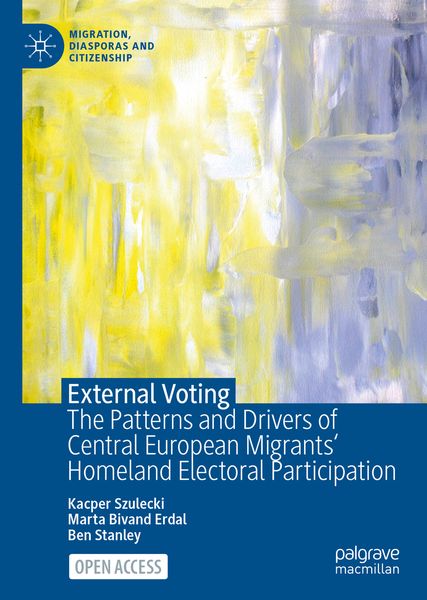
External Voting The Patterns and Drivers of Central European Migrants' Homeland Electoral Participation
-
- Englisch ausgewählt
48,99 €
inkl. gesetzl. MwSt.,
Lieferung nach Hause
Beschreibung
Produktdetails
Einband
Gebundene Ausgabe
Erscheinungsdatum
15.12.2022
Verlag
SpringerSeitenzahl
116
Maße (L/B/H)
21,6/15,3/1,2 cm
Gewicht
288 g
Auflage
1st ed. 2023
Sprache
Englisch
ISBN
978-3-031-19245-6
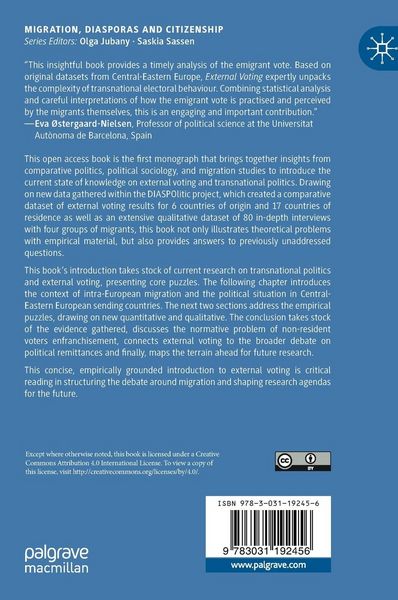
This open access book is the first monograph that brings together insights from comparative politics, political sociology, and migration studies to introduce the current state of knowledge on external voting and transnational politics. Drawing on new data gathered within the DIASPOlitic project, which created a comparative dataset of external voting results for 6 countries of origin and 17 countries of residence as well as an extensive qualitative dataset of 80 in-depth interviews with four groups of migrants, this book not only illustrates theoretical problems with empirical material, but also provides answers to previously unaddressed questions.
The empirical material focuses on the European context. The Eastern Enlargement of the European Union (2004-2007) triggered a westward wave of migration from Central and Eastern European countries which faced the expansion of existing émigré communities and the emergence of new ones. As this process coincided with the expansion ofmigrant voting rights, the result is a large set of populous diaspora communities which can potentially have a significant impact on country electoral politics, making the study of external voting highly relevant.
This book’s introduction takes stock of current research on transnational politics and external voting, presenting core puzzles. The following chapter introduces the context of intra-European migration and the political situation in Central-Eastern European sending countries. The next two sections address the empirical puzzles, drawing on new quantitative and qualitative. The conclusion takes stock of the evidence gathered, discusses the normative problem of non-resident voters enfranchisement, connects external voting to the broader debate on political remittances and finally, maps the terrain ahead for future research.
This concise, empirically grounded introduction to external voting is critical reading in structuring the debate around migration and shapingresearch agendas for the future.
Kundinnen und Kunden meinen
Verfassen Sie die erste Bewertung zu diesem Artikel
Helfen Sie anderen Kund*innen durch Ihre Meinung
Kurze Frage zu unserer Seite
Vielen Dank für dein Feedback
Wir nutzen dein Feedback, um unsere Produktseiten zu verbessern. Bitte habe Verständnis, dass wir dir keine Rückmeldung geben können. Falls du Kontakt mit uns aufnehmen möchtest, kannst du dich aber gerne an unseren Kund*innenservice wenden.
zum Kundenservice