Gutscheinbedingungen

**Gültig vom 15.06.2026 bis 17.06.2026 | Gültig für nicht preisgebundene fremdsprachige Bücher | Einzelne Artikel können ausgeschlossen sein | Maximaler rabattfähiger Warenkorbwert 500 € | Nicht kombinierbar mit weiteren Aktionen | Nur einmal pro Person einlösbar | Nur solange der Vorrat reicht

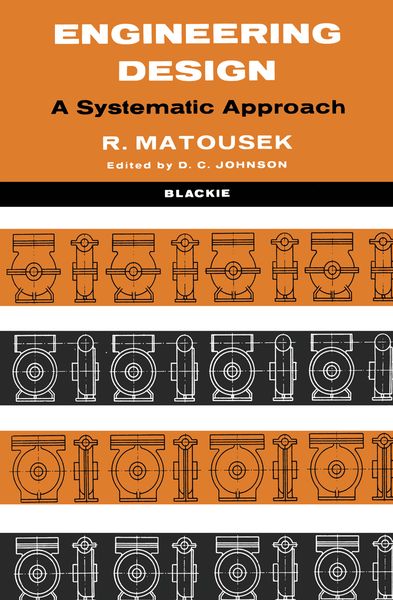
  • Produktbild: Engineering Design
  • Produktbild: Engineering Design
- 12%

Engineering Design A Systematic Approach

12% sparen

93,99 € UVP 106,99 €

inkl. gesetzl. MwSt., Versandkostenfrei

Lieferung nach Hause

Beschreibung

Produktdetails

Einband

Taschenbuch

Erscheinungsdatum

30.06.1963

Herausgeber

Robert Matousek

Verlag

Springer Netherland

Seitenzahl

264

Maße (L/B/H)

23,5/15,5/1,6 cm

Gewicht

427 g

Auflage

1963

Sprache

Englisch

ISBN

978-0-216-91273-1

Beschreibung

Produktdetails

Einband

Taschenbuch

Erscheinungsdatum

30.06.1963

Herausgeber

Robert Matousek

Verlag

Springer Netherland

Seitenzahl

264

Maße (L/B/H)

23,5/15,5/1,6 cm

Gewicht

427 g

Auflage

1963

Sprache

Englisch

ISBN

978-0-216-91273-1

Herstelleradresse

Springer-Verlag GmbH
Tiergartenstr. 17
69121 Heidelberg
DE

Email: ProductSafety@springernature.com

Kundinnen und Kunden meinen

0 Bewertungen

Informationen zu Bewertungen

Zur Abgabe einer Bewertung ist eine Anmeldung im Konto notwendig. Die Authentizität der Bewertungen wird von uns nicht überprüft. Wir behalten uns vor, Bewertungstexte, die unseren Richtlinien widersprechen, entsprechend zu kürzen oder zu löschen.

Die Bewertungen sind nach Format, Anzahl Sterne und Datum sortiert.

Verfassen Sie die erste Bewertung zu diesem Artikel

Helfen Sie anderen Kund*innen durch Ihre Meinung

Kundinnen und Kunden meinen

0 Bewertungen filtern

  • Produktbild: Engineering Design
  • Produktbild: Engineering Design
  • The Significance of Design.- 1| General Aspects of the Designer’s Work.- What is meant by design?.- What kinds of design work are there?.- Organization of the drawing office.- Relationship between the drawing office and other departments.- Why teach design as a special subject?.- 2| The Designer.- Qualities required in a designer.- What is a designer expected to know?.- 3| Design Factors.- A rational working plan for the drawing office.- What are the factors influencing design?.- How can one classify these factors clearly?.- 4| A Planned Policy for the Designer.- A The Systematic Working Plan.- B The Problem to be Solved.- The types of problem to be solved.- Exercise problems 1, 2.- C The Basic Design.- How are the various possible solutions found?.- How is the best solution found?.- The evaluation scheme.- Exercise problems 3–7.- D Materials.- Which factors determine the choice of material?.- How should one choose the material?.- Principal materials used.- Ferrous metals.- Non-ferrous metals.- E Manufacture.- The factors influencing manufacture?.- F Form Design.- What does the designer have to bear in mind in form design?.- General points regarding form design.- 1 How the basic design influences form design.- 2 How mechanical loading influences form design.- Rules.- Exercise problems 8 and 9.- 3 Influence of material on form design.- 4 How the production method influences form design.- (a) Form design of grey iron castings.- Rules.- Exercise problems 10–15.- (b) Form design of steel castings.- Rules.- Exercise problems 16 and 17.- (c) Form design of malleable iron castings.- Rules.- Non-ferrous alloys.- (d) Form design of aluminium castings.- Rules.- Exercise problem 18.- (e) Form design of pressure die castings.- Rules.- (f) Form design of plastics mouldings.- Rules.- (g) Form design of welded fabrications.- General.- Welding processes.- Gas or arc welding.- Weld forms.- Stresses.- Measures to combat contraction stress.- Joints used in welding 138.- Weldability of steels.- Design of welded structures.- Rules.- Exercise problems 19–23.- (h) Form design of forgings.- Hammer forging.- Principles of form design.- Rules.- Exercise problems 24–26.- Drop forging.- Rules.- Casting, forging, or welding?.- (i) Designing for manufacture by machining methods.- Designing for machinability.- Designing for economy.- Designing for clampability.- Designing for existing tool equipment.- Designing to avoid redundant fits.- Designing for accessibility.- Designing for ease of assembly.- 5 How the space factor influences form design.- Exercise problems 27 and 28.- 6 How size influences form design.- 7 How weight influences form design (lightweight construction).- (a) Optimization of form (lightweight construction).- Rules.- Exercise problem 29.- (b) Best possible estimate of strength.- (c) Use of welding instead of riveting.- Exercise problem 30.- (d) Use of welding instead of casting (lightweight construction in steel).- Exercise problem 31.- (e) Use of high-grade steel.- Exercise problem 32.- (f) Use of lightweight materials.- (g) Use of special sections.- (h) Use of new components.- (i) Saving of weight through basic change of layout.- (k) Lightweight construction by appropriate choice of parameter.- 8 How the use of standard components influences form design.- 9 How existing products influence form design.- 10 How appearance influences form design.- 11 How convenience of handling influences form design.- 12 How maintenance questions influence form design.- 13 How the question of repair influences form design.- 14 How surface properties influence form design.- 15 How fitness for shipment influences form design.- 16 How power requirements influence form design.- G Costs.- A Solutions of Exercise Problems.- B Bibliography.- C British Standard Specifications of Materials.- D Strength of Cast Iron.