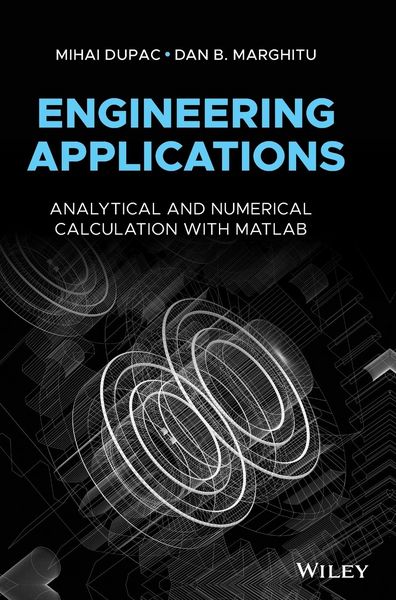
Engineering Applications Analytical and Numerical Calculation with MATLAB
149,99 €
inkl. gesetzl. MwSt.,
Lieferung nach Hause
Beschreibung
Produktdetails
Einband
Gebundene Ausgabe
Erscheinungsdatum
08.03.2021
Verlag
John Wiley & SonsSeitenzahl
368
Maße (L/B/H)
25/17,5/2,4 cm
Gewicht
792 g
Auflage
1. Auflage
Sprache
Englisch
ISBN
978-1-119-09362-6
ENGINEERING APPLICATIONS
A comprehensive text on the fundamental principles of mechanical engineering
Engineering Applications presents the fundamental principles and applications of the statics and mechanics of materials in complex mechanical systems design. Using MATLAB to help solve problems with numerical and analytical calculations, authors and noted experts on the topic Mihai Dupac and Dan B. Marghitu offer an understanding of the static behaviour of engineering structures and components while considering the mechanics of materials knowledge as the most important part of their design.
The authors explore the concepts, derivations, and interpretations of general principles and discuss the creation of mathematical models and the formulation of mathematical equations. This practical text also highlights the solutions of problems solved analytically and numerically using MATLAB. The figures generated with MATLAB reinforce visual learning for students and professionals as they study the programs. This important text:
* Shows how mechanical principles are applied to engineering design
* Covers basic material with both mathematical and physical insight
* Provides an understanding of classical mechanical principles
* Offers problem solutions using MATLAB
* Reinforces learning using visual and computational techniques
Written for students and professional mechanical engineers, Engineering Applications helpshone reasoning skills in order to interpret data and generate mathematical equations, offering different methods of solving them for evaluating and designing engineering systems.
A comprehensive text on the fundamental principles of mechanical engineering
Engineering Applications presents the fundamental principles and applications of the statics and mechanics of materials in complex mechanical systems design. Using MATLAB to help solve problems with numerical and analytical calculations, authors and noted experts on the topic Mihai Dupac and Dan B. Marghitu offer an understanding of the static behaviour of engineering structures and components while considering the mechanics of materials knowledge as the most important part of their design.
The authors explore the concepts, derivations, and interpretations of general principles and discuss the creation of mathematical models and the formulation of mathematical equations. This practical text also highlights the solutions of problems solved analytically and numerically using MATLAB. The figures generated with MATLAB reinforce visual learning for students and professionals as they study the programs. This important text:
* Shows how mechanical principles are applied to engineering design
* Covers basic material with both mathematical and physical insight
* Provides an understanding of classical mechanical principles
* Offers problem solutions using MATLAB
* Reinforces learning using visual and computational techniques
Written for students and professional mechanical engineers, Engineering Applications helpshone reasoning skills in order to interpret data and generate mathematical equations, offering different methods of solving them for evaluating and designing engineering systems.
Kundinnen und Kunden meinen
Verfassen Sie die erste Bewertung zu diesem Artikel
Helfen Sie anderen Kund*innen durch Ihre Meinung
Kurze Frage zu unserer Seite
Vielen Dank für dein Feedback
Wir nutzen dein Feedback, um unsere Produktseiten zu verbessern. Bitte habe Verständnis, dass wir dir keine Rückmeldung geben können. Falls du Kontakt mit uns aufnehmen möchtest, kannst du dich aber gerne an unseren Kund*innenservice wenden.
zum Kundenservice