
Effective Inquiry for Innovative Engineering Design From Basic Principles to Applications
-
- Hardcover
- Taschenbuch ausgewählt
-
Sprache:Englisch
97,99 €
inkl. gesetzl. MwSt.,
Lieferung nach Hause
Beschreibung
Produktdetails
Einband
Taschenbuch
Erscheinungsdatum
03.10.2012
Verlag
Springer UsSeitenzahl
154
Maße (L/B/H)
23,5/15,5/1 cm
Gewicht
265 g
Auflage
Softcover reprint of the original 1st ed. 2004
Sprache
Englisch
ISBN
978-1-4613-4729-3
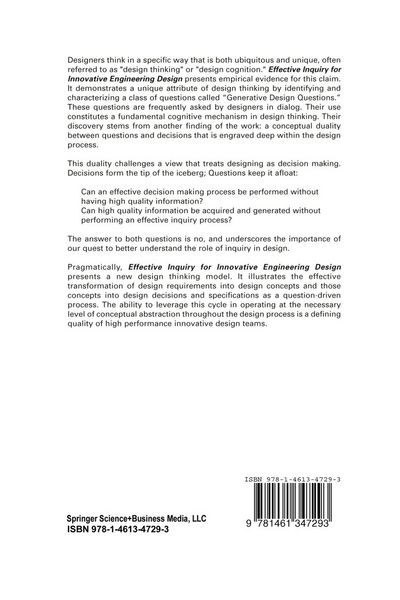
Effective Inquiry for Innovative Engineering Design presents empirical evidence for this claim. It demonstrates a unique attribute of design thinking by identifying and characterizing a class of questions called "Generative Design Questions". These questions are frequently asked by designers in dialog. Their use constitutes a fundamental cognitive mechanism in design thinking. Their discovery stems from another finding of the work: a conceptual duality between questions and decisions that is engraved deep within the design process.
This duality challenges a view that treats designing as decision making. Decisions form the tip of the iceberg; Questions keep it afloat: Can an effective decision making process be performed without having high quality information? Can high quality information be acquired and generated without performing an effective inquiry process? The answer to both questions is no, and underscores the importance of our quest to better understand the role of inquiry in design.
This duality challenges a view that treats designing as decision making. Decisions form the tip of the iceberg; Questions keep it afloat: Can an effective decision making process be performed without having high quality information? Can high quality information be acquired and generated without performing an effective inquiry process? The answer to both questions is no, and underscores the importance of our quest to better understand the role of inquiry in design.
Kundinnen und Kunden meinen
Verfassen Sie die erste Bewertung zu diesem Artikel
Helfen Sie anderen Kund*innen durch Ihre Meinung
Kurze Frage zu unserer Seite
Vielen Dank für dein Feedback
Wir nutzen dein Feedback, um unsere Produktseiten zu verbessern. Bitte habe Verständnis, dass wir dir keine Rückmeldung geben können. Falls du Kontakt mit uns aufnehmen möchtest, kannst du dich aber gerne an unseren Kund*innenservice wenden.
zum Kundenservice