KI-Beratung Beta

  • Produktbild: Distributed Database Management
  • Produktbild: Distributed Database Management

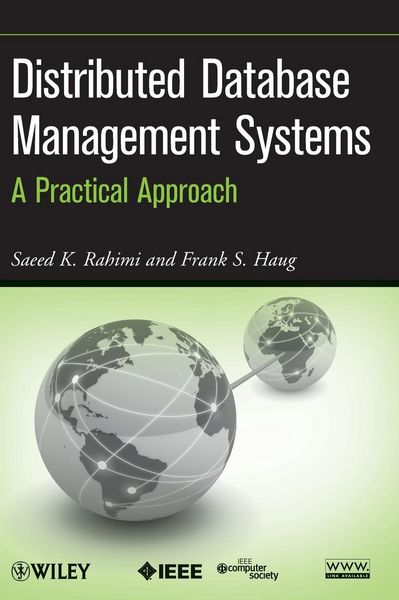
Distributed Database Management

203,99 €

inkl. gesetzl. MwSt., Versandkostenfrei


Beschreibung

This book addresses issues related to managing data across a distributed database system. It is unique because it covers traditional database theory and current research, explaining the difficulties in providing a unified user interface and global data dictionary. The book gives implementers guidance...

Beschreibung

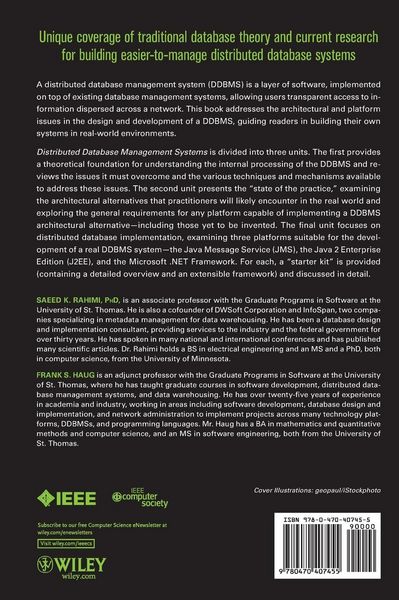
This book addresses issues related to managing data across a distributed database system. It is unique because it covers traditional database theory and current research, explaining the difficulties in providing a unified user interface and global data dictionary. The book gives implementers guidance on hiding discrepancies across systems and creating the illusion of a single repository for users. It also includes three sample frameworks--implemented using J2SE with JMS, J2EE, and Microsoft .Net--that readers can use to learn how to implement a distributed database management system. IT and development groups and computer sciences/software engineering graduates will find this guide invaluable. Unique coverage of traditional database theory and current research for building easier-to-mange distributed database systems
A distributed database management system (DDBMS) is a layer of software, implemented on top of existing database management systems, allowing users transparent access to information dispersed across a network. This book addresses the architectural and platform issues on the design and development of a DDBMS, guiding readers in building their own systems in real-world environments.
Distributed Database Management Systems is divided into three units. The first provides a theoretical foundation for understanding the internal processing of the DDBMS available to address these issues. The second unit presents the "state of the practice," examining the architectural alternatives that practitioners will likely encounter in the real world and the exploring the general requirements for any platform capable of implementing a DDBMS architectural alternative--including those yet to be invented. The final unit focuses on distributed database implementation, examining three platforms suitable for the development of a real DDBMS system--the Java Message Service (JMS), the Java 2 Enterprise Edition (J2EE), and the Microsoft .NET Framework. For each, a "starter kit" is provided (containing a detailed overview and an extensible framework) and discussed in detail.

Rezension

"The chapters are clearly written and all the technical details arethoroughly displayed." (Zentralblatt MATH, 2011)
Produktdetails

Einband

Gebundene Ausgabe

Erscheinungsdatum

02.08.2010

Abbildungen

Charts: 282 B&W, 0 Color; Drawings: 0 B&W, 0 Color; Tables: 0 B&W, 0 Color

Verlag John Wiley & Sons Inc

Produktdetails

Einband

Gebundene Ausgabe

Erscheinungsdatum

02.08.2010

Abbildungen

Charts: 282 B&W, 0 Color; Drawings: 0 B&W, 0 Color; Tables: 0 B&W, 0 Color

Verlag John Wiley & Sons Inc
Seitenzahl

768

Maße (L/B/H)

26/18,3/4,5 cm

Gewicht

1608 g

Auflage

1. Auflage

Sprache

Englisch

ISBN

978-0-470-40745-5

Herstelleradresse

Libri GmbH
Europaallee 1
36244 Bad Hersfeld
DE

Email: gpsr@libri.de

Noch keine Bewertungen vorhanden

Verfassen Sie die erste Bewertung zu diesem Artikel

Helfen Sie anderen Kundinnen und Kunden durch Ihre Meinung.

Kundinnen und Kunden meinen

Bewertungen (0)

Die Leseprobe wird geladen.
  • Produktbild: Distributed Database Management
  • Produktbild: Distributed Database Management
  • Preface.
     
    1 Introduction.
     
    1.1 Database Concepts.
     
    1.2 DBE Architectural Concepts.
     
    1.3 Archetypical DBE Architectures.
     
    1.4 A New Taxonomy.
     
    1.5 An Example DDBE.
     
    1.6 A Reference DDBE Architecture.
     
    1.7 Transaction Management in Distributed Systems.
     
    1.8 Summary.
     
    1.9 Glossary.
     
    References.
     
    References.
     
    2 Data Distribution Alternatives.
     
    2.1 Design Alternatives.
     
    2.2 Fragmentation.
     
    2.3 Distribution Transparency.
     
    2.4 Impact of Distribution on User Queries.
     
    2.5 A More Complex Example.
     
    2.6 Summary.
     
    2.7 Glossary.
     
    References.
     
    Exercises.
     
    3 Database Control.
     
    3.1 Authentication.
     
    3.2 Access Rights.
     
    3.3 Semantic Integrity Control.
     
    3.4 Distributed Semantic Integrity Control.
     
    3.5 Cost of Semantic Integrity Enforcement.
     
    3.6 Summary.
     
    3.7 Glossary.
     
    References.
     
    Exercises.
     
    4 Query Optimization.
     
    4.1 Sample Database.
     
    4.2 Relational Algebra.
     
    4.3 Computing Relational Algebra Operators.
     
    4.4 Query Processing in Centralized Systems.
     
    4.5 Query Processing in Distributed Systems.
     
    4.6 Summary.
     
    4.7 Glossary.
     
    References.
     
    Exercises.
     
    5 Controlling Concurrency.
     
    5.1 Terminology.
     
    5.2 Multitransaction Processing Systems.
     
    5.3 Centralized DBE Concurrency Control.
     
    5.4 Concurrency Control in Distributed Database Systems.
     
    5.5 Summary.
     
    5.6 Glossary.
     
    References.
     
    Exercises.
     
    6 Deadlock Handling.
     
    6.1 Deadlock Definition.
     
    6.2 Deadlocks in Centralized Systems.
     
    6.3 Deadlocks in Distributed Systems.
     
    6.4 Summary.
     
    6.5 Glossary.
     
    References.
     
    Exercises.
     
    7 Replication Control.
     
    7.1 Replication Control Scenarios.
     
    7.2 Replication Control Algorithms.
     
    7.3 Summary.
     
    7.4 Glossary.
     
    References.
     
    Exercises.
     
    8 Failure and Commit Protocols.
     
    8.1 Terminology.
     
    8.2 Undo/Redo and Database Recovery.
     
    8.3 Transaction States Revisited.
     
    8.4 Database Recovery.
     
    8.5 Other Types of Database Recovery.
     
    8.6 Recovery Based on Redo/Undo Processes.
     
    8.7 The Complete Recovery Algorithm.
     
    8.8 Distributed Commit Protocols.
     
    8.9 Summary.
     
    8.10 Glossary.
     
    References.
     
    Exercises.
     
    9 DDBE Security (Bradley S. Rubini).
     
    9.1 Cryptography.
     
    9.2 Securing Communications.
     
    9.3 Securing Data.
     
    9.4 Architectural Issues.
     
    9.5 A Typical Deployment.
     
    9.6 Summary.
     
    9.7 Glossary.
     
    References.
     
    Exercises.
     
    10 Data Modeling Overview.
     
    10.1 Categorizing MLs and DMs.
     
    10.2 The Conceptual Level of the CLP.
     
    10.3 Conceptual Modeling Language Examples.
     
    10.4 Working With Data Models.
     
    10.5 Using Multiple Types of Modeling.
     
    10.6 Summary.
     
    10.7 Glossary.
     
    References.
     
    Exercises.
     
    11 Logical Data Models.
     
    11.1 The RDM.
     
    11.2 The Network Data Model.
     
    11.3 The Hierarchical Data Model.
     
    11.4 The OODM.
     
    11.5 Summary.
     
    11.6 Glossary.
     
    References.
     
    Exercises.
     
    12 Traditional DDBE Architectures.