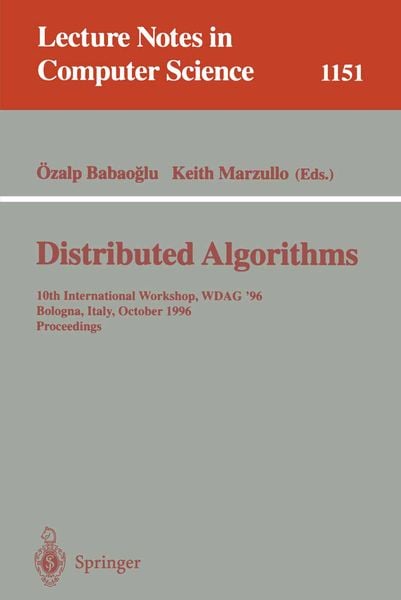
Distributed Algorithms 10th International Workshop, WDAG '96, Bologna, Italy, October 9-11, 1996, Proceedings
-
- Englisch ausgewählt
49,99 €
inkl. gesetzl. MwSt.,
Lieferung nach Hause
Beschreibung
Produktdetails
Einband
Taschenbuch
Erscheinungsdatum
25.09.1996
Herausgeber
Özalp Babaoglu + weitereVerlag
Springer BerlinSeitenzahl
388
Maße (L/B/H)
23,5/15,5/2,1 cm
Gewicht
586 g
Auflage
1996
Sprache
Englisch
ISBN
978-3-540-61769-3
The volume presents 21 revised full papers selected from 75 submissions together with invited contributions by Butler Lampson and Domenico Ferrari. The volume reflects the transition of the area from formerly being the domain of a small research community to becoming the dominant computing paradigm and an industrial technology. Among the topics covered are all current aspects of distributed algorithms ranging from theory to applications such as distributed intelligent agents.
Noch keine Bewertungen vorhanden
Verfassen Sie die erste Bewertung zu diesem Artikel
Helfen Sie anderen Kundinnen und Kunden durch Ihre Meinung.
Kurze Frage zu unserer Seite
Vielen Dank für dein Feedback
Wir nutzen dein Feedback, um unsere Produktseiten zu verbessern. Bitte habe Verständnis, dass wir dir keine Rückmeldung geben können. Falls du Kontakt mit uns aufnehmen möchtest, kannst du dich aber gerne an unseren Kund*innenservice wenden.
zum Kundenservice