
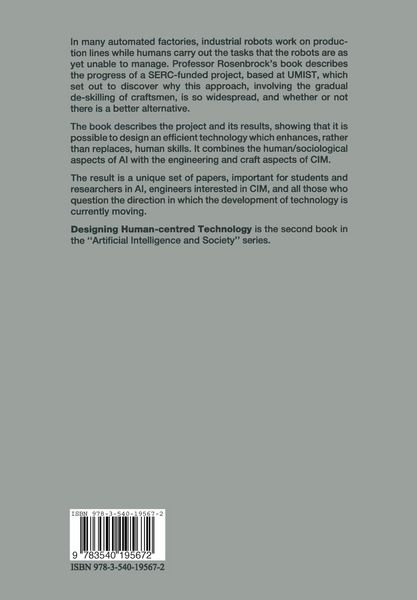
Designing Human-centred Technology A Cross-disciplinary Project in Computer-aided Manufacturing
Aus der Reihe
Human-centred Systems
-
- Englisch ausgewählt
49,99 €
inkl. gesetzl. MwSt.,
Lieferung nach Hause
Beschreibung
Produktdetails
Einband
Taschenbuch
Erscheinungsdatum
07.12.1989
Herausgeber
Howard H. RosenbrockVerlag
Springer BerlinSeitenzahl
208
Maße (L/B/H)
24,2/17/1,3 cm
Gewicht
399 g
Auflage
Softcover reprint of the original 1st ed. 1989
Sprache
Englisch
ISBN
978-3-540-19567-2
This second book in our series Artificial Intelligence and Society explores the issues involved in the design and application of human-centred systems in the manufacturing area. At first glance it may appear that a book on this topic is somewhat peripheral to the main concerns of the series. In fact, although starting from an engineering perspective, the book addresses some of the pivotal issues confronting those who apply new technology in general and artificial intelligence (AI) systems in particular. Above all, the book invites us to consider whether the present applications of technology are such as to make the best use of human skill and ingenuity and at the same time provide for realistic and economically sustainable systems design solutions. To do so it is necessary to provide systems which support the skill, and are amenable to the cultures, of the areas of application in question. In a philosophical sense it means providing tools to support skills rather than machines which replace them, to use Heidegger's distinction. The book gives an authoritative account of the University of Manchester Institute of Science and Technology (UMIST) tradition of human-centredness and provides a participatory design ap proach which focuses on collaborative learning and enhancement and creation of new skills. It also argues that collaboration should be supported by institutions through the creation of supportive infrastructures and research environments. It emphasises the optimisation of practical knowledge with the help of scientific knowledge and rejects the alternative.
Kundinnen und Kunden meinen
Verfassen Sie die erste Bewertung zu diesem Artikel
Helfen Sie anderen Kund*innen durch Ihre Meinung
Kurze Frage zu unserer Seite
Vielen Dank für dein Feedback
Wir nutzen dein Feedback, um unsere Produktseiten zu verbessern. Bitte habe Verständnis, dass wir dir keine Rückmeldung geben können. Falls du Kontakt mit uns aufnehmen möchtest, kannst du dich aber gerne an unseren Kund*innenservice wenden.
zum Kundenservice