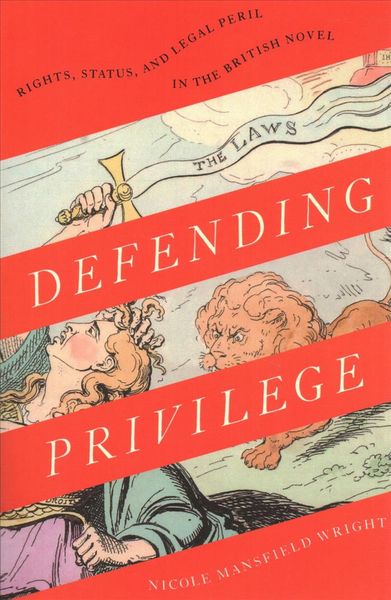
Defending Privilege Rights, Status, and Legal Peril in the British Novel
-
- Hardcover
- Taschenbuch ausgewählt
- eBook
-
Sprache:Englisch
43,99 €
inkl. gesetzl. MwSt.,
Lieferung nach Hause
Beschreibung
Produktdetails
Einband
Taschenbuch
Erscheinungsdatum
10.03.2020
Verlag
University PressesSeitenzahl
224
Maße (L/B/H)
22,6/15/1,8 cm
Gewicht
318 g
Sprache
Englisch
ISBN
978-1-4214-3374-5
A critique of attempts by conservative eighteenth- and nineteenth-century authors to appropriate the rhetoric of victimhood and appeals to "rights" to safeguard the status of the powerful.
As revolution and popular unrest roiled the final decades of the eighteenth century, authors, activists, and philosophers across the British Empire hailed the rise of the liberal subject, valorizing the humanity of the marginalized and the rights of members of groups long considered inferior or subhuman. Yet at the same time, a group of conservative authors mounted a reactionary attempt to cultivate sympathy for the privileged. In Defending Privilege, Nicole Mansfield Wright examines works by Tobias Smollett, Charlotte Smith, Walter Scott, and others to show how conservatives used the rhetoric of victimhood in attempts to convince ordinary readers to regard a privileged person's loss of legal agency as a catastrophe greater than the calamities and legally sanctioned exclusion suffered by the poor and the enslaved. In promoting their agenda, these authors resuscitated literary modes regarded at the time as derivative or passé--including romance, the gothic, and epistolarity--or invented subgenres that are neglected today due to widespread revilement of their politics (the proslavery novel).
Although these authors are not typically considered alongside one another in scholarship, they are united by their firsthand experience of legal conflict: each felt that their privilege was degraded through lengthy disputes. In examining the work of these eighteenth- and early nineteenth-century authors, Wright traces a broader reactionary framework in the Anglophone literary legacy. Each novel seeks to reshape and manipulate public perceptions of who merits legal agency: the right to initiate a lawsuit, serve as a witness, seek counsel from a lawyer, and take other legal actions. As a result, Defending Privilege offers a counterhistory to scholarship on the novel's capacity to motivate the promulgation of human rights and champion social ascendance through the upwardly mobile realist character.
Kundinnen und Kunden meinen
Verfassen Sie die erste Bewertung zu diesem Artikel
Helfen Sie anderen Kund*innen durch Ihre Meinung
Kurze Frage zu unserer Seite
Vielen Dank für dein Feedback
Wir nutzen dein Feedback, um unsere Produktseiten zu verbessern. Bitte habe Verständnis, dass wir dir keine Rückmeldung geben können. Falls du Kontakt mit uns aufnehmen möchtest, kannst du dich aber gerne an unseren Kund*innenservice wenden.
zum Kundenservice