Gutscheinbedingungen

**Gültig vom 15.06.2026 bis 17.06.2026 | Gültig für nicht preisgebundene fremdsprachige Bücher | Einzelne Artikel können ausgeschlossen sein | Maximaler rabattfähiger Warenkorbwert 500 € | Nicht kombinierbar mit weiteren Aktionen | Nur einmal pro Person einlösbar | Nur solange der Vorrat reicht

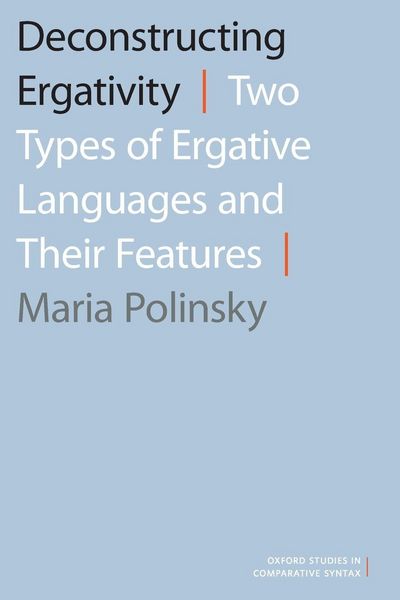
  • Produktbild: Deconstructing Ergativity
  • Produktbild: Deconstructing Ergativity

Deconstructing Ergativity Two Types of Ergative Languages and Their Features

72,99 €

inkl. gesetzl. MwSt., Versandkostenfrei

Lieferung nach Hause

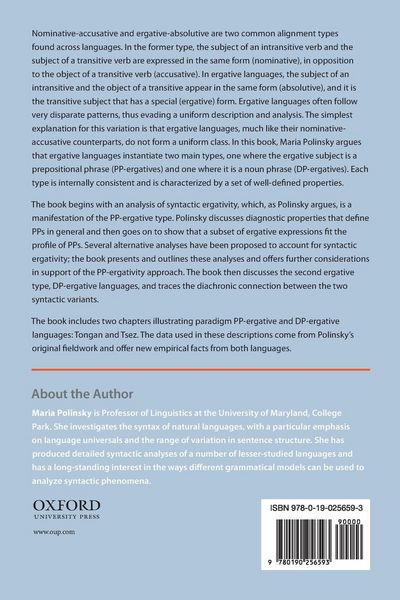
Beschreibung

Produktdetails

Einband

Taschenbuch

Erscheinungsdatum

01.05.2016

Verlag

Oxford University Press

Seitenzahl

416

Maße (L/B/H)

23,4/15,6/2,2 cm

Gewicht

544 g

Sprache

Englisch

ISBN

978-0-19-025659-3

Beschreibung

Produktdetails

Einband

Taschenbuch

Erscheinungsdatum

01.05.2016

Verlag

Oxford University Press

Seitenzahl

416

Maße (L/B/H)

23,4/15,6/2,2 cm

Gewicht

544 g

Sprache

Englisch

ISBN

978-0-19-025659-3

Herstelleradresse

Libri GmbH
Europaallee 1
36244 Bad Hersfeld
DE

Email: gpsr@libri.de

Kundinnen und Kunden meinen

0 Bewertungen

Informationen zu Bewertungen

Zur Abgabe einer Bewertung ist eine Anmeldung im Konto notwendig. Die Authentizität der Bewertungen wird von uns nicht überprüft. Wir behalten uns vor, Bewertungstexte, die unseren Richtlinien widersprechen, entsprechend zu kürzen oder zu löschen.

Die Bewertungen sind nach Format, Anzahl Sterne und Datum sortiert.

Verfassen Sie die erste Bewertung zu diesem Artikel

Helfen Sie anderen Kund*innen durch Ihre Meinung

Kundinnen und Kunden meinen

0 Bewertungen filtern

Die Leseprobe wird geladen.
  • Produktbild: Deconstructing Ergativity
  • Produktbild: Deconstructing Ergativity
    • Preface

    • Abbreviations

    • Part I: Two types of ergatives

    • 1 Introduction

    • 1.1 Setting the stage

    • 1.2 Syntactic ergativity

    • 1.2.1 The phenomenon

    • 1.2.2 The range of the phenomenon

    • 1.2.3 The relevance of syntactic ergativity

    • 1.3. The importance of starting small

    • 1.3.1 Syntactic ergativity broadly defined

    • 1.3.2 Not all A-bar movement phenomena are created equal

    • 1.3.3 Some methodological odds and ends

    • Appendix: Compensatory strategies under syntactic ergativity

    • 2 Proposal

    • 2.1 Crucial empirical observations

    • 2.1.1 Diachronic pathways to ergativity

    • 2.1.2 Oblique subjects

    • 2.2 The proposal: Two classes of ergative languages

    • 2.3 From PP specifier to syntactic ergativity

    • 2.3.1 The relationship between the verbal functional head and ergative P

    • 2.3.2 Ergative P and P-stranding

    • 2.3.3 Ergative P and pied-piping

    • 2.3.4 From a PP subject to syntactic ergativity

    • 2.4 Basic clausal structures in the two types of ergative languages

    • 2.4.1 PP-ergative and DP-ergative languages: transitive clauses

    • 2.4.2 PP-ergative and DP-ergative languages: unergative clauses

    • 2.4.3 PP specifiers everywhere? Preventing overgeneration

    • 2.4.4 Compatibility between the ergative and the passive

    • 2.5 Summary

    • 3 Prepositional phrases: Establishing the diagnostics

    • 3.1 PPs have distinct extraction and subextraction properties

    • 3.2 Restrictions on PPs as pivots of clefts

    • 3.3 PPs have resumptive proforms and may have special modifiers

    • 3.4 PPs are less accessible to agreement probes than DPs are

    • 3.5 PPs and binding

    • 3.6 PPs and A-movement

    • 3.7 PPs and control

    • 3.8 Summary

    • 4 Ergative as a PP: Take One

    • 4.1 Ergative expressions can be PPs

    • 4.2 Subextraction out of the ergative expression

    • 4.3 Ergative cannot extract leaving a gap

    • 4.4 Ergative and agreement

    • 4.5 Ergative and depictives

    • 4.6 Ergative and quantifier float

    • 4.7 Taking stock

    • 4.7.1 Silent P head

    • 4.7.2 Overt P head

    • 4.7.3 The nature of the operator

    • 5 Ergative as a PP: Take Two

    • 5.1 Binding: Reflexives and reciprocals

    • 5.2 Raising

    • 5.2.1 No true raising

    • 5.2.2 Ergative is not preserved under raising-at least in Tongan

    • 5.3 control

    • 5.3 Summary

    • 6 Cross-linguistic landscape: Correlates of PP-ergativity

    • 6.1. Word order correlates

    • 6.2 Expletive subjects

    • 6.3 Non-canonical (quirky) subjects

    • 7 The other ergative: A true DP

    • 7.1 Extraction of the ergative with a gap

    • 7.2 Subextraction from the ergative and the absolutive

    • 7.3 Agreement

    • 7.4 Binding

    • 7.5 Control and raising

    • 7.6 Word order

    • 7.7 Summary

    • 8 The relationship between the PP-ergative type and the DP-ergative type: Phylogeny and ontogeny

    • 8.1 Diachronic relationship between the PP-ergative type and the DP-ergative type

    • 8.2 Caught in transition: Niuean

    • 8.3 Caught in transition: Adyghe

    • 8.4 PP-ergatives and DP-ergatives in language acquisition

    • 9 Alternative accounts of variation across ergative languages

    • 9.1 Comp-trace vs. P-trace

    • 9.2 Criterial freezing

    • 9.3 Phase boundaries and high/low absolutive languages

    • 9.4 Non-syntactic explanations for variation across ergative languages

    • 9.5 Summary

    • Part II: Paradigm languages

    • 10 A paradigm PP-Ergative language: Tongan

    • 10.1 Tongan basics

    • 10.1.1 General remarks

    • 10.1.2 Predicates

    • 10.1.3 Case marking

    • 10.1.4 Word order: Preliminary remarks

    • 10.1.5 Questions

    • 10.2 Subject and possessive marking: Clitics

    • 10.2.1 Subject clitics

    • 10.2.1.1 Basic facts about clitics

    • 10.2.1.2 Accounting for Tongan clitics

    • 10.2.1.3 Clitic doubling

    • 10.2.2 Possessive clitics and possessive markers

    • 10.3 Deriving Tongan clause structure

    • 10.3.1 Word order: Deriving V1

    • 10.3.2 Word order: The right periphery

    • 10.3.2.1 The definitive accent

    • 10.3.2.2 VOS is not due to scrambling

    • 10.3.2.3 VOS as rightward topicalization

    • 10.3.3 Basic clause structures

    • 10.3.3.1 Intransitives: Unaccusatives

    • 10.3.3.2 Intransitives: Unergatives

    • 10.3.3.3 Transitive clauses

    • 10.3.4 Tongan ergativity and split ergativity

    • 10.4 A-bar movement

    • 10.4.1 Relative clauses

    • 10.4.2 Wh-questions

    • 10.4.3 Focus: Exceptive constructions

    • 10.4.4 Ko-Topicalization

    • 10.4.5 Interim summary

    • 10.5 Raising and control

    • 10.5.1 The status of ke-clauses

    • 10.5.2 "Raising "

    • 10.5.2.1 Raising-like verbs and their structures

    • 10.5.2.2 What moves in ke-clauses and where?

    • 10.5.2.3 What is the nature of the operator in ke-clauses?

    • 10.5.2.4 The transparency of finite ke-clauses

    • 10.5.3 The verb lava

    • 10.5.3.1 Monoclausal structure with lava: Restructuring

    • 10.5.3.2 Biclausal structures with lava

    • 10.5.4 Control

    • 10.5.4.1 Basic facts

    • 10.5.4.2 No obligatory control

    • 10.5.4.3 The internal syntax of control ke-clauses

    • 10.5.5 Interim summary

    • 10.6 Binding

    • 10.6.1 Anaphoric binding

    • 10.6.2 Reciprocals? Just pluractionality

    • 10.6.3 Other binding contexts

    • 10.7 Summary

    • 11 A paradigm DP-Ergative language: Tsez

    • 11.1 Tsez basics

    • 11.1.1 Preliminaries

    • 11.1.2 Unergatives and unaccusatives

    • 11.1.3 Clauses with two or more arguments

    • 11.2 Discontinuous noun phrases

    • 11.3 Non-finite forms

    • 11.3.1 Infinitival and masdar clauses

    • 11.3.2 Event nominalizations

    • 11.4 A-bar movement

    • 11.5 Raising and control

    • 11.5.1 Raising

    • 11.5.2 Complement control

    • 11.5.2.1 Forward control

    • 11.5.2.2 Backward control

    • 11.5.3 Infinitival relative clauses

    • 11.6 Binding

    • 11.6.1 Anaphoric binding

    • 11.6.2 Depictives

    • 11.7 Interim summary

    • 11.8 Deriving Tsez clauses

    • 11.8.1 Two possible analyses

    • 11.8.1.1 A single vP

    • 11.8.1.2 Layered functional heads in the verb phrase

    • 11.8.2 Single heads or layered structure: Which analysis is superior?

    • 11.9 Summary

    • 12 Taking stock

    • References

    • index