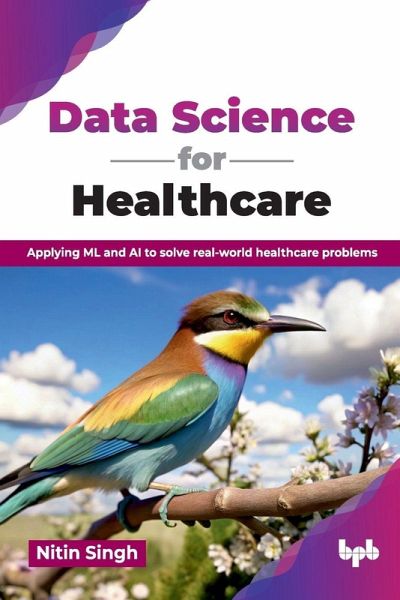
Data Science for Healthcare
Applying ML and AI to solve real-world healthcare problems (English Edition)
Versandkostenfrei!
Versandfertig in 1-2 Wochen
36,99 €
inkl. MwSt.

PAYBACK Punkte
18 °P sammeln!

Healthcare is under pressure to do more with less. Data science and AI are now used to predict risk, reduce avoidable admissions, speed up documentation, and guide clinical decisions. The industry is rapidly being transformed by the power of data, using advanced analytics and predictive models to improve patient care and operational efficiency. In this book, you will learn how healthcare data is captured and structured, how to clean and prepare it, and how to build predictive models for problems like sepsis risk and length of stay. The book covers natural language processing for clinical notes...
Healthcare is under pressure to do more with less. Data science and AI are now used to predict risk, reduce avoidable admissions, speed up documentation, and guide clinical decisions. The industry is rapidly being transformed by the power of data, using advanced analytics and predictive models to improve patient care and operational efficiency. In this book, you will learn how healthcare data is captured and structured, how to clean and prepare it, and how to build predictive models for problems like sepsis risk and length of stay. The book covers natural language processing for clinical notes, computer vision for imaging, and generative AI for tasks such as question answering and denial review. It also shows how to evaluate models, monitor them in production, and design workflows that people will actually use. By the end of this book, you will know how to move from an idea to a working healthcare AI solution. You will be able to frame the use case, choose the correct data, build and evaluate a model, explain its output, and position it in a clinical or business workflow. WHAT YOU WILL LEARN ¿ Understand how healthcare data is captured, structured, and governed. ¿ Build predictive models for sepsis risk, readmission, and length of stay. ¿ Apply NLP to clinical notes for extraction, summarization, and question answering. ¿ Use computer vision techniques to analyze scans and imaging data. ¿ Leverage generative AI and RAG for clinician-facing decision support. ¿ Design evaluation, monitoring, and explainability for production healthcare models. ¿ Integrate AI outputs into real clinical and operational workflows. WHO THIS BOOK IS FOR This book is for anyone working at the intersection of data and healthcare, including data scientists, analysts, machine learning engineers, clinical informatics teams, and digital health leaders. It is designed for readers who want practical, working examples of AI in patient risk prediction, documentation support, and workflow automation.
Andere Kunden interessierten sich für