• Produktbild: Convergence of Knowledge, Technology and Society
  • Produktbild: Convergence of Knowledge, Technology and Society
- 10%

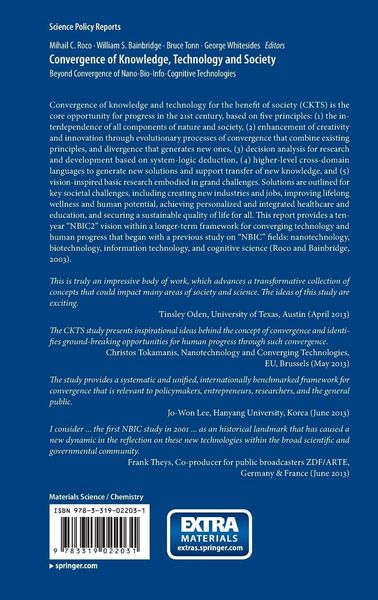
Convergence of Knowledge, Technology and Society Beyond Convergence of Nano-Bio-Info-Cognitive Technologies

Aus der Reihe Science Policy Reports
10% sparen

191,99 € UVP 213,99 €

inkl. MwSt, Versandkostenfrei

Lieferung nach Hause

Beschreibung

Details

Einband

Gebundene Ausgabe

Erscheinungsdatum

11.02.2014

Abbildungen

LVI, 102 illus., 100 illus. in color., farbige Illustrationen, schwarz-weiss Illustrationen

Herausgeber

Mihail C. Roco + weitere

Verlag

Springer

Seitenzahl

558

Maße (L/B/H)

24,1/16/3,9 cm

Gewicht

11518 g

Auflage

2013

Sprache

Englisch

ISBN

978-3-319-02203-1

Beschreibung

Portrait

Dr. Mihail C. Roco is the Senior Advisor for Nanotechnology at the National Science Foundation (NSF) and a key architect of the National Nanotechnology Initiative. Dr. Roco is the founding Chair of the U.S. National Science and Technology Council’s Subcommittee on Nanoscale Science, Engineering and Technology (NSET) and established the Nanotechnology Group of the International Risk Governance Council. Prior to joining National Science Foundation, he was Professor of mechanical and chemical engineering. Dr. Roco is credited with thirteen patents and has contributed over two hundred archival articles in sixteen books including recently 'Managing Nano-Bio-Info-Cognition Innovations' (2007) and 'Mapping Nanotechnology Knowledge and Innovation: Global and Longitudinal Patent and Literature Analysis' (2009). Dr. Roco is a corresponding member of the Swiss Academy of Engineering Sciences and a member of the International Risk Governance Council. His research included experimental and simulation methods to investigate nanosystems. He formally proposed the National Nanotechnology Initiative (NNI) in a presentation at The White House OSTP, Committee on Technology, on March 11, 1999. He conducted research, teaching, consulting to industry, and international organizations in the Americas, Europe, Japan, and Australia. He is a Fellow of ASME, Fellow of AIChE and Fellow of the Institute of Physics. He was elected Engineer of the Year by the U.S. Society of Professional Engineers and NSF in 1999 and again in 2004. He was honored as recipient of the Carl Duisberg Award in Germany, the 'Burgers Professorship Award' in The Netherlands, and the 'University Research Professorship' and Fingerson/TSI awards in the U.S. He received the National Materials Advancement Award from the Federation of Materials Societies in 2007 as 'the individual most responsible for support and investment in nanotechnology by government, industry, and academia worldwide'.

William SimsBainbridge is an American sociologist who currently resides in Virginia. He is co-director of Human-Centered Computing at the National Science Foundation (NSF). He is the first Senior Fellow to be appointed by the Institute for Ethics and Emerging Technologies. Professor Bainbridge is most well known for his work on the sociology of religion. He has published extensively on the sociology of computer gaming, and he has pioneered the use of online virtual worlds for scientific conferences and research proposal review panels. He has edited two major reference works relevant to NBIC, The Encyclopedia of Human-Computer Interaction and Leadership in Science and Technology. His doctoral research and first book concerned the social movement dedicated to exploration of outer space, and he has returned to that topic for the book he is currently writing, examining the social and intellectual barriers to future progress in that direction.  

Bruce Tonn, is a professor at the University of Tennesee. Dr. Tonn's research focuses on environmental and energy policy, futures studies, sustainability, and policy decision making methods. It also includes uncertainty methods, technology policy, computers in society, and social theory.

George Whitesides, is a Woodford L. and Ann A. Flowers Professor at Harvard University. His research interests are: physical and organic chemistry, materials science, biophysics, complexity and emergence, surface science, microfluidics, optics, self-assembly, micro- and nanotechnology, science for developing economies, catalysis, energy production and conservation, origin of life, rational drug design, cell-surface biochemistry, simplicity, and infochemistry.

Details

Einband

Gebundene Ausgabe

Erscheinungsdatum

11.02.2014

Abbildungen

LVI, 102 illus., 100 illus. in color., farbige Illustrationen, schwarz-weiss Illustrationen

Herausgeber

Verlag

Springer

Seitenzahl

558

Maße (L/B/H)

24,1/16/3,9 cm

Gewicht

11518 g

Auflage

2013

Sprache

Englisch

ISBN

978-3-319-02203-1

Herstelleradresse

Springer-Verlag GmbH
Tiergartenstr. 17
69121 Heidelberg
DE

Email: ProductSafety@springernature.com

Weitere Bände von Science Policy Reports

Weitere Bände von Science Policy Reports

Unsere Kundinnen und Kunden meinen

0 Bewertungen

Informationen zu Bewertungen

Zur Abgabe einer Bewertung ist eine Anmeldung im Konto notwendig. Die Authentizität der Bewertungen wird von uns nicht überprüft. Wir behalten uns vor, Bewertungstexte, die unseren Richtlinien widersprechen, entsprechend zu kürzen oder zu löschen.

Verfassen Sie die erste Bewertung zu diesem Artikel

Helfen Sie anderen Kund*innen durch Ihre Meinung

Unsere Kundinnen und Kunden meinen

0 Bewertungen filtern

  • Produktbild: Convergence of Knowledge, Technology and Society
  • Produktbild: Convergence of Knowledge, Technology and Society
  • Acknowledgements.- Study Team and Report Authors.- External Reviewers.- Preface (Executive Summary).- Overview and Recommendations.- 1 Convergence Platforms: Foundational Science and Technology Tools.- 2 Convergence Platforms: Human-Scale Convergence and the Quality of Life.- 3 Convergence Platforms: Earth-Scale Systems.- 4 Methods to Improve and Expedite Convergence.- 5 Implications: Human Health and Physical Potential.- 6 Implications: Human Cognition and Communication and the Emergence of Cognitive Society.- 7 Implications: Societal Collective Outcomes, including Manufacturing.- 8 Implications: People and Physical Infrastructure.- 9 Implications: Convergence of Knowledge and Technology for a Sustainable Society.- 10 Innovative and Responsible Governance of Converging Technologies.- Appendices A - H.