
Gutscheinbedingungen

**Gültig vom 15.06.2026 bis 17.06.2026 | Gültig für nicht preisgebundene fremdsprachige Bücher | Einzelne Artikel können ausgeschlossen sein | Maximaler rabattfähiger Warenkorbwert 500 € | Nicht kombinierbar mit weiteren Aktionen | Nur einmal pro Person einlösbar | Nur solange der Vorrat reicht

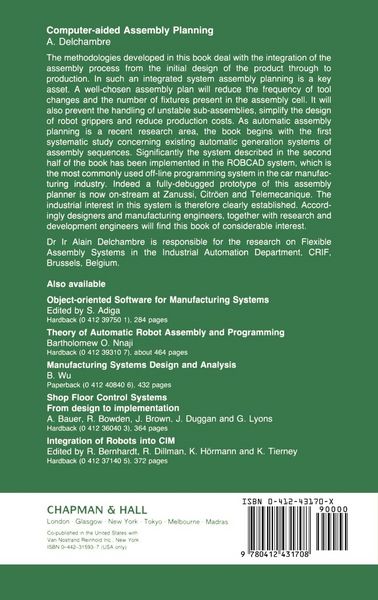
  • Produktbild: Computer-aided Assembly Planning
  • Produktbild: Computer-aided Assembly Planning
- 12%

Computer-aided Assembly Planning

12% sparen

93,99 € UVP 106,99 €

inkl. gesetzl. MwSt., Versandkostenfrei

Lieferung nach Hause

Beschreibung

Produktdetails

Einband

Gebundene Ausgabe

Erscheinungsdatum

30.09.1992

Verlag

Springer Netherland

Seitenzahl

276

Maße (L/B/H)

24,1/16/2,1 cm

Gewicht

603 g

Auflage

1992

Sprache

Englisch

ISBN

978-0-412-43170-8

Beschreibung

Produktdetails

Einband

Gebundene Ausgabe

Erscheinungsdatum

30.09.1992

Verlag

Springer Netherland

Seitenzahl

276

Maße (L/B/H)

24,1/16/2,1 cm

Gewicht

603 g

Auflage

1992

Sprache

Englisch

ISBN

978-0-412-43170-8

Herstelleradresse

Springer-Verlag GmbH
Tiergartenstr. 17
69121 Heidelberg
DE

Email: ProductSafety@springernature.com

Kundinnen und Kunden meinen

0 Bewertungen

Informationen zu Bewertungen

Zur Abgabe einer Bewertung ist eine Anmeldung im Konto notwendig. Die Authentizität der Bewertungen wird von uns nicht überprüft. Wir behalten uns vor, Bewertungstexte, die unseren Richtlinien widersprechen, entsprechend zu kürzen oder zu löschen.

Die Bewertungen sind nach Format, Anzahl Sterne und Datum sortiert.

Verfassen Sie die erste Bewertung zu diesem Artikel

Helfen Sie anderen Kund*innen durch Ihre Meinung

Kundinnen und Kunden meinen

0 Bewertungen filtern

  • Produktbild: Computer-aided Assembly Planning
  • Produktbild: Computer-aided Assembly Planning
  • 1. Flexible assembly.- 1.1 Introduction.- 1.2 Economic importance of assembly.- 1.3 Definition of assembly.- 1.4 Historical survey.- 1.5 Definition of an assembly cell.- 1.6 Robotized flexible assembly cell components.- 1.7 Current research areas.- 1.8 Integrated control of a flexible assembly cell.- 1.9 Specifications of an automatic assembly plan generator.- 1.10 Typical case studies.- 2. State of the art.- 2.1 Introduction.- 2.2 Assembly modelling.- 2.3 Solution strategies.- 2.4 Description formalisms of assembly sequences.- 2.5 Conclusions.- 3. Assembly modelling.- 3.1 Introduction.- 3.2 Geometrical information.- 3.3 Component information.- 3.4 Final assembly information.- 3.5 Topological information.- 3.6 Technological information.- 3.7 Processing oblique assembly directions.- 3.8 Processing complex assembly directions.- 3.9 Conclusions.- 4. Basic principles of the proposed approach.- 4.1 Introduction.- 4.2 Classification of assembly sequences.- 4.3 General methodology.- 4.4 Conclusions.- 5. Automatic and systematic generation of precedence constraints.- 5.1 Introduction.- 5.2 Realizability conditions of an assembly operation.- 5.3 Precedence operators.- 5.4 Sources of precedence constraints.- 5.5 User-friendliness of the precedence constraint formalism.- 5.6 Automatic and systematic generation of precedence constraints.- 5.7 Conclusions.- 6. Generation and choice of assembly plans.- 6.1 Introduction.- 6.2 Precedence constraint-based reduction of the number of assembly sequences.- 6.3 Choice criteria.- 6.4 Displaying selected assembly plans.- 6.5 Conclusions.- 7. Conclusions.- 7.1 Summary of the major contributions of this book.- 7.2 Guidelines for future developments.- Appendix A Generation of assembly sequences and trees.- Appendix B GRAFCET syntax.- References.