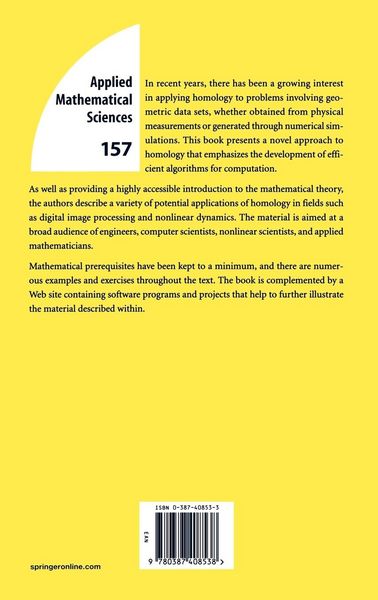
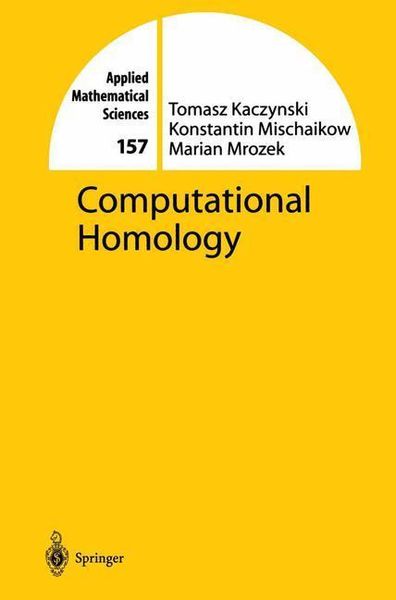
• Produktbild: Computational Homology
  • Produktbild: Computational Homology
  • Produktbild: Computational Homology
Band 157 - 18%

Computational Homology

18% sparen

112,99 € UVP 139,09 €

inkl. gesetzl. MwSt., Versandkostenfrei

Lieferung nach Hause

Beschreibung

Produktdetails

Einband

Gebundene Ausgabe

Erscheinungsdatum

09.01.2004

Verlag

Springer Us

Seitenzahl

482

Maße (L/B/H)

24/16,1/3,3 cm

Gewicht

1950 g

Auflage

2004

Sprache

Englisch

ISBN

978-0-387-40853-8

Beschreibung

Rezension

From the reviews:


"...This is an interesting and unusual book written with the intention of serving several purposes. One of them is to demonstrate that methods of algebraic topology, in particular homology theory, that have proved remarkably successful in several areas of pure mathematics can provide powerful, and in some cases indispensable, tools in a number of areas of applied mathematics and science. The second is to provide the necessary theory and "technology" for such applications. This means on the one hand providing all the necessary mathematical foundations of the subject, including definitions and theorems, and on the other hand efficient computational techniques capable of dealing with real life situations. Thus, the book stresses algorithmic and computational approaches; and in fact includes computer code written in a programming language specially designed for this purpose. It is addressed to a varied audience of computer scientists, experimental scientists and engineers while at the same time trying to retain the interest of mathematicians. With this in mind the authors have attempted to produce a modular book, which allows a number of different reading approaches. The basic subdivision of the book is into three parts. The last part contains all the basic pre-requisites from algebra and topology: the most essential facts about Euclidean spaces, point set topology, abelian groups, vector spaces and matrix algebras. This part also contains a description of the programming language used to describe the algorithms found in the book..." --MATHEMATICAL REVIEWS


"This is an interesting and unusual book with the intention of serving several purposes. One of them is to demonstrate that methods of algebraic topology, in particular homology theory … . The second is to provide the necessary theory and ‘technology’ for such applications. … the book admirably achieves all its stated purposes. In addition it will provide much neededammunition for those algebraic topologists who have been feeling besieged by allegations of their subject’s lack of ‘useful’ applications." (Andrzej Kozlowski, Mathematical Reviews, 2005g)


"This book provides the conceptual background for computational homology – a powerful tool used to study the properties of spaces and maps that are insensitive to small perturbations. The material presented here is a unique combination of current research and classical rigor, computation and application." (Corina Mohorianu, Zentralblatt Mathematik, Vol. 1039 (8), 2004)


"In addition to developing a computational homology theory which produces efficient algorithms, the authors demonstrate how these algorithms can be applied to a variety of problems … . I certainly recommend Computational Homology to mathematicians and applied scientists who wish to learn about the potential of algebraic topological methods. … this book is the first comprehensive effort to describe the computational aspects of homology theory … . It is written at a level that is suitable for advanced undergraduate and early graduate courses … ." (Thomas Wanner, SIAM Review, Vol. 48 (1). 2006)


"This is the first textbook on what is necessarily a mixture of classical mathematics, computer science, and applications. … it is a unique feature of Computational Homology that every geometric step, however conceptually simple, is broken down into elementary operations. … The book offers a reliable yet practical introduction to (cubical homology), with a strong emphasis on computational aspects. Hands-on experience can be gained through the many problems within the book and also by means of the software packages … ." (Arno Berger, Zeitschrift für Angewandte Mathematik und Mechanik, Vol. 86 (4). 2006)


Produktdetails

Einband

Gebundene Ausgabe

Erscheinungsdatum

09.01.2004

Verlag

Springer Us

Seitenzahl

482

Maße (L/B/H)

24/16,1/3,3 cm

Gewicht

1950 g

Auflage

2004

Sprache

Englisch

ISBN

978-0-387-40853-8

Herstelleradresse

Springer-Verlag GmbH
Tiergartenstr. 17
69121 Heidelberg
DE

Email: [email protected]

Kundinnen und Kunden meinen

0 Bewertungen

Informationen zu Bewertungen

Zur Abgabe einer Bewertung ist eine Anmeldung im Konto notwendig. Die Authentizität der Bewertungen wird von uns nicht überprüft. Wir behalten uns vor, Bewertungstexte, die unseren Richtlinien widersprechen, entsprechend zu kürzen oder zu löschen.

Die Bewertungen sind nach Format, Anzahl Sterne und Datum sortiert.

Verfassen Sie die erste Bewertung zu diesem Artikel

Helfen Sie anderen Kund*innen durch Ihre Meinung

Kundinnen und Kunden meinen

0 Bewertungen filtern

  • Produktbild: Computational Homology
  • Produktbild: Computational Homology
  • Produktbild: Computational Homology
  • Preface
    Part I Homology
    1 Preview
    1.1 Analyzing Images
    1.2 Nonlinear Dynamics
    1.3 Graphs
    1.4 Topological and Algebraic Boundaries
    1.5 Keeping Track of Directions
    1.6 Mod 2 Homology of Graphs
    2 Cubical Homology
    2.1 Cubical Sets
    2.1.1 Elementary Cubes
    2.1.2 Cubical Sets
    2.1.3 Elementary Cells
    2.2 The Algebra of Cubical Sets
    2.2.1 Cubical Chains
    2.2.2 Cubical Chains in a Cubical Set
    2.2.3 The Boundary Operator
    2.2.4 Homology of Cubical Sets
    2.3 Connected Components and H0(X)
    2.4 Elementary Collapses
    2.5 Acyclic Cubical Spaces
    2.6 Homology of Abstract Chain Complexes
    2.7 Reduced Homology
    2.8 Bibliographical Remarks
    3 Computing Homology Groups
    3.1 Matrix Algebra over Z
    3.2 Row Echelon Form
    3.3 Smith Normal Form
    3.4 Structure of Abelian Groups
    3.5 Computing Homology Groups
    3.6 Computing Homology of Cubical Sets
    3.7 Preboundary of a Cycle-Algebraic Approach
    3.8 Bibliographical Remarks
    4 Chain Maps and Reduction Algorithms
    4.1 Chain Maps
    4.2 Chain Homotopy
    4.3 Internal Elementary Reductions
    4.3.1 Elementary Collapses Revisited
    4.3.2 Generalization of Elementary Collapses
    4.4 CCR Algorithm
    4.5 Bibliographical Remarks
    5 PreviewofMaps
    5.1 Rational Functions and Interval Arithmetic
    5.2 Maps on an Interval
    5.3 Constructing Chain Selectors
    5.4 Maps of A1
    6 Homology of Maps
    6.1 Representable Sets
    6.2 Cubical Multivalued Maps
    6.3 Chain Selectors
    6.4 Homology of Continuous Maps
    6.4.1 Cubical Representations
    6.4.2 Rescaling
    6.5 Homotopy Invariance
    6.6 Bibliographical Remarks
    7 Computing Homology of Maps
    7.1 Producing Multivalued Representation
    7.2 Chain Selector Algorithm
    7.3 Computing Homology of Maps
    7.4 Geometric Preboundary Algorithm (optional section)
    7.5 Bibliographical Remarks
    Part II Extensions
    8 Prospects in Digital Image Processing
    8.1 Images and Cubical Sets
    8.2 Patterns from Cahn-Hilliard
    8.3 Complicated Time-Dependent Patterns
    8.4 Size Function
    8.5 Bibliographical Remarks
    9 Homological Algebra
    9.1 Relative Homology
    9.1.1 Relative Homology Groups
    9.1.2 Maps in Relative Homology
    9.2 Exact Sequences
    9.3 The Connecting Homomorphism
    9.4 Mayer-Vietoris Sequence
    9.5 Weak Boundaries
    9.6 Bibliographical Remarks
    10 Nonlinear Dynamics
    10.1 Maps and Symbolic Dynamics
    10.2 Differential Equations and Flows
    10.3 Wayzewski Principle
    10.4 Fixed-Point Theorems
    10.4.1 Fixed Points in the Unit Ball
    10.4.2 The Lefschetz Fixed-Point Theorem
    10.5 Degree Theory
    10.5.1 Degree on Spheres
    10.5.2 Topological Degree
    10.6 Complicated Dynamics
    10.6.1 Index Pairs and Index Map
    10.6.2 Topological Conjugacy
    10.7 Computing Chaotic Dynamics
    10.8 Bibliographical Remarks
    11 Homology of Topological Polyhedra
    11.1 Simplicial Homology
    11.2 Comparison of Cubical and Simplicial Complexes
    11.3 Homology Functor
    11.3.1 Category of Cubical Sets
    11.3.2 Connected Simple Systems
    11.4 Bibliographical Remarks
    Part III Tools from Topology and Algebra
    12 Topology
    12.1 Norms and Metrics in Rd
    12.2 Topology
    12.3 Continuous Maps
    12.4 Connectedness
    12.5 Limits and Compactness
    13 Algebra
    13.1 Abelian Groups
    13.1.1 Algebraic Operations
    13.1.2 Groups
    13.1.3 Cyclic Groups and Torsion Subgroup
    13.1.4 Quotient Groups
    13.1.5 Direct Sums
    13.2 Fields and Vector Spaces
    13.2.1 Fields
    13.2.2 Vector Spaces
    13.2.3 Linear Combinations and Bases
    13.3 Homomorphisms
    13.3.1 Homomorphisms of Groups
    13.3.2 Linear Maps
    13.3.3 Matrix Algebra
    13.4 Free Abelian Groups
    13.4.1 Bases in Groups
    13.4.2 Subgroups of Free Groups
    13.4.3 Homomorphisms of Free Groups
    14 Syntax of Algorithms
    14.1 Overview
    14.2 Data Structures
    14.2.1 Elementary Data Types
    14.2.2 Lists
    14.2.3 Arrays
    14.2.4 Vectors and Matrices
    14.2.5 Sets