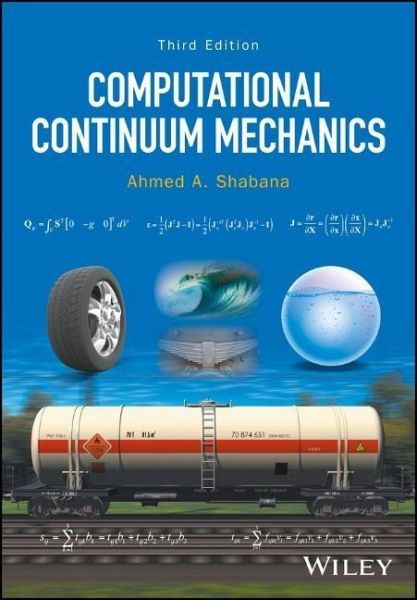
Computational Continuum Mechanics
Versandkostenfrei!
Versandfertig in über 4 Wochen
130,99 €
inkl. MwSt.
Weitere Ausgaben:

PAYBACK Punkte
65 °P sammeln!

An updated and expanded edition of the popular guide to basic continuum mechanics and computational techniquesThis updated third edition of the popular reference covers state-of-the-art computational techniques for basic continuum mechanics modeling of both small and large deformations. Approaches to developing complex models are described in detail, and numerous examples are presented demonstrating how computational algorithms can be developed using basic continuum mechanics approaches.The integration of geometry and analysis for the study of the motion and behaviors of materials under varyin...
An updated and expanded edition of the popular guide to basic continuum mechanics and computational techniques
This updated third edition of the popular reference covers state-of-the-art computational techniques for basic continuum mechanics modeling of both small and large deformations. Approaches to developing complex models are described in detail, and numerous examples are presented demonstrating how computational algorithms can be developed using basic continuum mechanics approaches.
The integration of geometry and analysis for the study of the motion and behaviors of materials under varying conditions is an increasingly popular approach in continuum mechanics, and absolute nodal coordinate formulation (ANCF) is rapidly emerging as the best way to achieve that integration. At the same time, simulation software is undergoing significant changes which will lead to the seamless fusion of CAD, finite element, and multibody system computer codes in one computational environment. Computational Continuum Mechanics, Third Edition is the only book to provide in-depth coverage of the formulations required to achieve this integration.
_ Provides detailed coverage of the absolute nodal coordinate formulation (ANCF), a popular new approach to the integration of geometry and analysis
_ Provides detailed coverage of the floating frame of reference (FFR) formulation, a popular well-established approach for solving small deformation problems
_ Supplies numerous examples of how complex models have been developed to solve an array of real-world problems
_ Covers modeling of both small and large deformations in detail
_ Demonstrates how to develop computational algorithms using basic continuum mechanics approaches
Computational Continuum Mechanics, Third Edition is designed to function equally well as a text for advanced undergraduates and first-year graduate students and as a working reference for researchers, practicing engineers, and scientists working in computational mechanics, bio-mechanics, computational biology, multibody system dynamics, and other fields of science and engineering using the general continuum mechanics theory.
This updated third edition of the popular reference covers state-of-the-art computational techniques for basic continuum mechanics modeling of both small and large deformations. Approaches to developing complex models are described in detail, and numerous examples are presented demonstrating how computational algorithms can be developed using basic continuum mechanics approaches.
The integration of geometry and analysis for the study of the motion and behaviors of materials under varying conditions is an increasingly popular approach in continuum mechanics, and absolute nodal coordinate formulation (ANCF) is rapidly emerging as the best way to achieve that integration. At the same time, simulation software is undergoing significant changes which will lead to the seamless fusion of CAD, finite element, and multibody system computer codes in one computational environment. Computational Continuum Mechanics, Third Edition is the only book to provide in-depth coverage of the formulations required to achieve this integration.
_ Provides detailed coverage of the absolute nodal coordinate formulation (ANCF), a popular new approach to the integration of geometry and analysis
_ Provides detailed coverage of the floating frame of reference (FFR) formulation, a popular well-established approach for solving small deformation problems
_ Supplies numerous examples of how complex models have been developed to solve an array of real-world problems
_ Covers modeling of both small and large deformations in detail
_ Demonstrates how to develop computational algorithms using basic continuum mechanics approaches
Computational Continuum Mechanics, Third Edition is designed to function equally well as a text for advanced undergraduates and first-year graduate students and as a working reference for researchers, practicing engineers, and scientists working in computational mechanics, bio-mechanics, computational biology, multibody system dynamics, and other fields of science and engineering using the general continuum mechanics theory.
Andere Kunden interessierten sich für