Complementary and Alternative Medicine Legal Boundaries and Regulatory Perspectives
-
- Taschenbuch ausgewählt
- eBook
-
Sprache:Englisch
45,99 €
inkl. gesetzl. MwSt.,
Lieferung nach Hause
Beschreibung
Produktdetails
Einband
Taschenbuch
Erscheinungsdatum
01.01.1998
Verlag
Johns Hopkins University PressSeitenzahl
208
Maße (L/B/H)
22,9/15,2/1,2 cm
Gewicht
346 g
Sprache
Englisch
ISBN
978-0-8018-5689-1
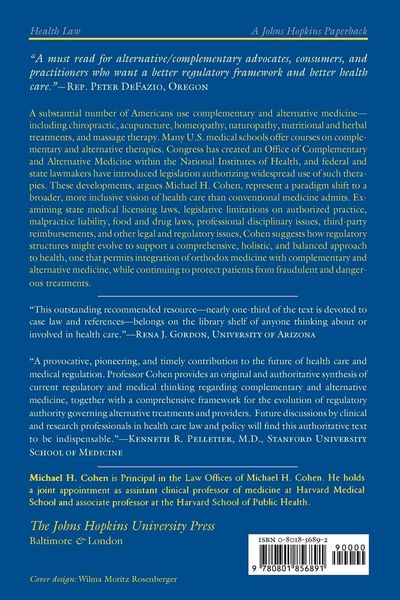
Explores the legal issues that health care providers, institutions, and regulators confront as they contemplate integrating complementary and alternative medicine into mainstream U.S. health care.
A third of all Americans use complementary and alternative medicine--including chiropractic, acupuncture, homeopathy, naturopathy, nutritional and herbal treatments, and massage therapy--even when their insurance does not cover it and they have to pay for such treatments themselves. Nearly a third of U.S. medical schools offer courses on complementary and alternative therapies. Congress has created an Office of Alternative Medicine within the National Institutes of Health, and federal and state lawmakers have introduced legislation authorizing widespread use of such therapies. These institutional and legislative developments, argues Michael H. Cohen, express a paradigm shift to a broader, more inclusive vision of health care than conventional medicine admits.
Cohen explores the legal issues that health care providers (both conventional and alternative), institutions, and regulators confront as they contemplate integrating complementary and alternative medicine into mainstream U.S. health care. Challenging traditional ways of thinking about health, disease, and the role of law in regulating health, Cohen begins by defining complementary and alternative medicine and then places the regulation of orthodox and alternative health care in historical context. He next examines the legal ramifications of complementary and alternative medicine, including state medical licensing laws, legislative limitations on authorized practice, malpractice liability, food and drug laws, professional disciplinary issues, and third-party reimbursement. The final chapter provides a framework for thinking about the possible evolution of the regulatory structure.
This book is the first to set forth the emerging moral and legal authority on which the safe and effective practice of alternative health care can rest. It further suggests how regulatory structures might develop to support a comprehensive, holistic, and balanced approach to health, one that permits integration of orthodox medicine with complementary and alternative medicine, while continuing to protect patients from fraudulent and dangerous treatments.
Kundinnen und Kunden meinen
Verfassen Sie die erste Bewertung zu diesem Artikel
Helfen Sie anderen Kund*innen durch Ihre Meinung
Kurze Frage zu unserer Seite
Vielen Dank für dein Feedback
Wir nutzen dein Feedback, um unsere Produktseiten zu verbessern. Bitte habe Verständnis, dass wir dir keine Rückmeldung geben können. Falls du Kontakt mit uns aufnehmen möchtest, kannst du dich aber gerne an unseren Kund*innenservice wenden.
zum Kundenservice