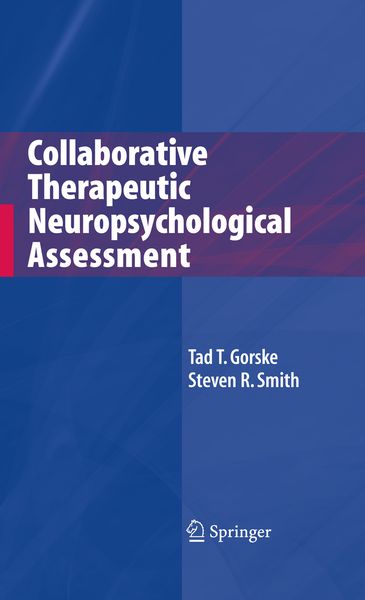
Collaborative Therapeutic Neuropsychological Assessment
-
- Hardcover ausgewählt
- Taschenbuch
- eBook
-
Sprache:Englisch
111,99 €
UVP
128,39 €
inkl. MwSt,
Lieferung nach Hause
Beschreibung
Details
Einband
Gebundene Ausgabe
Erscheinungsdatum
20.10.2008
Abbildungen
XIV, 8 illus., schwarz-weiss Illustrationen
Verlag
Springer UsSeitenzahl
152
Maße (L/B/H)
24,5/16,4/1,5 cm
Gewicht
375 g
Auflage
2009 edition
Sprache
Englisch
ISBN
978-0-387-75425-3
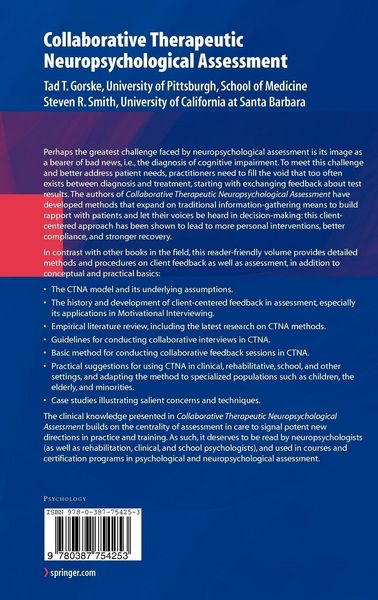
One of the challenges the field of clinical neuropsychology faces is to develop an assessment process that is relevant and responsive to the needs of patients. Indeed, it has been suggested that the survival of neuropsychology as a clinical discipline may be threatened due to an overemphasis on diagnosing cognitive deficits as opposed to developing methods that meet patients’ needs. One way to meet this need is for psychologists to extend their services by developing clinical interventions that contribute to enhancing patients’ cognitive and emotional well-being. Providing feedback from the results of neuropsychological tests is one method suggested as a way to enhance patient care and satisfaction with the assessment process while providing a link between clinical assessment and therapeutic interventions.
In current practice, providing feedback to patients about the results of neuropsychological assessments has been considered an optional procedure by clinicians and thus received little attention in the literature. Yet there is evidence that when feedback is provided to patients the effects are overwhelmingly positive. Feedback provides a bridge between assessment and treatment by facilitating the development of applicable treatment plans. There is no agreed upon conceptual framework for providing feedback from neuropsychological assessment, although researchers have made recommendations. However, these recommendations have done little to affect clinical practice and training despite the fact that including patient-oriented feedback enhances the likelihood that neuropsychological assessment will remain a relevant and important component of patient care. The purpose of this proposed book is to first describe developments in methods of neuropsychological assessment feedback that involve active collaboration with patients in an open exchange of information and results. Second, we will present a comprehensive model for conducting neuropsychologicalassessment feedback. The authors of this book are expert clinical practitioners and academic researchers who are at the forefront of the development and implementation of Collaborative Therapeutic Neuropsychological Assessment methods. Table of contents follows.
Unsere Kundinnen und Kunden meinen
Verfassen Sie die erste Bewertung zu diesem Artikel
Helfen Sie anderen Kund*innen durch Ihre Meinung
Kurze Frage zu unserer Seite
Vielen Dank für dein Feedback
Wir nutzen dein Feedback, um unsere Produktseiten zu verbessern. Bitte habe Verständnis, dass wir dir keine Rückmeldung geben können. Falls du Kontakt mit uns aufnehmen möchtest, kannst du dich aber gerne an unseren Kund*innenservice wenden.
zum Kundenservice