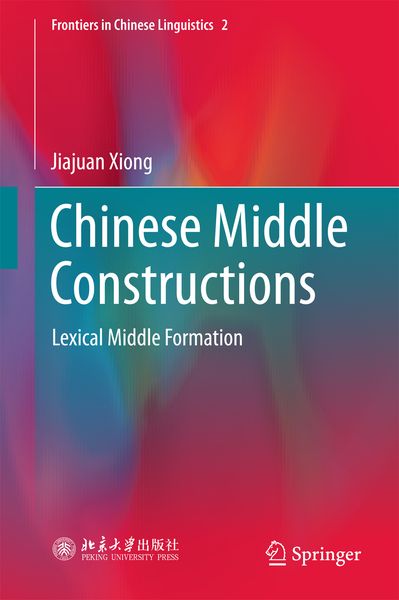
Produktbild: Chinese Middle Constructions
Band 2

Chinese Middle Constructions Lexical Middle Formation

48,99 €

inkl. gesetzl. MwSt., Versandkostenfrei

Lieferung nach Hause

Beschreibung

Produktdetails

Einband

Gebundene Ausgabe

Erscheinungsdatum

24.11.2017

Abbildungen

XXII, 1 illus., schwarz-weiss Illustrationen

Verlag

Springer Singapore

Seitenzahl

290

Maße (L/B/H)

24,1/16/2,3 cm

Gewicht

635 g

Auflage

1st edition 2018

Sprache

Englisch

ISBN

978-981-10-6186-8

Beschreibung

Produktdetails

Einband

Gebundene Ausgabe

Erscheinungsdatum

24.11.2017

Abbildungen

XXII, 1 illus., schwarz-weiss Illustrationen

Verlag

Springer Singapore

Seitenzahl

290

Maße (L/B/H)

24,1/16/2,3 cm

Gewicht

635 g

Auflage

1st edition 2018

Sprache

Englisch

ISBN

978-981-10-6186-8

Herstelleradresse

Springer-Verlag GmbH
Tiergartenstr. 17
69121 Heidelberg
DE

Email: [email protected]

Kundinnen und Kunden meinen

0 Bewertungen

Informationen zu Bewertungen

Zur Abgabe einer Bewertung ist eine Anmeldung im Konto notwendig. Die Authentizität der Bewertungen wird von uns nicht überprüft. Wir behalten uns vor, Bewertungstexte, die unseren Richtlinien widersprechen, entsprechend zu kürzen oder zu löschen.

Die Bewertungen sind nach Format, Anzahl Sterne und Datum sortiert.

Verfassen Sie die erste Bewertung zu diesem Artikel

Helfen Sie anderen Kund*innen durch Ihre Meinung

Kundinnen und Kunden meinen

0 Bewertungen filtern

  • Produktbild: Chinese Middle Constructions
  • Chapter 1 The Middle Voice vs. the Middle Construction1.1 The Middle Voice1.2 The Middle Construction1.3 The Relationship between the “Middle Voice” and the “Middle Construction”1.4 Chinese Middle ConstructionsChapter 2 Middle Constructions: Previous Research2.1 Syntactic Approaches2.2 Lexical Approaches2.3 Semantic Approaches2.4 Parametric Approaches2.5 Chapter SummaryChapter 3 The Qilai Middle3.1 The Various Usages of Qilai3.2 The [NP Theme V-qilai AP] Pattern3.3 The Middlehood of the [NP theme V-qilai AP] Structure3.4 Verbal Constraints on the Qilai Middle3.5 The Qilai Adjunct Middle3.6 Ditransitivity in the Qilai Middle3.7 Chapter SummaryChapter 4 The Hao and Rongyi/nan Middles4.1 Two Different Uses of the Prefix Hao4.2 Hao versus Rongyi/Nan4.3 The Hao Construction Versus the Rongyi/Nan Construction4.4 The Middle Construction Versus the Tough Construction4.5 Verbal Constraints on the Hao Middle and the Rongyi/Nan Middle4.6 Are There Any Hao/Rongyi/Nan Adjunct Middles?4.7 Ditransitivity in the Hao/Rongyi/Nan Middles4.8 Chapter SummaryChapter 5 The De and Bu Middles5.1 The Semantic Volatility of De Constructions5.2 The Syntactic Analyses of the three De Constructions5.3 [NP Theme V-bu-A theme ]: the Unergative5.4 [NP Theme V-de-A theme ] and [NP Theme V-bu-A theme ]: the Middles5.5 Formational Constraints on the De-middle and the Bu-middle5.6 Are There Any Adjunct De-middles or Bu-middles?5.7 Are De and Bu Full-fledged Modals?5.8 More on De: Its Chengdu Chinese Counterpart Te5.9 Chapter SummaryChapter 6 More on Chinese Middles6.1 Transitive Middles6.2 Genericity in Chinese6.3 Theme-as-Subject Constructions in Chinese6.4 Lexical Middles: Unergative and Transitive6.5 Unergativity at the Clausal Level6.6 Chapter SummaryChapter 7 Conclusions7.1 Summary of the Dissertation7.2 Questions for Future ResearchAppendix 1Appendix 2References