• Produktbild: Chinese Lexical Semantics
  • Produktbild: Chinese Lexical Semantics
Band 8922

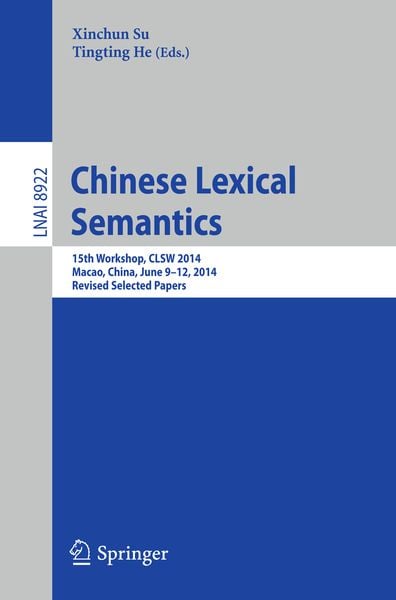
Chinese Lexical Semantics 15th Workshop, CLSW 2014, Macao, China, June 9--12, 2014, Revised Selected Papers

49,99 €

inkl. gesetzl. MwSt., Versandkostenfrei

Lieferung nach Hause

Beschreibung

Produktdetails

Einband

Taschenbuch

Erscheinungsdatum

14.01.2015

Abbildungen

XIV, 80 illus., schwarz-weiss Illustrationen

Herausgeber

Xinchun Su + weitere

Verlag

Springer

Seitenzahl

450

Maße (L/B/H)

23,5/15,5/2,5 cm

Gewicht

734 g

Auflage

2014

Sprache

Englisch

ISBN

978-3-319-14330-9

Beschreibung

Produktdetails

Einband

Taschenbuch

Erscheinungsdatum

14.01.2015

Abbildungen

XIV, 80 illus., schwarz-weiss Illustrationen

Herausgeber

Verlag

Springer

Seitenzahl

450

Maße (L/B/H)

23,5/15,5/2,5 cm

Gewicht

734 g

Auflage

2014

Sprache

Englisch

ISBN

978-3-319-14330-9

Herstelleradresse

Springer-Verlag KG
Sachsenplatz 4-6
1201 Wien
AT

Email: [email protected]

Kundinnen und Kunden meinen

0 Bewertungen

Informationen zu Bewertungen

Zur Abgabe einer Bewertung ist eine Anmeldung im Konto notwendig. Die Authentizität der Bewertungen wird von uns nicht überprüft. Wir behalten uns vor, Bewertungstexte, die unseren Richtlinien widersprechen, entsprechend zu kürzen oder zu löschen.

Die Bewertungen sind nach Format, Anzahl Sterne und Datum sortiert.

Verfassen Sie die erste Bewertung zu diesem Artikel

Helfen Sie anderen Kund*innen durch Ihre Meinung

Kundinnen und Kunden meinen

0 Bewertungen filtern

  • Produktbild: Chinese Lexical Semantics
  • Produktbild: Chinese Lexical Semantics
  • Lexical semantics.- Embedded Compounding Monosyllabic Morphemes: a perspective from the Lexical Study and TCFL.- Word Ordering in Chinese Opposite Compounds.- Study on Prosodic Morphology of Chinese Verbal Monosyllabic-Disyllabic Synonyms.- Semantic Derivation of the “吃 [chi] (eat) + Object” Idiom in Mandarin, Taiwanese and Hakka.- On the Lexical Meaning of Conditional Connectives in Chinese.- Combination of Mandarin Chinese Verb “xiě” and Nouns from the Perspective of Generative Lexicon Theory.- The Mechanism behind Idioms’ Meaning Extension.- A Cognitive Grammar Approach to Relative Antonyms.- Instantiations of the Generation Mechanism of A-not-A Question in Chinese and Some Relevant Syntactic Issues.- A Reanalysis of Chinese Passive with a Retained Object.- Quantitative Research on the Origins of Contemporary Chinese Vocabulary Based on The Great Chinese Dictionary .- The Ergativization of the Verb “死”[si](Die) in Chinese Language History.- Grammaticalization and Subjectivization of “Po”.- On chi: its Gestalt and Collocations.- The Nature of men and Its Co-occurrence with Numeral Expressions in Mandarin Chinese.- A Study on the Causative Alternation from a Non-derivational Perspective.- The Processing of Dummy Verbs in Semantic Role Labeling.- Categorization and Intensity of Chinese Emotion Words.- Lexical Semantic Restrictions on the Syntactic Representation of the Semantic Roles of Pinjie Class.- Syntactic Distribution of Motion Agents’ Concept from the Redundancy of Leg Nouns.- Investigate into the Cognitive Motivation of the Derivative Meaning of Words: The Case of Luojuan.- Applications on Natural Language Processing.- A Rule-Based Method for Identifying Patterns in Old Chinese Sentences.- Semi-supervised Sentiment Classification with Self-training on Feature Subspaces.- The Effect of Modifiers for Sentiment Analysis.- Word Relevance Computation for Noun-noun Metaphor Recognition.- Learning Semantic Similarity for Multi-Label Text Categorization.- Latent Semantic Distance between Chinese Basic Words and Non-basic Words.- Manual Investigation on Context for Word Sense Disambiguation.- Conventionalizing Common Sense for Chinese Textual Entailment Recognition.- Scale-Free Distribution in Chinese Semantic Field Network: a Main Cause of Using the Shortest Path Length for Representing Semantic Distance between Terms.- Recognition and Extraction of Honorifics in Chinese Diachronic Corpora.- A Hypothesis on Word Similarity and Its Application.- Lexical Resources and Corpus Linguistics.- Chinese Near-synonym Study Based on the Chinese Gigaword Corpus and the Chinese Learner Corpus.- Semantic Labeling of Chinese Verb-complement Structure Based on Feature Structure.- Structurally and Functionally Comparative Analysis of Lexical Bundles in the English Abstracts of Chinese and International Journals.- Corpus Building for the Outcome-based Education of the Ancient Chinese Courses.- Building Chinese Semantic Treebank for Patent Text on the Basis of 3 Dimensional Dynamic Concept Model.- Statistics and Analysis of Coordination Structures in Patent Text.- Syntactic Distribution, Semantic Framework, and Pragmatic Function of the Modal Adverb Meizhun (Maybe).- Preliminary Study on the Construction of Bilingual Phrase Structure Treebank.- Quantitative Analysis of “ADV+N” via Cognitive Property Knowledge base.- Annotating Principal Event Chain in Chinese Texts.- A Study on Metaphors in Idioms Based on Chinese Idiom Knowledge Base.- Generalized Case Theory and the Argument-omission Structure in Mandarin Chinese.