
Cellular-Molecular Mechanisms in Epigenetic Evolutionary Biology
-
- Hardcover ausgewählt
- Taschenbuch
- eBook
-
Sprache:Englisch
174,99 €
inkl. MwSt,
Lieferung nach Hause
Beschreibung
Details
Einband
Gebundene Ausgabe
Erscheinungsdatum
14.02.2020
Verlag
SpringerSeitenzahl
214
Maße (L/B/H)
24,1/16/1,9 cm
Gewicht
496 g
Auflage
1st ed. 2020
Sprache
Englisch
ISBN
978-3-030-38132-5
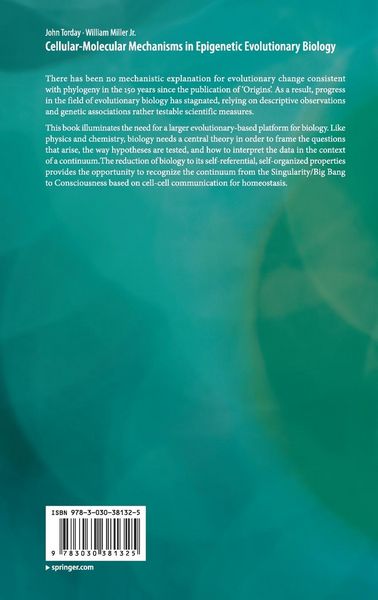
There has been no mechanistic explanation for evolutionary change consistent with phylogeny in the 150 years since the publication of ‘Origins’. As a result, progress in the field of evolutionary biology has stagnated, relying on descriptive observations and genetic associations rather testable scientific measures.
This book illuminates the need for a larger evolutionary-based platform for biology. Like physics and chemistry, biology needs a central theory in order to frame the questions that arise, the way hypotheses are tested, and how to interpret the data in the context of a continuum.The reduction of biology to its self-referential, self-organized properties provides the opportunity to recognize the continuum from the Singularity/Big Bang to Consciousness based on cell-cell communication for homeostasis.
Unsere Kundinnen und Kunden meinen
Verfassen Sie die erste Bewertung zu diesem Artikel
Helfen Sie anderen Kund*innen durch Ihre Meinung
Kurze Frage zu unserer Seite
Vielen Dank für dein Feedback
Wir nutzen dein Feedback, um unsere Produktseiten zu verbessern. Bitte habe Verständnis, dass wir dir keine Rückmeldung geben können. Falls du Kontakt mit uns aufnehmen möchtest, kannst du dich aber gerne an unseren Kund*innenservice wenden.
zum Kundenservice