Gutscheinbedingungen

**Gültig vom 15.06.2026 bis 17.06.2026 | Gültig für nicht preisgebundene fremdsprachige Bücher | Einzelne Artikel können ausgeschlossen sein | Maximaler rabattfähiger Warenkorbwert 500 € | Nicht kombinierbar mit weiteren Aktionen | Nur einmal pro Person einlösbar | Nur solange der Vorrat reicht

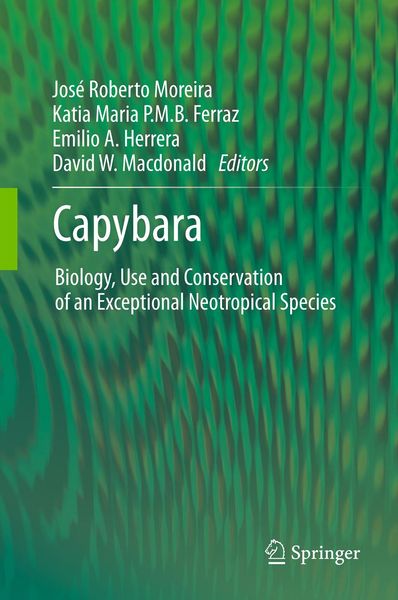
  • Produktbild: Capybara
  • Produktbild: Capybara
- 13%

Capybara Biology, Use and Conservation of an Exceptional Neotropical Species

13% sparen

213,99 € UVP 246,09 €

inkl. gesetzl. MwSt., Versandkostenfrei

Lieferung nach Hause

Beschreibung

Produktdetails

Einband

Gebundene Ausgabe

Erscheinungsdatum

16.08.2012

Herausgeber

José Roberto Moreira + weitere

Verlag

Springer Us

Seitenzahl

422

Maße (L/B/H)

24,1/16/2,7 cm

Gewicht

774 g

Auflage

2013

Sprache

Englisch

ISBN

978-1-4614-3999-8

Beschreibung

Produktdetails

Einband

Gebundene Ausgabe

Erscheinungsdatum

16.08.2012

Herausgeber

Verlag

Springer Us

Seitenzahl

422

Maße (L/B/H)

24,1/16/2,7 cm

Gewicht

774 g

Auflage

2013

Sprache

Englisch

ISBN

978-1-4614-3999-8

Herstelleradresse

Springer-Verlag GmbH
Tiergartenstr. 17
69121 Heidelberg
DE

Email: ProductSafety@springernature.com

Kundinnen und Kunden meinen

0 Bewertungen

Informationen zu Bewertungen

Zur Abgabe einer Bewertung ist eine Anmeldung im Konto notwendig. Die Authentizität der Bewertungen wird von uns nicht überprüft. Wir behalten uns vor, Bewertungstexte, die unseren Richtlinien widersprechen, entsprechend zu kürzen oder zu löschen.

Die Bewertungen sind nach Format, Anzahl Sterne und Datum sortiert.

Verfassen Sie die erste Bewertung zu diesem Artikel

Helfen Sie anderen Kund*innen durch Ihre Meinung

Kundinnen und Kunden meinen

0 Bewertungen filtern

Weitere Artikel findest du in

  • Produktbild: Capybara
  • Produktbild: Capybara
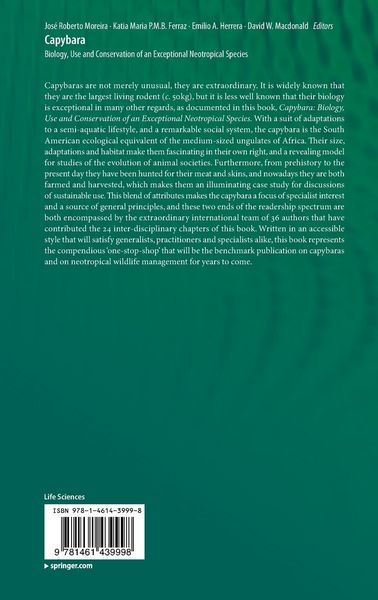
  • Foreword.- Preface.- Part I: Biology, Ecology and Evolution.- Taxonomy, natural history and distribution of the capybara.- Paleontology, evolution and systematics of capybara.- Phylogenetics of Caviomorph rodents and genetic perspectives on the evolution of sociality and mating systems in the Caviidae.- Foraging strategies and feeding habits of capybaras.- Capybara digestive adaptations.- Reproductive morphology and physiology of the male capybara.- Morphology and reproductive physiology of female capybaras.- Capybara demographic traits.- Diseases of capybara.- Capybara scent glands and scent-marking behavior.- Capybara social behavior and use of space: patterns and processes.- Part II: Production.- Products and uses of capybaras.- Confined and semi-confined production systems for capybaras.- Social and spatial relationships of capybaras in a semi-confined production system.- Feeds and nutrition of farmed capybaras.- The impact of management practices on female capybara reproductive parameters in captivity.- The sustainable management of capybaras.- Part III: Conservation.- Capybaras as a source of protein: utilization and management in Venezuela.- Conservation and use of the capybara and the lesser capybara in Colombia.- Capybara production in Brazil: captive breeding or sustainable management?.- Capybaras use in Argentina.- Counting capybaras.- Brazilian spotted fever: the role of capybaras.- The capybara paradigm: from sociality to sustainability.- Index.