Gutscheinbedingungen

**Gültig bis 10.06.2026 / Gültig für gebrauchte Bücher / Mindestbestellwert 20,00 € / Einzelne Artikel können ausgeschlossen sein / Online auf www.bücher.de.de / Nicht kombinierbar mit anderen Gutscheinen oder Preisaktionen / Nur einmal pro Einkauf einlösbar / Gutschein wird auf max. 500€ Bestellwert angerechnet / Keine Barauszahlung / Nicht gültig für Versandkosten und Services

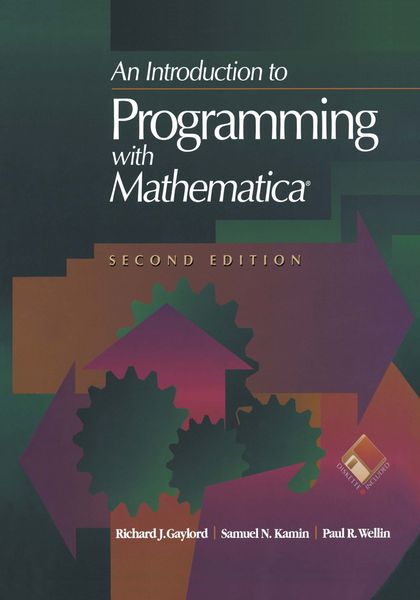
  • Produktbild: An Introduction to Programming with Mathematica®
  • Produktbild: An Introduction to Programming with Mathematica®

An Introduction to Programming with Mathematica®

49,99 €

inkl. gesetzl. MwSt., Versandkostenfrei

Lieferung nach Hause

Beschreibung

Produktdetails

Einband

Taschenbuch

Erscheinungsdatum

28.09.2011

Verlag

Springer Us

Seitenzahl

452

Maße (L/B/H)

25,4/17,8/2,6 cm

Gewicht

893 g

Auflage

Second Edition 1996

Sprache

Englisch

ISBN

978-1-4612-7502-2

Beschreibung

Produktdetails

Einband

Taschenbuch

Erscheinungsdatum

28.09.2011

Verlag

Springer Us

Seitenzahl

452

Maße (L/B/H)

25,4/17,8/2,6 cm

Gewicht

893 g

Auflage

Second Edition 1996

Sprache

Englisch

ISBN

978-1-4612-7502-2

Herstelleradresse

Springer-Verlag GmbH
Tiergartenstr. 17
69121 Heidelberg
DE

Email: ProductSafety@springernature.com

Kundinnen und Kunden meinen

0 Bewertungen

Informationen zu Bewertungen

Zur Abgabe einer Bewertung ist eine Anmeldung im Konto notwendig. Die Authentizität der Bewertungen wird von uns nicht überprüft. Wir behalten uns vor, Bewertungstexte, die unseren Richtlinien widersprechen, entsprechend zu kürzen oder zu löschen.

Die Bewertungen sind nach Format, Anzahl Sterne und Datum sortiert.

Verfassen Sie die erste Bewertung zu diesem Artikel

Helfen Sie anderen Kund*innen durch Ihre Meinung

Kundinnen und Kunden meinen

0 Bewertungen filtern

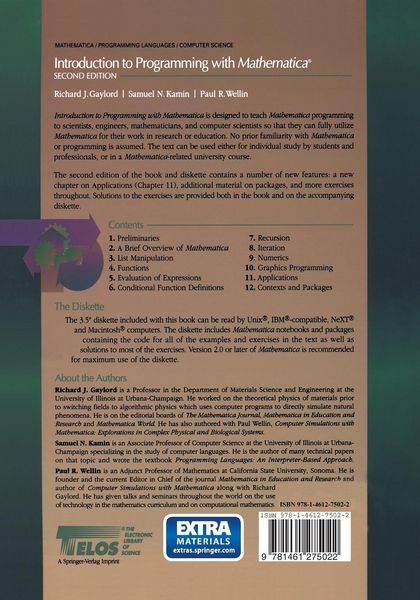
  • Produktbild: An Introduction to Programming with Mathematica®
  • Produktbild: An Introduction to Programming with Mathematica®
  • 1 Preliminaries.- 1.1 Introduction.- 1.2 Using Mathematica.- 1.2.1 Getting Into and Out of Mathematica.- 1.2.2 Getting Help.- 1.2.3 The Syntax of Inputs.- 1.2.4 Errors.- 1.3 The Mathematica Language.- 1.3.1 Internal Forms of Expressions.- 1.3.2 Predicates and Boolean Operations.- 1.3.3 Evaluation of Expressions.- 1.3.4 Attributes.- 1.4 The Mathematica Interface.- 1.4.1 The Notebook Front End.- 1.4.2 The Command Line Interface.- 2 A Brief Overview of Mathematica.- 2.1 Numerical and Symbolic Computations.- 2.2 Functions.- 2.2.1 Functions of Number Theory.- 2.2.2 Functions of Linear Algebra.- 2.2.3 Random Number Generators.- 2.2.4 Packages.- 2.3 Graphics.- 2.3.1 Two-Dimensional Plots.- 2.3.2 Parametric Plots.- 2.3.3 Three-Dimensional Plots.- 2.4 Representation of Data.- 2.5 Programming.- 2.5.1 Example-Harmonic Numbers.- 2.5.2 Example—Perfect Numbers.- 3 List Manipulation.- 3.1 Introduction.- 3.2 Creating and Measuring Lists.- 3.2.1 List Construction.- 3.2.2 Dimensions of Lists.- 3.3 Working With the Elements of a List.- 3.3.1 Positions in a List.- 3.3.2 Extracting Elements and Rearranging Lists.- 3.4 Working with Several Lists.- 3.5 Higher-Order Functions.- 3.6 Applying Functions to Lists Repeatedly.- 3.7 Strings and Characters.- 4 Functions.- 4.1 Introduction.- 4.2 Programs as Functions.- 4.2.1 Nesting Function Calls.- 4.2.2 Value Names.- 4.3 User-Defined Functions.- 4.4 Auxiliary Functions.- 4.4.1 Compound Functions.- 4.4.2 Localizing Names.- 4.5 Anonymous Functions.- 4.6 One-Liners.- 4.6.1 The Josephus Problem.- 4.6.2 Pocket Change.- 5 Evaluation of Expressions.- 5.1 Introduction.- 5.2 Creating Rewrite Rules.- 5.2.1 The Global Rule Base.- 5.3 Expressions.- 5.3.1 Atoms.- 5.4 Patterns.- 5.4.1 Blanks.- 5.4.2 Expression Pattern-Matching.- 5.4.3 Sequence Pattern-Matching.- 5.4.4 Conditional Pattern-Matching.- 5.4.5 Alternatives.- 5.5 Term Rewriting.- 5.6 Transformation Rules.- 6 Conditional Function Definitions.- 6.1 Introduction.- 6.2 Conditional Functions.- 6.3 Example—Classifying Points.- 7 Recursion.- 7.1 Fibonacci Numbers.- 7.2 List Functions.- 7.3 Thinking Recursively.- 7.4 Recursion and Symbolic Computations.- 7.5 Gaussian Elimination.- 7.6 Trees.- 7.6.1 Binary Trees.- 7.6.2 Huffman Encoding.- 7.7 Dynamic Programming.- 7.8 Higher-Order Functions and Recursion.- 7.9 Debugging.- 7.9.1 Tracing Evaluation.- 7.9.2 Printing Variables.- 7.9.3 Common Errors.- 8 Iteration.- 8.1 Newtons Method.- 8.1.1 Do Loops.- 8.1.2 While Loops.- 8.2 Vectors and Matrices.- 8.2.1 List Component Assignment.- 8.2.2 Finding prime numbers.- 8.3 Passing Arrays to Functions.- 8.4 Gaussian Elimination Revisited.- 9 Numerics.- 9.1 Types of Numbers.- 9.1.1 Integers and Rationals.- 9.1.2 Real Numbers.- 9.1.3 Complex Numbers.- 9.1.4 Computing with Different Number Types.- 9.1.5 Digits and Number Bases.- 9.2 Random Numbers.- 9.3 Precision and Accuracy.- 9.3.1 Roundoff Errors.- 9.4 Numerical Computations.- 9.4.1 Newton’s Method Revisited.- 9.4.2 Gaussian Elimination Revisited Again.- 10 Graphics Programming.- 10.1 Graphics Primitives.- 10.1.1 Two-Dimensional Graphics Primitives.- 10.1.2 Three-Dimensional Graphics Primitives.- 10.2 Graphics Directives and Options.- 10.3 Built-in Graphics Functions.- 10.3.1 The Structure of Built-in Graphics.- 10.3.2 Graphics Anomalies.- 10.3.3 Options for Built-in Graphics Functions.- 10.4 Graphics Programming.- 10.4.1 Simple Closed Paths.- 10.4.2 Drawing Trees.- 10.5 Sound.- 10.5.1 The Sound of Mathematics.- 10.5.2 White Music, Brownian Music, and Fractal Noise.- 11 Applications.- 11.1 The Random Walk.- 11.1.1 Introduction.- 11.1.2 The One-Dimensional Random Walk.- 11.1.3 The Two-Dimensional Lattice Walk.- 11.1.4 Visualizing The Two-Dimensional Lattice Walk.- 11.1.5 Numerical Analysis Of The Two-Dimensional Lattice Walk.- 11.2 The Game of Life.- 11.3 Implementing Languages.- 12 Contexts and Packages.- 12.1 Introduction.- 12.2 Using Packages.- 12.2.1 Loading Packages.- 12.2.2 Finding Out What s in a Package.- 12.3 Contexts.- 12.4 Packages.- 12.5 Avoiding Name Collisions.- 12.6 The BaseConvert Package.- 12.7 The RandomWalks Package.- 12.7.1 Adding Options and Defaults.- 12.7.2 The RandomWalks Package.- References.