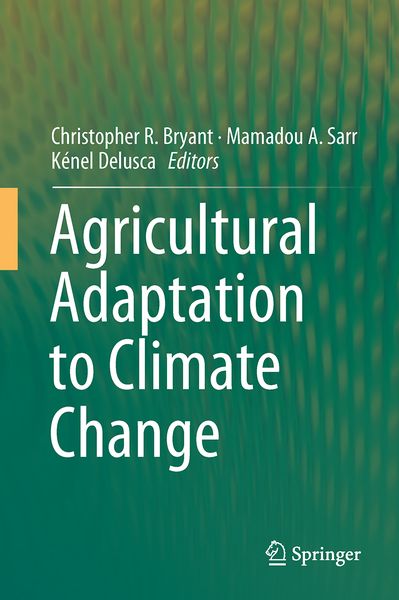
Agricultural Adaptation to Climate Change
-
- Hardcover ausgewählt
- Taschenbuch
- eBook
-
Sprache:Englisch
95,99 €
UVP
106,99 €
inkl. MwSt,
Lieferung nach Hause
Beschreibung
Details
Einband
Gebundene Ausgabe
Erscheinungsdatum
07.09.2016
Abbildungen
XIII, 38 illus., 20 illus. in color., schwarz-weiss Illustrationen, farbige Illustrationen
Herausgeber
Christopher R. Bryant + weitereVerlag
SpringerSeitenzahl
234
Maße (L/B/H)
24,1/16/1,9 cm
Gewicht
633 g
Auflage
1st ed. 2016
Sprache
Englisch
ISBN
978-3-319-31390-0
This book deals with one of the major challenges facing human society and its governments, climate change and variability. The principal objective of the book is to explore how agricultural production through the actions primarily of farmers, including peasant farmers, adapt to these changing circumstances, what the limitations of adaptation are, how the process of adaptation varies between different territories (e.g. developed countries versus developing countries), and what are or can be the most effective roles for actors other than the farmers, including different levels of government and non-governmental organizations (NGOs) such as professional associations of farmers and community organizations.
The principal argument is threefold: 1) while there are significant differences between territories and countries in terms of the capacity of farmers (and the other actors) to engage in capacity building to be able to adapt effectively to climate change and variability, 2) the critical roles are those played out by the farmers themselves, but that 3) other actors can play an important role in accompanying farmers in their adaptation process, providing relevant and strategic information, counseling them and facilitating networking and meetings when appropriate. This effectively means that without engaging in the local adaptation processes governments can really only play effective roles by working with other actors at the local and regional levels. When it occurs, it can be very effective, but when it does not, farmers are left to their own devices (and even then, many are able to use their own creativity and local knowledge to survive and continue to develop).
Essentially therefore, the secondary argument that is followed throughout the book is that adaptation is essentially a social process that requires an understanding of social processes and dynamics in each farming community and territory. It involves an understanding, for instance, of information diffusion processes in the different farming communities and territories, which provides a set of tools to promote and facilitate the adoption process in the context of adaptation to climate change and variability.
Unsere Kundinnen und Kunden meinen
Verfassen Sie die erste Bewertung zu diesem Artikel
Helfen Sie anderen Kund*innen durch Ihre Meinung
Kurze Frage zu unserer Seite
Vielen Dank für dein Feedback
Wir nutzen dein Feedback, um unsere Produktseiten zu verbessern. Bitte habe Verständnis, dass wir dir keine Rückmeldung geben können. Falls du Kontakt mit uns aufnehmen möchtest, kannst du dich aber gerne an unseren Kund*innenservice wenden.
zum Kundenservice