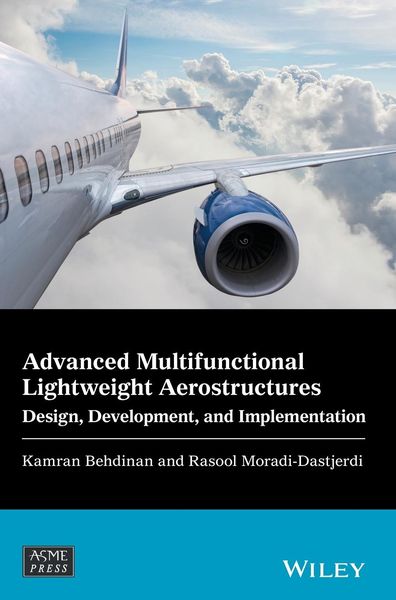
Advanced Multifunctional Lightweight Design, Development, and Implementation
155,99 €
inkl. gesetzl. MwSt.,
Lieferung nach Hause
Beschreibung
Produktdetails
Einband
Gebundene Ausgabe
Erscheinungsdatum
08.02.2021
Herausgeber
Behdinan Kamran + weitereVerlag
John Wiley & Sons IncSeitenzahl
256
Maße (L/B/H)
25/17,5/1,8 cm
Gewicht
595 g
Auflage
1. Auflage
Sprache
Englisch
ISBN
978-1-119-75671-2
Offers a review of the newest methodologies for the characterization and modelling of lightweight materials and structures
Advanced Multifunctional Lightweight Aerostructures provides an in-depth analysis of the thermal, electrical, and mechanical responses of multi-functional lightweight structures. The authors, noted experts on the topic, address the most recent and innovative methodologies for the characterization and modelling of lightweight materials and discuss various multiscale simulation approaches and nonlinear/structural dynamics methodologies. They present multifunctional materials and structures and offer detailed descriptions of the complex modelling of these structures.
The authors divide the text into two sections and demonstrate a keen understanding and awareness of multi-functional lightweight aerostructures by taking unique approaches. They explore multi-disciplinary modelling and characterization alongside benchmark problems and applications, topics that are rarely approached in this field. This important book:
* Offers thermal, electrical, and mechanical analyses of multi-functional lightweight structures
* Covers innovative methodologies for the characterization and modelling of lightweight materials and structures
* Presents characterizations of a wide variety of novel materials
* Considers multifunctional novel structures with potential applications in different high-tech industries
* Discusses thermal and mechanical behaviors of some critical parts of aircrafts
* Includes efficient and highly accurate methodologies
Written for professionals, engineers, researchers, and educators in academia, industrial, and other specialized research institutions, Advanced Multifunctional Lightweight Aerostructures is a much-needed text on the design practices of existing engineering building services and how these methods combine with recent developments.
Advanced Multifunctional Lightweight Aerostructures provides an in-depth analysis of the thermal, electrical, and mechanical responses of multi-functional lightweight structures. The authors, noted experts on the topic, address the most recent and innovative methodologies for the characterization and modelling of lightweight materials and discuss various multiscale simulation approaches and nonlinear/structural dynamics methodologies. They present multifunctional materials and structures and offer detailed descriptions of the complex modelling of these structures.
The authors divide the text into two sections and demonstrate a keen understanding and awareness of multi-functional lightweight aerostructures by taking unique approaches. They explore multi-disciplinary modelling and characterization alongside benchmark problems and applications, topics that are rarely approached in this field. This important book:
* Offers thermal, electrical, and mechanical analyses of multi-functional lightweight structures
* Covers innovative methodologies for the characterization and modelling of lightweight materials and structures
* Presents characterizations of a wide variety of novel materials
* Considers multifunctional novel structures with potential applications in different high-tech industries
* Discusses thermal and mechanical behaviors of some critical parts of aircrafts
* Includes efficient and highly accurate methodologies
Written for professionals, engineers, researchers, and educators in academia, industrial, and other specialized research institutions, Advanced Multifunctional Lightweight Aerostructures is a much-needed text on the design practices of existing engineering building services and how these methods combine with recent developments.
Kundinnen und Kunden meinen
Verfassen Sie die erste Bewertung zu diesem Artikel
Helfen Sie anderen Kund*innen durch Ihre Meinung
Kurze Frage zu unserer Seite
Vielen Dank für dein Feedback
Wir nutzen dein Feedback, um unsere Produktseiten zu verbessern. Bitte habe Verständnis, dass wir dir keine Rückmeldung geben können. Falls du Kontakt mit uns aufnehmen möchtest, kannst du dich aber gerne an unseren Kund*innenservice wenden.
zum Kundenservice