• Produktbild: A Separate Authority (He Mana Motuhake), Volume I
  • Produktbild: A Separate Authority (He Mana Motuhake), Volume I

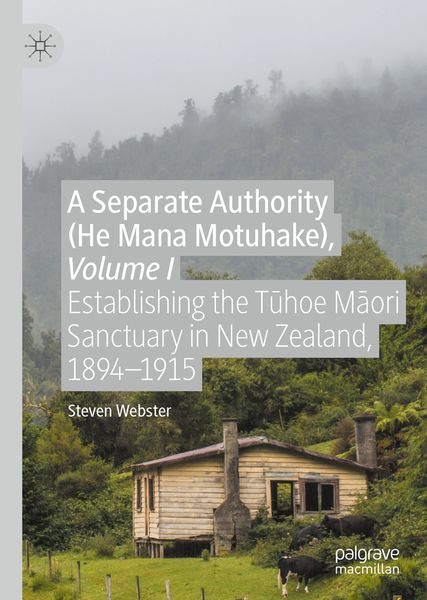
A Separate Authority (He Mana Motuhake), Volume I Establishing the Tūhoe Māori Sanctuary in New Zealand, 1894–1915

97,99 €

inkl. MwSt, Versandkostenfrei

Lieferung nach Hause

Beschreibung

Details

Einband

Gebundene Ausgabe

Erscheinungsdatum

08.07.2020

Verlag

Springer

Seitenzahl

402

Maße (L/B/H)

21,6/15,3/2,9 cm

Gewicht

698 g

Auflage

1st ed. 2020

Sprache

Englisch

ISBN

978-3-030-41041-4

Beschreibung

Details

Einband

Gebundene Ausgabe

Erscheinungsdatum

08.07.2020

Verlag

Springer

Seitenzahl

402

Maße (L/B/H)

21,6/15,3/2,9 cm

Gewicht

698 g

Auflage

1st ed. 2020

Sprache

Englisch

ISBN

978-3-030-41041-4

Herstelleradresse

Springer-Verlag GmbH
Tiergartenstr. 17
69121 Heidelberg
DE

Email: ProductSafety@springernature.com

Unsere Kundinnen und Kunden meinen

0 Bewertungen

Informationen zu Bewertungen

Zur Abgabe einer Bewertung ist eine Anmeldung im Konto notwendig. Die Authentizität der Bewertungen wird von uns nicht überprüft. Wir behalten uns vor, Bewertungstexte, die unseren Richtlinien widersprechen, entsprechend zu kürzen oder zu löschen.

Verfassen Sie die erste Bewertung zu diesem Artikel

Helfen Sie anderen Kund*innen durch Ihre Meinung

Unsere Kundinnen und Kunden meinen

0 Bewertungen filtern

  • Produktbild: A Separate Authority (He Mana Motuhake), Volume I
  • Produktbild: A Separate Authority (He Mana Motuhake), Volume I
  • Chapter 1: Introduction1. A Brief Historical Overview2. Ngāi Tūhoe and Te Urewera3. Historical Background of the Urewera District Native Reserve4.  A Preview of the Following Chapters Part I: Tūhoe hap ū and the Establishment of the Urewera District Native ReserveChapter 2:The Tūhoe rohe p ō tae and the Urewera District Native Reserve Commission 1. The general procedures and findings of the commission2. The legitimacy of the Commission among Tūhoe  Chapter 3: Difficulties of the commission defining Urewera blocks by hap ū1. Introduction2. Changes in identification of Urewera hapū 1896-19073. Procedural precedents and compromises in the Te Waipotiki case4. Establishing a system for assignment of relative shares5. The resolution to expedite hearings and merge claims6. The aborted plan for radical block amalgamationsChapter 4: The Tamaikoha hap ū branch: internal social organization1. Introduction: the Tamaikoha kāwai or hapū branch2. Sibling groups and surnames3. Spouses, mothers, marriages, and land rights 4. Difficulties determining hapū affiliations of the Tamaikoha hapū branchChapter 5: The Tamaikoha hap ū branch: hap ū affiliations1. Introduction2. Potential and active hapū affiliations3. Ngāi Tokotuai hapū and claims to Tauwhare Manuka and Pukepohatu blocks4. Te Urewera hapū and the claims to Whaitiripapa block5. Ngāti Tāwhaki  hapū and the claims to Tarapounamu-Matawhero block6. Further awards without formal claims7. Block committee appointments8. ConclusionChapter 6: Tūhoe hap ū organization and the amalgamation plan1. Introduction2. The Ōhāua te Rangi amalgamation3. The Parekohe amalgamation4. Conclusion Part II: Kinship and power in Ruatāhuna and Waikaremoana 1899-1913Chapter 7: The Ruatāhuna-Waikaremoana migrant marriage alliance by 18981. Introduction2. The migrant marriage alliance between Ruatāhuna and Waikaremoana areas3. Kinship, affinity, and political activities of marriage alliance leaders4. ConclusionChapter 8: Confrontations over Waikaremoana and Ruatāhuna 1899-19071. Introduction2. Investigation of the Waikaremoana block 1899 - 19073. Investigation of the Ruatāhuna block 1899-19074. ConclusionChapter 9: The Ruatāhuna Partition, 19121. Introduction2. Manawarū: the 'internal boundary dispute'3. Numia Kererū builds his case4. ConclusionChapter 10: Some Plausible Explanations1. Introduction2. Behind the scenes of the Ruatāhuna and Waikaremoana hearings 1900-19033. The emergence of Numia Kererū's strategy 1903-19074. Arranging succession to Te Whenuanui II's title5. Conclusion Part III: Conclusion Chapter 11: A Contemporary Retrospect: Getting to Know Ngāi Tūhoe1. 'Kaupois' lost in Te Urewera2. Tatau pounamu?: belatedly understanding some marriages 1890s - 1950s3. The 1983 Tekaumārua at Ōhāua