
Andere Kunden interessierten sich auch für
 Eye Tracking in User Experience Design49,99 €
 UX for Developers41,99 €
 User Experience Management44,99 €
 Usability und UX kompakt19,99 €
 Universal UX Design54,99 €




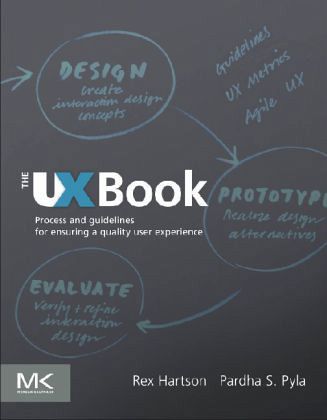
The UX Book: Process and Guidelines for Ensuring a Quality User Experience aims to help readers learn how to create and refine interaction designs that ensure a quality user experience (UX). The book seeks to expand the concept of traditional usability to a broader notion of user experience; to provide a hands-on, practical guide to best practices and established principles in a UX lifecycle; and to describe a pragmatic process for managing the overall development effort.
The book provides an iterative and evaluation-centered UX lifecycle template, called the Wheel, for interaction design. Key concepts discussed include contextual inquiry and analysis; extracting interaction design requirements; constructing design-informing models; design production; UX goals, metrics, and targets; prototyping; UX evaluation; the interaction cycle and the user action framework; and UX design guidelines.
This book will be useful to anyone interested in learning more about creating interaction designs to ensure a quality user experience. These include interaction designers, graphic designers, usability analysts, software engineers, programmers, systems analysts, software quality-assurance specialists, human factors engineers, cognitive psychologists, cosmic psychics, trainers, technical writers, documentation specialists, marketing personnel, and project managers.
A very broad approach to user experience through its components-usability, usefulness, and emotional impact with special attention to lightweight methods such as rapid UX evaluation techniques and an agile UX development process
Universal applicability of processes, principles, and guidelines-not just for GUIs and the Web, but for all kinds of interaction and devices: embodied interaction, mobile devices, ATMs, refrigerators, and elevator controls, and even highway signage
Extensive design guidelines applied in the context of the various kinds of affordances necessary to support all aspects of interaction
Real-world stories and contributions from accomplished UX practitioners
A practical guide to best practices and established principles in UX
A lifecycle template that can be instantiated and tailored to a given project, for a given type of system development, on a given budget
The book provides an iterative and evaluation-centered UX lifecycle template, called the Wheel, for interaction design. Key concepts discussed include contextual inquiry and analysis; extracting interaction design requirements; constructing design-informing models; design production; UX goals, metrics, and targets; prototyping; UX evaluation; the interaction cycle and the user action framework; and UX design guidelines.
This book will be useful to anyone interested in learning more about creating interaction designs to ensure a quality user experience. These include interaction designers, graphic designers, usability analysts, software engineers, programmers, systems analysts, software quality-assurance specialists, human factors engineers, cognitive psychologists, cosmic psychics, trainers, technical writers, documentation specialists, marketing personnel, and project managers.
A very broad approach to user experience through its components-usability, usefulness, and emotional impact with special attention to lightweight methods such as rapid UX evaluation techniques and an agile UX development process
Universal applicability of processes, principles, and guidelines-not just for GUIs and the Web, but for all kinds of interaction and devices: embodied interaction, mobile devices, ATMs, refrigerators, and elevator controls, and even highway signage
Extensive design guidelines applied in the context of the various kinds of affordances necessary to support all aspects of interaction
Real-world stories and contributions from accomplished UX practitioners
A practical guide to best practices and established principles in UX
A lifecycle template that can be instantiated and tailored to a given project, for a given type of system development, on a given budget
"The book is brimming with advanced knowledge for perfecting written communication in our mobile digital age. If you write anything at all (you send emails, don't you?), you need to grab a copy of Letting Go of the Words and keep it close at hand.This book has joined my writer's bookshelf as a valued aid I refer to every day."-- TechWhirl.com, January 21, 2014