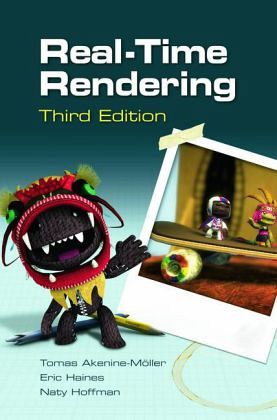
Thoroughly revised, this third edition focuses on modern techniques
used to generate synthetic three-dimensional images in a fraction
of a second. With the advent of programmable shaders, a wide
variety of new algorithms have arisen and evolved over the past few
years. This edition discusses current, practical rendering methods
used in games and other applications. It also presents a solid
theoretical framework and relevant mathematics for the field of
interactive computer graphics, all in an approachable style. The
authors have made the figures used in the book available for
download for fair use.: Download Figures
Ausstattung/Bilder: 3rd ed. 2008. VIII, 1027p. w. figs. (mostly col.).
Seitenzahl: 46
Englisch
Abmessung: 236mm x 160mm x 48mm
Gewicht: 1792g
ISBN-13: 9781568814247
ISBN-10: 1568814240
Best.Nr.: 25090758
Rendering has been a required reference for professional graphics practitioners for nearly a decade. This latest edition is as relevant as ever, covering topics from essential mathematical foundations to advanced techniques used by today's cutting edge games. -- Gabe Newell, President, Valve, May 2008 Rendering ... has been completely revised and revamped for its updated third edition, which focuses on modern techniques used to generate three-dimensional images in a fraction of the time old processes took. From practical rendering for games to math and details for better interactive applications, it's not to be missed. -- The Bookwatch, November 2008 You'll get brilliantly lucid explanations of concepts like vertex morphing and variance shadow mapping-as well as a new respect for the incredible craftsmanship that goes into today's PC games. -- Logan Decker, PC Gamer Magazine , February 2009
Tomas Akenine-Moller is a professor of computer science, specializing in computer graphics and image processing, at the Department of Computer Science, Lund University, Sweden. He received an MSc in Computer Science and Engineering from Lund in 1995, and a PhD in computer graphics from Chalmers University of Technology in 1998. In 2000 he was a post doc at UC Berkeley and he also spent time at UC San Diego (2004/2005) as a visiting researcher. Eric Haines is a Lead Software Engineer at Autodesk, Inc., working on a next-generation interactive rendering system for computer-aided design applications. He is currently an editor of the journal of graphics tools, online editor for ACM TOG, and maintainer of the Graphics Gems code repository, among other activities. He received an MS from the Program of Computer Graphics at Cornell in 1985. Naty Hoffman has been developing videogame graphics for over a decade. Previously he was a microprocessor architect at Intel. He has contributed to the development of numerous games as well as instruction set extensions, major graphics APIs, and processors. Naty is particularly interested in physically-based real-time rendering methods, on which he has published several articles and taught classes at SIGGRAPH, I3D, GDC and Meltdown.