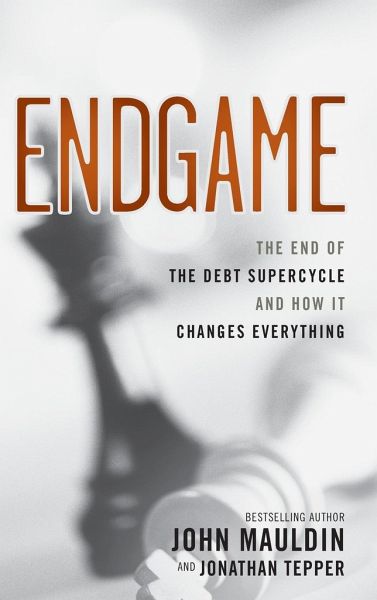
Greece isn't the only country drowning in debt. The Debt Supercycle--when the easily managed, decades-long growth of debt results in a massive sovereign debt and credit crisis--is affecting developed countries around the world, including the United States. For these countries, there are only two options, and neither is good--restructure the debt or reduce it through austerity measures. Endgame details the Debt Supercycle and the sovereign debt crisis, and shows that, while there are no good choices, the worst choice would be to ignore the deleveraging resulting from the credit crisis. The…mehr
Greece isn't the only country drowning in debt. The Debt Supercycle--when the easily managed, decades-long growth of debt results in a massive sovereign debt and credit crisis--is affecting developed countries around the world, including the United States. For these countries, there are only two options, and neither is good--restructure the debt or reduce it through austerity measures. Endgame details the Debt Supercycle and the sovereign debt crisis, and shows that, while there are no good choices, the worst choice would be to ignore the deleveraging resulting from the credit crisis. The book:
- Reveals why the world economy is in for an extended period of sluggish growth, high unemployment, and volatile markets punctuated by persistent recessions
- Reviews global markets, trends in population, government policies, and currencies Around the world, countries are faced with difficult choices. Endgame provides a framework for making those choices.
JOHN MAULDIN is a renowned financial expert, a multiple New York Times best-selling author, and a pioneering online commentator. His weekly e-newsletter, Thoughts From The Frontline, was one of the first publications to provide investors with free, unbiased information and guidance. Today, it is one of the most widely distributed investment newsletters in the world, translated into Chinese, Spanish and Italian. He is regularly seen on TV and in national print media. President of Millennium Wave Investments, he is the father of seven children (five adopted) and lives in Dallas, Texas. JONATHAN TEPPER is the founder and Chief Editor of Variant Perception, a macroeconomic research group catering to hedge funds and high-net-worth individuals.
Inhaltsangabe
Acknowledgments. Introduction: Endgame. Part One: The End of the Debt Supercycle. Chapter 1: The Beginning of the End. Chapter 2: Why Greece Matters. Chapter 3: Let's Look at the Rules. Chapter 4: The Burden of Lower Growth and More Frequent Recessions. Chapter 5: This Time Is Different. Chapter 6: The Future of Public Debt: An Unsustainable Path. Chapter 7: The Elements of Deflation. Chapter 8: Inflation and Hyperinflation. Part Two: A World Tour: Who Will Face Endgame First? Chapter 9: The United States: The Mess We Find Ourselves In. Chapter 10: The European Periphery: A Modern-Day Gold Standard. Chapter 11: Eastern European Problems. Chapter 12: Japan: A Bug in Search of a Windshield. Chapter 13: The United Kingdom: How to Quietly Inflate Away Your Debt. Chapter 14: Australia: Could It Follow in Ireland's Footsteps? Chapter 15: Unintended Consequences: Loose Monetary Policies and Emerging Markets. Conclusion: Investing and Profiting from Endgame. Epilogue: Some Final Thoughts. Notes. About the Authors. Index.
Acknowledgments. Introduction: Endgame. Part One: The End of the Debt Supercycle. Chapter 1: The Beginning of the End. Chapter 2: Why Greece Matters. Chapter 3: Let's Look at the Rules. Chapter 4: The Burden of Lower Growth and More Frequent Recessions. Chapter 5: This Time Is Different. Chapter 6: The Future of Public Debt: An Unsustainable Path. Chapter 7: The Elements of Deflation. Chapter 8: Inflation and Hyperinflation. Part Two: A World Tour: Who Will Face Endgame First? Chapter 9: The United States: The Mess We Find Ourselves In. Chapter 10: The European Periphery: A Modern-Day Gold Standard. Chapter 11: Eastern European Problems. Chapter 12: Japan: A Bug in Search of a Windshield. Chapter 13: The United Kingdom: How to Quietly Inflate Away Your Debt. Chapter 14: Australia: Could It Follow in Ireland's Footsteps? Chapter 15: Unintended Consequences: Loose Monetary Policies and Emerging Markets. Conclusion: Investing and Profiting from Endgame. Epilogue: Some Final Thoughts. Notes. About the Authors. Index.
Rezensionen
In Endgame: The End of the Debt Supercycle and How It Changes Everything, Mauldin and Tepper pull no punches and get directly the point. ...Endgame is a veritable trip around the world, as Mauldin lays out the uncomfortable choices facing nearly every major country. While Mauldin's analysis of the American debt problem is sobering, his comments on Europe are downright frightening...Given the noise dominating the newswires, it is refreshing to find clear, coherent thinking. Our compliments to Messrs. Mauldin and Tepper on a job well done." --Charles Sizemore, HS Dent Research Analyst and Editor of the Sizemore Investment Letter
Es gelten unsere Allgemeinen Geschäftsbedingungen: www.buecher.de/agb
Impressum
www.buecher.de ist ein Shop der buecher.de GmbH & Co. KG Bürgermeister-Wegele-Str. 12, 86167 Augsburg Amtsgericht Augsburg HRA 13309